The 90s arrived and Nelson Pino got on a raft. He was adrift for six days with death hovering around him. He then suffered the final loss of his mother while he was still at the Guantánamo Naval Base.
MIAMI.-In 1980 his mother tried to get Nelson and his sister out of Cuba through the Mariel. When they were ready, their father arrived with the police to prevent them from leaving. He was barely seven years old when he saw how his mother was taken prisoner, while the neighbors threw eggs at them and shouted: “worms”, “scum”. She, alone, sick, with two small children, was marked by that public punishment and arrest.
Since then he learned what it meant to be singled out. He saw his mother, sick with nerves, deteriorate, carry the stigma and yet never give up. From her he inherited the work ethic and the stubbornness to get ahead.
The 90s arrived and Nelson Pino He got on a raft. He was adrift for six days with death hovering around him. He then suffered the final loss of his mother while he was still at the Guantanamo Naval Base, leaving his barely 15-year-old sister alone. He finally arrived in the United States and began working in humble jobs. Today he has a thriving company and three restaurants.
—How do you remember your childhood?
My childhood was very good, a childhood of learning, growing and everything I am today. I had a warrior mother, a woman who taught me a lot about how to undertake life, because she never stopped working. He died very young, but he left a huge mark. It was her, my sister and I, and we were very happy. We went out, we enjoyed ourselves, and although we lived in a country with many needs, we had enough. I owe that to her and my family, who always fought, were entrepreneurs and workers. I wanted to follow that same lineage, that same family line.
—At what moment did you begin to realize that there was no future in Cuba?
From very early on I saw the difference, I understood that there was no future in a country where one could not grow beyond certain limits. I started thinking about how to get out. My uncles had left very young, in 1981. My mother divorced my father when I was about six years old. Then, she remarried a person who wanted to leave for Mariel.

—Did they try to leave through the Mariel?
Yes. In 1980 we tried to leave. I was about seven years old and I remember going to Mariel, to a place like a building with many chairs where people waited. There were the docks. My father came with the police because we were leaving without his consent. They arrested my mother. She became very sick at that time. There was all the drama: the eggs, the screaming, the return to the house. The worst thing was that many of the people in the neighborhood who attacked you later went to have coffee with you. Cuba is like that. One does not forget, but one has to learn to forgive, because carrying resentment is for life. They made my mother suffer a lot and we lost the opportunity to go out when I was seven years old and my sister was five.
—How did you experience that rejection?
People treated you like you were a criminal. I was very small and I didn’t really understand what was happening, but I was afraid. Seeing a mother alone, sick, with two small children, and not being able to do anything while adults yelled at you and threw stones and eggs at you, that marks. My mother was always sick with nerves. All of this, added to the daily deprivation, water, food, constant stress, left its consequences. I felt shame, confusion, guilt… I didn’t know who the culprit was. I felt like I had to protect them because I was the man; but he was a boy.
—Did you ever talk to your father about that?
I never complained to him directly. He lives in Cuba. I help him, because he is my father. But I could never forgive him for that. I always carried it inside. Maybe he sees this video and it’s the first time in 51 years that I’ve said it on camera. I never had the courage to tell him face to face. That marked me a lot, it played with my future and deeply affected my mother, who was my pillar, my hero, my everything. I love him, but it’s true that that affected me a lot. Later my father lived his life and was not always present in my life, like my mother was.
—Did that influence your refusal to live in Cuba?
Yes. It wasn’t hate, but it was a deep rejection. I knew that there I would not be able to be the person I wanted to be. I saw my friends’ parents, grandparents, all doing the same thing: fighting for the daily bread, a bicycle, a little food. I knew that wasn’t going to get better. At school you also felt rejection when they knew you had tried to leave. Not all teachers were like that, but there was different treatment.
—You tried to leave again…
Yes, in 1991. I already wanted to leave school and my father put me to work at a motel, Vista Alegre, in maintenance. There, with a mower, we made an engine for a raft. We build everything with a lot of effort. We were six people. When we were ready, we were discovered by some men who said they were hunting for crabs. They promised not to give us away, but after 40 minutes the soldiers arrived. They arrested us. I was imprisoned in Villa Marista for more than a month. I was about 16 years old.
—And finally in 1994?
In ’94 we left. We spent six days at sea. Our raft was damaged and we found another one with two people dead. That raft saved the lives of six of us. The United States Navy rescued us. They took us to Guantánamo, then to Panama. I was there six months. In December of that year, my mother died at the age of 42. My sister was left alone in Cuba when she was 15 years old. I spent a year and three months in Guantánamo before arriving in the United States.
—How were your beginnings here?
My grandfather was already here. He was the father who raised me, the pillar of the family. He gave me a job in a bakery. Then I worked in cable, at MediaOne, and then I started looking for how to start my own business.
—Where does your inclination for manual work and business come from?
There was always a workshop in my house. Grills, furniture, welding were made. I started with food trucks. I worked, bought one, then two routes, then more. I sold, I invested, I fell, I got up. I started a business without permits, they closed it. I started again. In this country you fall and get up, and the experience is not lost.
—How did you get into building food trucks?
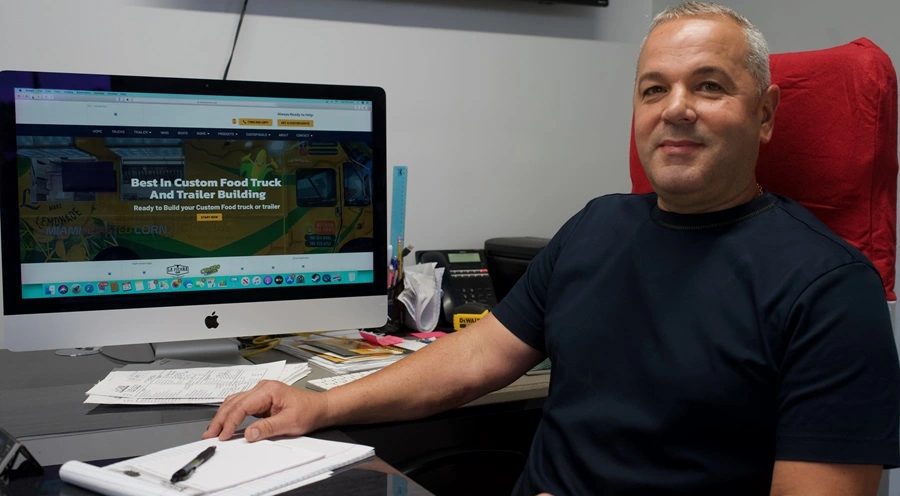
My wife and I started with a small store. Then we moved on to selling restaurant equipment. Someone asked us if we did food trucks and we said yes. We did one, then another, and another. Large contracts came, schools, important companies. We form a solid team. With Reef Technology we made more than 100 trucks. It was a million-dollar contract that gave us a great boost. Then we started making bathrooms, kitchens… Our company is called S4L Industries

—Nelson, today you also have restaurants…
Yes, it started as a hobby. We opened Cubiche, then Butcher Cuisine in Miami Lakes, and then Cubiche Barbecue Ranch, a ranch with live music and barbecue. I like to work, to be there. I work seven days a week and I feel good doing it.
—What advice do you give to those starting out?
This is a country that must be thanked. Learn from those who have been around for a while. Work doesn’t kill anyone. First you have to create bases and roots, then enjoy. Focus on something you like and do it. Falls teach. Thanks to them I am who I am today.
—And your sister?
My sister is a warrior. She became a doctor in Cuba, an immunologist. They didn’t let her leave. He came to the United States for a conference and stayed. Today she is a doctor here and practices. He sacrificed a lot and already brought his family. Seeing her succeed is one of my greatest satisfactions.
—If you had stayed in Cuba, Nelson, what do you think would have happened?
I don’t see myself working for the government. Maybe he would have ended up in prison, or lost. In Cuba, inventing is dangerous. Everyone finishes as they can. I am grateful for having gone out and for everything I have been able to build.