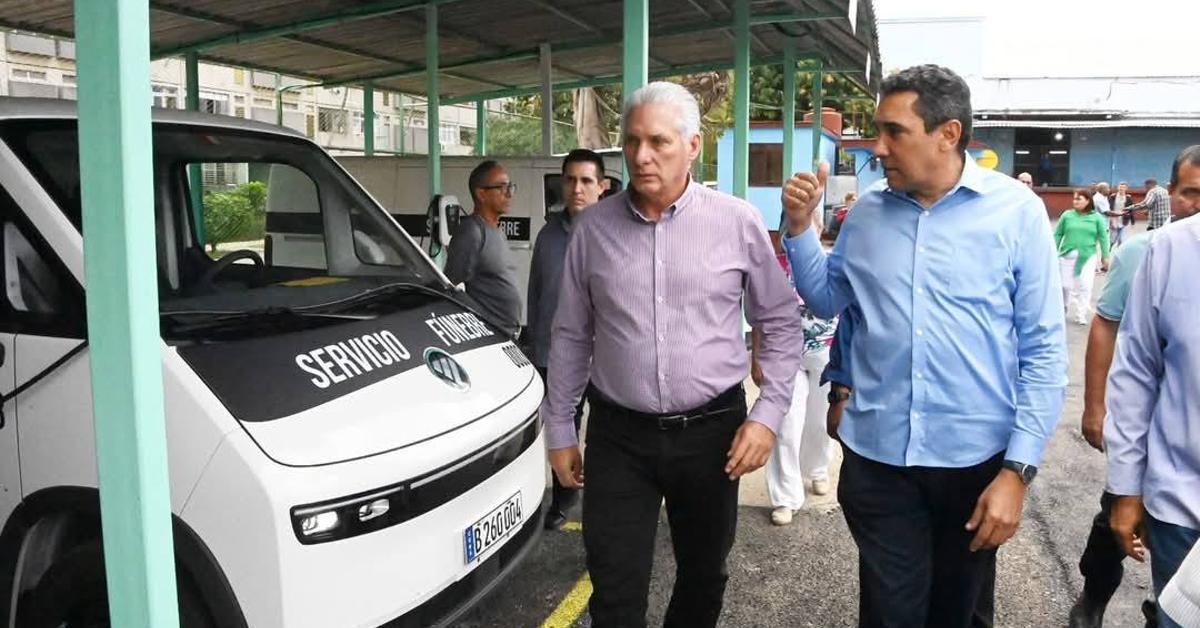
Madrid/Christmas has been, paradoxically, wrapped in a mortuary halo in Cuba. At least as far as information is concerned. If on Christmas Eve itself, the state press broadcast images of Miguel Díaz-Canel learning about the new electric vehicles for obituary services, the announcement of the construction of the new Sancti Spíritus crematorium was reserved for Christmas. Both events have been seen by many as symbols of a regime in a terminal state, although the need to improve the sector is evident in recent years.
“Very necessary service for the inhabitants of this province. We only insist on strict compliance with all the environmental regulations established so as not to contaminate with its harmful gases and odors due to its location with respect to the prevailing winds and the clean industrial area and existing residential area,” requested a commentator following the news of the Sancti Spiritus crematorium.
The HIV patients, who are continuing their antiretroviral treatments in the sanatorium known as La Rosita, next to which the new incinerator for corpses and bone remains will be built, will not be so happy, although Yoel Aquiles Martínez, provincial director of Obituary Services, speaks of a beautification of the environment thanks to the work of clearing, cleaning and collecting debris and the planting of green areas in the surroundings.
The HIV patients, who are continuing their antiretroviral treatments in the sanatorium known as La Rosita, next to which the new incinerator will be built, will not be so happy.
“Fortunately, the project was approved for us using a facility that belonged to the Health Directorate and had been underutilized for years, so progress can be made on what was built to shape what the crematorium will be,” he said, explaining that these tasks have been carried out since November and the construction works will soon begin, which has involved an investment of more than 25 million pesos.
The oven and fireplace have been in the entity’s warehouses for a long time and will finally begin to be installed three years after it was announced. The story dates back to January 2023, when the authorities assured that Sancti Spíritus would no longer be one of the four Cuban provinces without a crematorium for corpses. Discussions with technicians over the appropriate place to locate it have bogged down the work, something that the economic crisis has not favored either.
“We are talking about an oven that would work with gas, which does not release particles into the environment, since it has two burners in its tower: one below in what would be the stove and the other in the upper part of the chimney, so the risk of contamination and stench are zero,” says the official.
The crematorium will have electricity with solar panels “so that it works 24 hours a day,” he says. the note, published in Escambrayalthough to date – due to the lack of batteries – it has not been possible to accumulate photovoltaic energy in Cuba. They have also explained that there will be a chapel for religious events, a flower garden, a cafeteria and warehouses, among other things.
Until the new crematorium is in operation, residents of Sancti Spiritus will have to continue going to Camagüey, Ciego de Ávila, Villa Clara, Cienfuegos or Matanzas for cremation, something that, as the note specifies, “involves a high cost for transportation.” The shortage of hearses has been an issue in itself in recent years on the Island, where they are even resorting to requesting state companies, like Etecsathat they transfer the deceased in their vans. The increase in mortality due to arboviruses has put an end to this situation of chronic lack of vehicles.
Last July, the Minister of Transportation, Eduardo Rodríguez Dávila, announced that the Government planned to acquire at least 120 cars for funeral services. Of them, 50 were to be for Havana and 50 for five other provinces: 20 to Santiago de Cuba, 10 to Holguín and the same number to Camagüey, five to Villa Clara and another five to Ciego de Ávila. The remaining they were then left unspecified.
Linked or not to that announcement, this Wednesday Díaz-Canel visited the SERVI AXESS company, a state MSME of the AXESS Marketing Company, integrated into the Ministry of Transportation, where the 15 electric vehicles that will soon be part of the Havana fleet to transport the deceased were located. The new obituary service “includes a mixed energy supply scheme, using solar panels for load backup and conventional power at enabled points, seeking to guarantee operational continuity even in the face of interruptions,” the press reported.
The company arrives, they say, to be part of a sector in which private initiative has not shown much interest, although there are infinite needs to cover.
The company arrives, they say, to be part of a sector in which private initiative has not shown much interest, although there are infinite needs to cover. The lack of coffins, the problems in the cold storage rooms, the shortage of floral decorations… all of this adds, to the pain of the death of a loved one, the inconvenience of having to find a solution to the problems and the suffering of not being able to give a dignified farewell to a family member or friend.
“It is a difficult moment for the family, having a relative die and there being no funeral carriages to transport them from the hospital to the funeral home and from there to the cemetery,” lamented a user on networks. “I have experienced that unpleasant moment. Then, when it comes time to take the coffin out of the funeral home, they tell you that there is no hearse and that they are negotiating with organizations to collaborate. And an hour later a truck appears and it is transported. Then that very large truck cannot maneuver inside the cemetery, because the streets are narrow. So, you are forced to carry on your shoulders for more than 300 meters, along narrow paths.”