Havana/The health authorities yesterday pointed out a new culprit for the shortage of medicines in Cuban pharmacies: the illegal market generated from within the Public Health system itself. “Prestige institutions” are involved in this scheme, as well as pharmacy workers, “from other areas and other activities in the sector,” admitted this Monday Maylin Beltrán Delgado, head of the Department of Pharmacies and Optics of the Ministry of Public Health.
The official pointed out on the Mesa Redonda television program that, given the “growing phenomenon of the illegal market,” a surveillance “plan of measures” was implemented throughout the country. “We have exceeded 5,000 controls this year – about 13 a day, on average,” said Beltrán Delgado. These joint operations, he added, made it possible to measure “the severity of the control problems in the network.” At the end of October, “33 serious extraordinary events” had been identified in the pharmacy system. Of this figure, 18 were “robberies carried out by people outside the health sector, who raid pharmacies to steal the few medications available.”
He explained that, of these thefts, “around 10 were related to controlled substances (drugs, narcotics, psychotropics and substances with a similar effect)” and recalled that the sale of these products “involves a drug trafficking crime.”
“Today the industry has also stopped responding to requests for medicines on a regular basis”
The shortage – which last year was 70% in pharmacies – is also due to the fact that national drugs face a “notable production decrease.” “Today the industry has also stopped responding to requests for medicines on a regular basis,” admitted Cristina Lara Bastanzuri, director of Medicines and Medical Technologies. Without taking into account the fact that China and India are by far the main producers of raw materials, the official blamed the “United States blockade” for a problem that affects the difficulties in importing active ingredients and excipients, as well as “technological obsolescence in some plants, interruptions in the energy supply and limitations to carry out adequate industrial maintenance.”
The poor local production has too much impact, if one takes into account that the basic list of medicines in the country is made up of 651 medicines, of which 62% – 403 products – correspond to medicines that must be produced by the national pharmaceutical industry, while the remaining 38% comprise medicines that are imported. Of the latter, at least 60% are missing.
The breaking point, Lara Bastanzuri pointed out, was the break in 2019 with Brazil, which Jair Bolsonaro governed at the time, because it meant the loss of an “important source of supplies, inputs and income for the sector.”
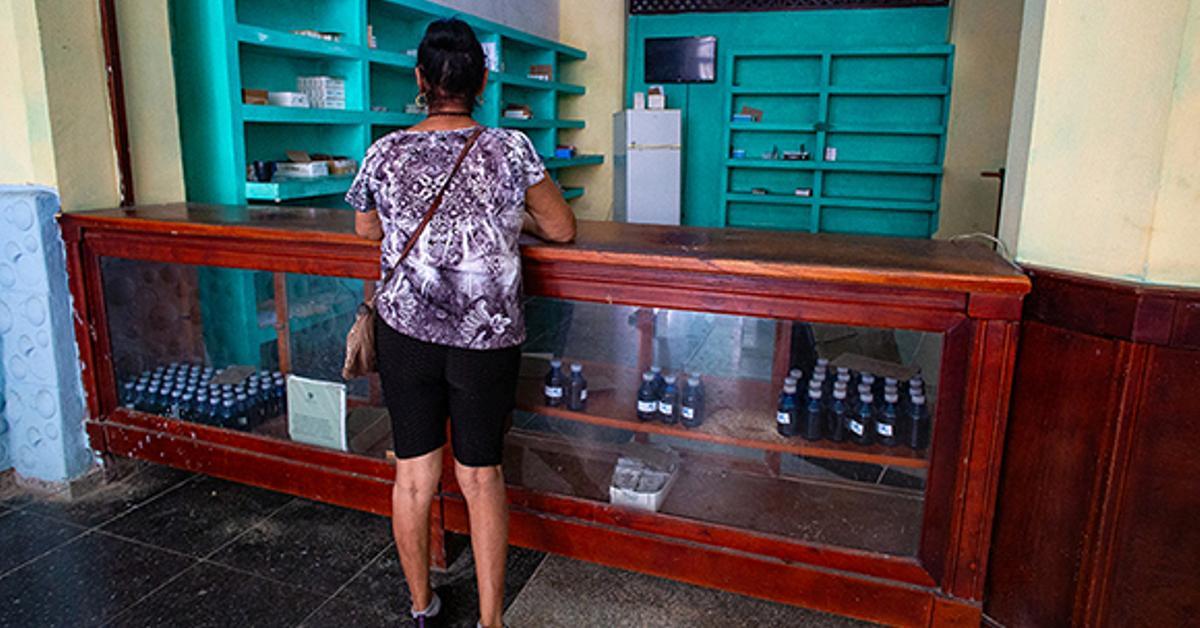
There is “a practically total shortage in pharmacies. That is real, the medications are not there”
This has led to “a practically total shortage in pharmacies. That is real, the medications are not there,” the official accepted, adding that it is not even possible to guarantee the permanence of card-controlled medicines, those intended for chronic patients with diseases such as high blood pressure, diabetes mellitus or epilepsy, and that “constitute the highest priority within the outpatient care system.”
“Practically the financing that goes into the industry is allocated to saving lives, to life-saving medications, to serums,” which leaves the community pharmacy in oblivion, which remains several days without supplies arriving.
The wait can be long, even up to 60 days, when the original design of the supply system operated with replenishment cycles of “every 12 or 15 days.” This delay has caused the pressure on the organized sales system to be greater “and citizen dissatisfaction to inevitably increase.”
This irregularity in distribution has also had an impact when it comes to prescribing, “because the population is practically moving towards the medications that are available.” Family doctors and specialists are “frequently forced to adapt their treatment regimens to the momentary availability of medications.”
Doctors are “frequently forced to adapt their treatment regimens to the availability of medications”
Without medicines and with a collapsed health system, Cuba is currently facing an “epidemic phase” due to the viruses that plague the Island and that have, until now, left 55 dead.
However, despite the fact that there are no supplies or electricity for some devices to work, the Government announced with great fanfare that, starting this Monday, it is treating patients suffering from after-effects of chikungunya fever. The specialized consultation, “unprecedented in Cuba,” offers patients –according to Cubadebate– access to diagnostic studies such as tomography and ultrasound.
“For those with severe pain, specialized anesthetic interventions will be available for control. Likewise, personalized physiotherapy programs will be designed to promote rehabilitation and prompt return to daily and work activities,” said the media, which reported that the consultations are carried out at the Institute of Neurology and Neurosurgery.