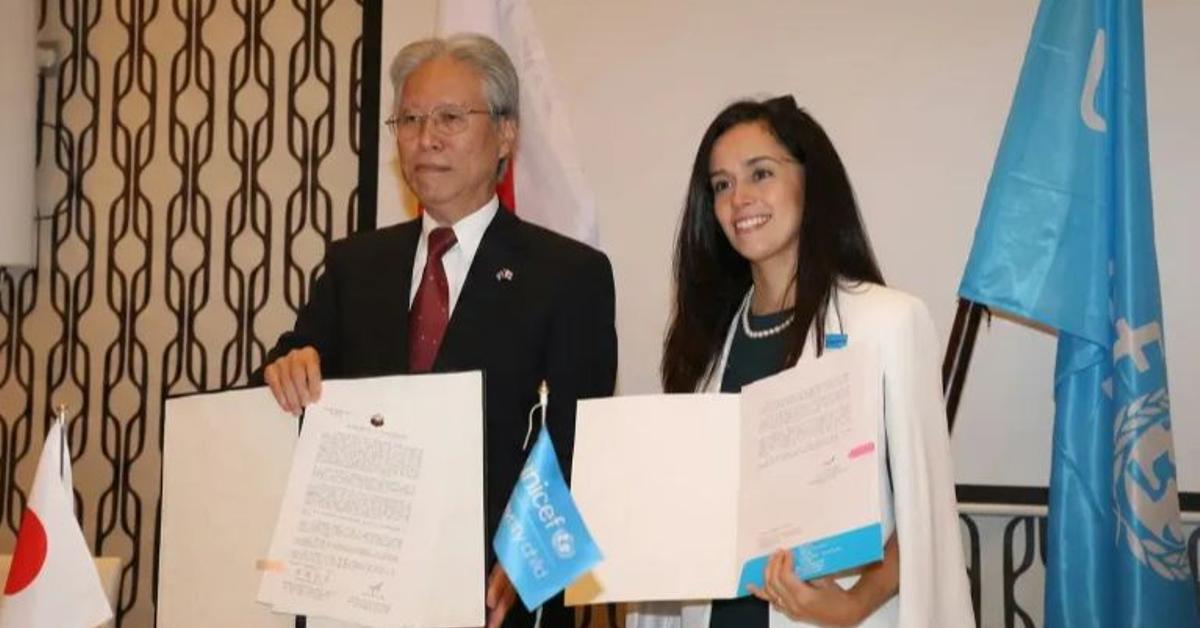
Havana/The Government of Japan and Unicef will cooperate in a project valued at one million dollars aimed at vulnerable communities in three provinces in eastern Cuba to improve infrastructure and water, sanitation, hygiene and health services, state media reported this Monday.
The donation provided by Japan will be executed by Unicef in Granma, Santiago de Cuba and Guantámamo in an estimated period of 24 months.
The deputy representative of Unicef on the island, Sunny Guidotti, explained that this initiative “contributes to guaranteeing the right to health, safe water and protective educational environments of thousands of children and adolescents from vulnerable areas in the east of the country, a territory currently in the process of recovery after the devastating passage of Hurricane Melissa.”
The deputy representative of Unicef on the island, Sunny Guidotti, explained that this initiative “contributes to guaranteeing the right to health, safe water and protective educational environments for thousands of children.”
In addition, he expressed his willingness to continue working together with the Cuban authorities to contribute together to achieve the results planned in the project design and thus strengthen the resilience of the communities to the impacts of climate change.
The project plans to benefit 5,000 girls, boys and adolescents in the three provinces and guarantee that they have adequate water, sanitation and hygiene services in their schools.
Additionally, it plans to help some 145,000 people from communities surrounding these educational institutions in these areas.
In addition, it is proposed to strengthen the resilience of maternal and child health services with essential equipment and supplies for the continuity and quality of care in at least five maternal and child health institutions, as well as to train 190 professionals in specialized care and nutrition during the first 1,000 days of life. The news arrives just after knowing the catastrophic increase in infant mortality, which has gone to 9.7 per 100,000 births after rising 2.6 points.
In this section, the initiative projects access to strengthened health services for 47,882 newborns and pregnant women better prepared to respond to emergencies, with an equity and gender focus.
According to data shared by Unicef, Cuba faces the impact of climate change and extreme phenomena such as hurricanes, floods, droughts and earthquakes, which generate annual losses equivalent to 4.6% of the Gross Domestic Product (GDP) and directly affect the child and adolescent population, and pregnant women.
Cuba faces the impact of climate change and extreme phenomena such as hurricanes, floods, droughts and earthquakes, which generate annual losses equivalent to 4.6% of the Gross Domestic Product.
It is not the first time that this type of cooperation has occurred after a meteorological event in Cuba. Last year, the Asian country announced resources destined for 114 victims of Artemisa after the passage of Rafael who totally or partially lost their homes. In addition, water purifiers, blankets, tents and mats arrived, in a shipment managed by the Japan International Cooperation Agency (Jica) worth about $160,000.
The ambassador then recalled, during a speech, other precedents. “Similar actions of the Japanese people and Government in disaster situations in Cuba” were carried out after the passage of hurricanes Sandy (2012), Matthew (2016), Irma (2017) and Ian (2022).
Since 2018, Japan has also maintained eight Large-Scale Non-Refundable Financial Assistance programs on the Island. One of them assisted the population of Pinar del Río after the scourge of Ian. So, the donation included “23 water purifiers, the same number of simple tanks to store the liquid, and 50 reels of cables and adapters,” Japanese authorities listed.