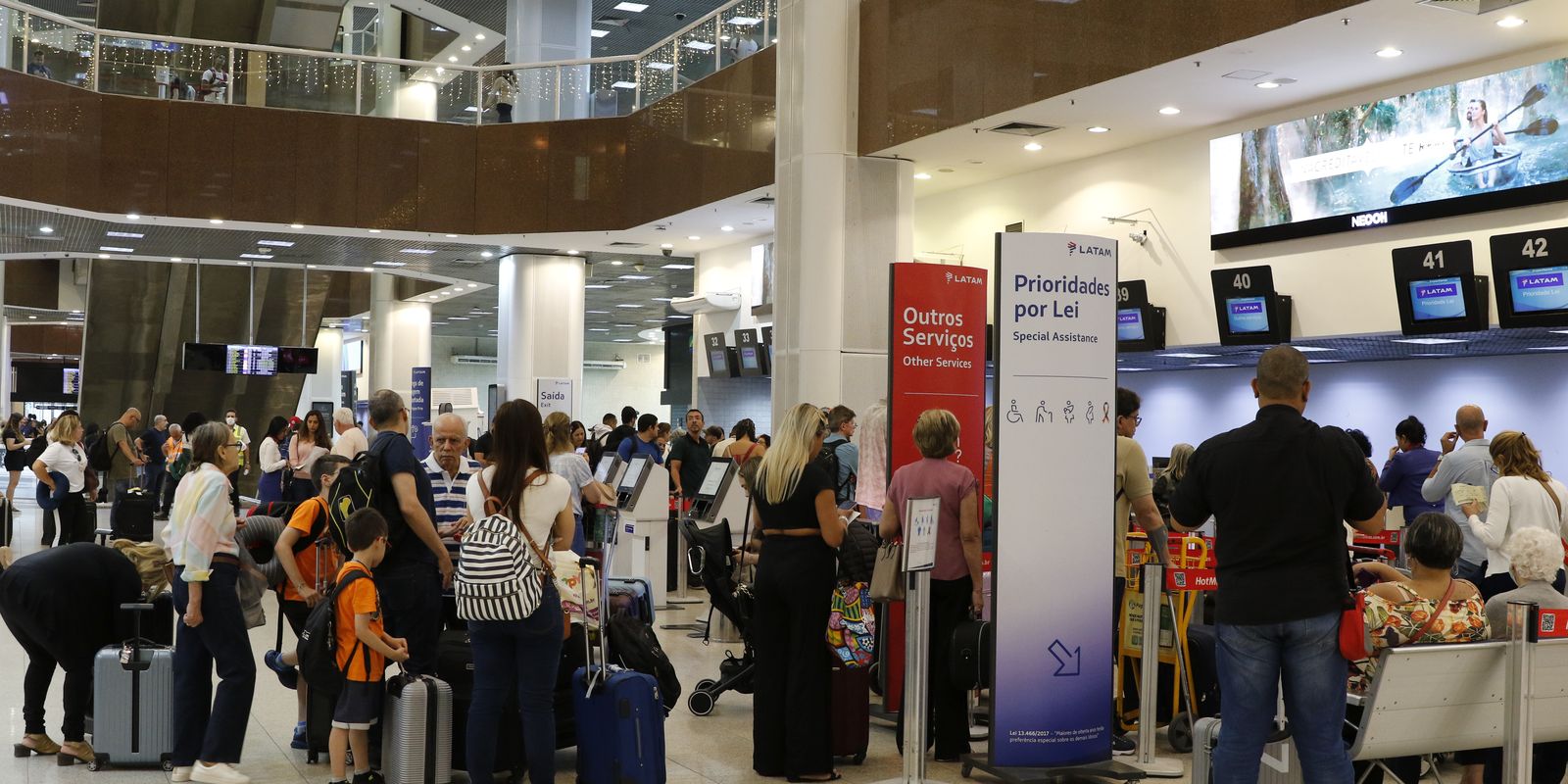
The National Civil Aviation Agency (Anac) met with airline companies to evaluate the possibilities of changing operations at Rio de Janeiro airports, “in a technical and operational way”. 
One of the possible results is the increase in flights at Santos Dumont airport, in the center of the capital, which could have a direct effect on Tom Jobim International Airport, Galeão.
In 2023, the federal government limited the number of passengers on Santos Dumont by 6.5 million per year. With this measure, Galeão saw an increase in the number of boardings and disembarks.
The possible increase in Santos Dumont flights received criticism from the mayor of Rio de Janeiro, Eduardo Paes. For him, allowing more passengers at the terminal, operated by the state-owned Infraero, harms Galeão, on Ilha do Governador, north of the capital of Rio de Janeiro, controlled by the private group Changi.
On social media, Paes declared that Galeão is “fundamental for the development of Rio and Brazil” and that the federal government’s previous decision to limit movement in Santos Dumont is “public policy that saved and strengthened Galeão”.
According to Paes, in the last two years, Galeão reached a record number of passengers, jumping from 8 million to 17 million. Furthermore, he adds, there was an increase of 2 million international tourists.
The mayor stated that the regulatory agency acts in a non-transparent manner and is contrary to the interests of the city and the country.
“Anac’s move in the dark to relax the flight restrictions on Santos Dumont, which is already known to be contrary to the interests of Rio and Brazil, draws attention,” he wrote.
Anac declared that it received “with surprise” the post made by Paes on social media.
“Anac repudiates any suggestion of acting ‘in the dark’ or of the existence of ‘hidden forces’, reaffirming that all its acts occur through transparent, auditable and duly documented administrative processes, in line with the principles of public administration”, highlights the agency in a press release.
According to the agency, the flexibility of Santos Dumont’s operations has been discussed since June 2025, “in an open and transparent manner”. Furthermore, according to Anac, the change is foreseen in the process of renegotiating the economic-financial balance of the Galeão concession contract, “approved within the TCU, in a consensual solution between those involved, including the Galeão concessionaire”.
Anac was also willing to present to Rio de Janeiro City Hall, in detail, the entire administrative process, technical and legal foundations and the guidance received from both the TCU and the Ministry of Ports and Airports. And he added that it complies with public policy guidelines established by the Ministry of Ports and Airports, to which it is linked, “endorsed by the Federal Audit Court (TCU) and aligned with the decisions of the federal government”.
Ministry
Wanted by Brazil Agencythe Ministry of Ports and Airports reinforced that Anac’s movement is part of the Galeão re-bidding process, which will be carried out through an auction, in March 2026.
“Eventual expansion of passenger processing capacity at Santos Dumont Airport is expected to occur gradually, with an estimated start from the last quarter of 2026, in a planned, responsible manner and in line with the public interest”, informed the ministry.
Galeão x Santos Dumont
The distance between the two terminals is around 20 kilometers. In addition to being located in the city center, Santos Dumont is closer to tourist regions, such as the south zone, which has beaches and hotels.
Galeão was granted to the private sector in 2014. However, in 2022, when the terminal suffered the effects of the Covid-19 pandemic, which considerably reduced the number of passengers, the controlling group formally expressed to the government its intention to return the operation.
The following year, Changi approached the government to renegotiate the contract. The negotiation ended in 2024, and the definitive terms of the renegotiation were approved in June by the Federal Audit Court (TCU). Anac participated in the preparation.
The increase in the number of passengers on Galeão was one of the elements defended by the concessionaire and was part of the negotiations.
The renegotiation was signed on September 25 and also provides for an assisted sale. The process is like a new auction, in which other companies can bid. However, it is carried out directly, that is, without having to renationalize the airport to grant it again.
THE assisted sale of Galeão is scheduled for March 30, 2026 and a minimum bid of R$932 million is stipulated to obtain the right to explore the airport. Furthermore, it is agreed that Infraero will sell its entire stake (49% of the airport) to the winning group.
Businesspeople
The Federation of Industries of the State of Rio de Janeiro (Firjan) also expressed concern about the possible increase in the passenger ceiling on Santos Dumont and defended the creation of incentive policies to improve logistics access to Galeão, which also operates air cargo transport.
According to Firjan, from January to October 2025, cargo transport grew 46.3% compared to the same period in 2023, the year in which passenger imitation began.
“It is essential that a change in the maximum passenger movement ceiling on Santos Dumont does not result in the economic emptying of Rio de Janeiro”, asks Firjan.
The Federation of Commerce of Goods, Services and Tourism of the State of Rio de Janeiro (Fecomércio-RJ) expressed “institutional nonconformity” and defends the maintenance of the current passenger ceiling.
For the entity, even with a limitation of 6.5 million annual passengers, Santos Dumont remained among the busiest airports in the country, “operating within its capacity and with a high level of quality for users”.
“The possible relaxation of current rules compromises the coherence of the implemented public policy, weakens sector planning and generates regulatory insecurity”, says Fecomércio-RJ.