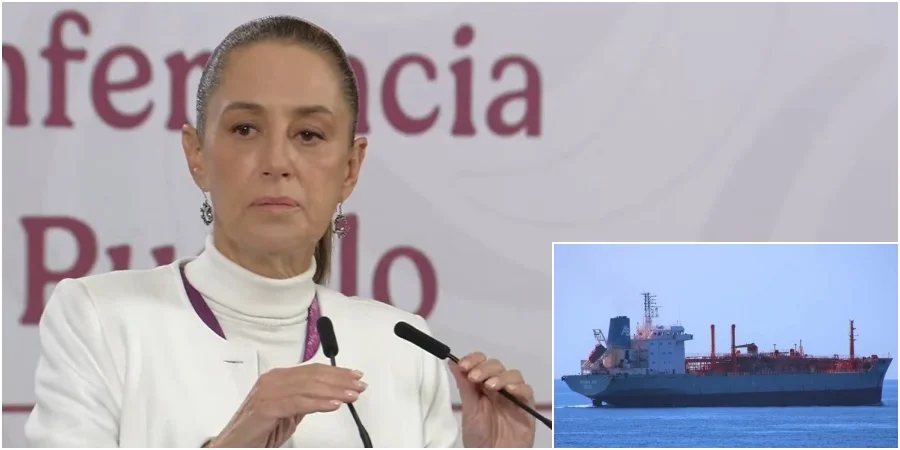
The president did not offer key data about the most recent shipment of fuel to the Island: neither prices, nor exact volume, nor commercial conditions.
CDMX, Mexico. –The Mexican president, Claudia Sheinbaum, confirmed this Monday the shipment of oil from his country to Cuba as part of bilateral agreements of “energy and financial cooperation” and in continuity of the “historic” support offered to the Island, after the EFE agency will inform that two ships with a total of 80,000 barrels of fuel had set sail for Cuban territory to alleviate the blackout crisis.
In your morning conferenceSheinbaum defended the operation in terms of sovereignty and legality. “First, we do it within a legal framework as a sovereign country; and second, we continue a series of supports that have historically been given by our country to Cuba,” he declared. He also maintained that “everything is legal and is part of something that has been done” with the Island “for a long time.”
The president did not offer key data about the shipment—neither prices, nor exact volumes by Petróleos Mexicanos (PEMEX), nor commercial conditions—beyond framing it as a sustained practice and, furthermore, with a humanitarian component. He did announce that PEMEX will later disclose information on the price and expenses associated with transportation, loading and unloading, and recalled that deliveries are also made for “humanitarian reasons to the people of Cuba.”
Sheinbaum also sought to place the bilateral link in a historical narrative: he alluded to Mexico’s position in the Organization of American States against the US embargo, highlighting that, “regardless of the political party,” both countries have maintained relations. He also presented a chronology of the relationship since 1994, including a Mexican investment of 350 million dollars for the “modernization” of the Cuban Camilo Cienfuegos refinery, and recalled official visits to the Island from the mandate of Luis Echeverría to that of Andrés Manuel López Obrador.
However, on a strictly informative level, the presidential explanation left unanswered the central questions that determine the true scope of the shipment: exactly how much oil or fuel was delivered, under what figure (sale, credit, exchange, donation or other mechanism), with what costs and in what terms, in addition to what public controls accompany the operation.
For Cuba, the arrival of hydrocarbons can temporarily alleviate electricity generation and the operation of basic services, with a very limited impact in the face of a structural crisis.
Already last Thursday, Sheinbaum had reaffirmed that his government will maintain the relationship and the historical policy of support for Havana, after it was proposed in Washington – during a hearing in the United States House of Representatives – that Mexico should “reconsider” its support for the regimes of Cuba and Venezuela.
“That relationship has always been a difference between the Government of the United States and the Government of Mexico. It does not have to influence the Mexico-United States relationship and our position is sovereign, it is a sovereign decision and it has a lot to do with the humanism that we represent,” said the president.
A day earlier, the Subcommittee on the Western Hemisphere of the Foreign Affairs Committee of the United States House of Representatives had held a hearing titled “Relations of Mexico with the region”. The hearing was led by Cuban-American Congresswoman María Elvira Salazar (R-Fla.), who in her opening remarks He reproached the Mexican foreign policy of “non-intervention” and used Cuba as an example of what he described as a contradiction between discourse and practice.
Salazar stated that “in the last four months” Mexico had sent to Cuba, free of charge, some 55 oil vessels/tankers that would have a value of “more than 3,000 million dollars.” In addition, he criticized the agreements for hiring Cuban doctors in Mexico, for which the Government of the Aztec country would be paying “more than 100 million dollars” to the Cuban Government and not directly to the doctors.
The legislator also maintained that these agreements violate Chapter 23 of the T-MEC due to an alleged relationship with “forced labor,” and described a scheme that has been denounced by international organizations and media, by which doctors receive only a minimum part of the payment, while the rest goes to the Cuban State.