This story begins in 2019. The context in the banking sector was very different. When consulted for this report, Banorte pointed out that at that time there was a trend that showed the intentions of large technology companies to enter the financial services sector to compete. Neobanks were also beginning to emerge. And there Grupo Financiero Banorte, owned by Carlos Hank González and directed by Marcos Ramírez, as the third player in the Mexican financial system by assets, established its strategy for the next three years based on three paths: accelerate the digital transformation of the bank, generate alliances and launch its own 100% digital, independent bank, but with communicating vessels “from which Banorte could learn.”
The axis of the alliances was consolidated with Cards of the Future, a company that, in alliance with the Rappi delivery platform, issued the Rappicard credit card. The project was started by Juan Guerra, now director of Revolut. Guerra had left an innovation and technology directorate at the then Citibanamex to direct Rappicard. His experience both in the financial institution led by Jane Fraser and abroad supported him.
At the same time that Rappicard was seeking to gain market share, its project was being cooked up within Banorte, a digital bank that years later would be called Bineo. The double strategy sought to attract a younger audience, a large number of clients who, according to the sources consulted by ExpansionI was getting old.
In parallel, a plan was devised so that under the shell of Ixe, another of the firms that Banorte merged in the past, a new bank would be created, 100% digital, that would not require branches and that would be more dynamic in its service. But times in the technology revolution do not wait and soon there was a ‘boom’ of financial applications that later led to a fever to seek a banking license.
The plan called Norte Digital, which was created in 2019 and which aimed at greater digitalization and in an attempt to win over the younger public, Banorte started the plan to have the design and name be in charge of them and went to the universities to launch contests for that purpose.
This is not the first time that Banorte has worked with young people. In its offices in Monterrey, the corporate is very close to the Autonomous University of Nuevo León, where it recruits students from different careers to begin their work activity.
Those in charge of the project had requested that the digital bank have autonomy: without shared services with Banorte, in a different building and with external personnel with a very technological profile. Although at the beginning these requirements were met, along the way things changed.
The construction of the digital bank began, in a Wework, from scratch: articles of incorporation, requirements before the National Banking and Securities Commission (CNBV), permits, certificates for the operating systems to run in the cloud. It was precisely this last point that made them call themselves “the first 100% digital bank.”
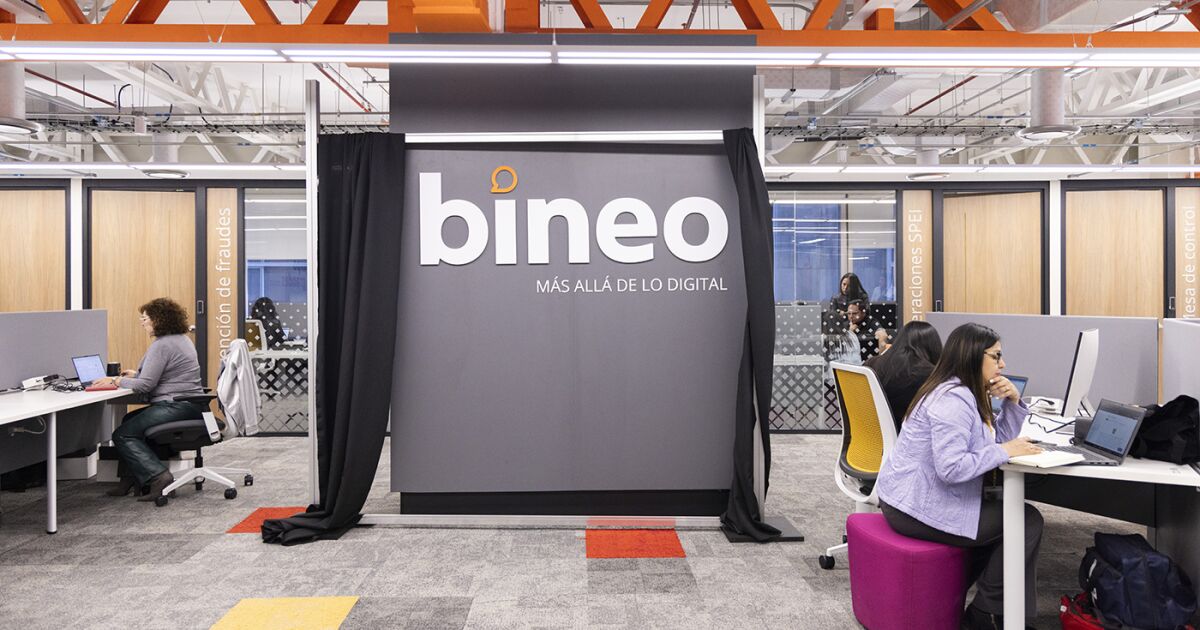
However, Bineo’s offices ended up in the old Interacciones building, another of the banks that merged in 2018, on the iconic Paseo de la Reforma avenue. Small offices, decorated in orange tones in which you could read legends such as: “We are humans, we are not bots.”
The competition
At the same time that Bineo was calling itself “the first digital bank,” Hey Banco, a subsidiary of Banregio, had already begun negotiations with the regulator to split from its parent company, obtain its own banking license and start competition with what Manuel Rivero, director of Hey Banco, considers a better option: a variety of financial products so that clients feel attracted.
Much had changed between 2019 and 2020, in which Banorte’s strategy was beginning to be outlined, and the context in which Bineo was launched. “We thought of a world that did not have the digitalization that was acquired during the pandemic,” they say from Banorte. “The bank was one of those that took advantage of digitalization the most. At the beginning of April we began to open digital accounts in the portal. We were the first bank to do so without having to upload your voter ID. And that digitalization greatly benefited our pillar of accelerating Banorte’s digital transformation,” the bank explains.
If Banorte was the first to open the gap in the process with the authorities, competition was beginning to grow. Being digital, unlike five years before, was no longer a differentiating factor.
Those were the times when there were changes in banking: Ualá, a bank of Argentine origin, bought the ABC Capital license and, betting on a new platform, decided to launch its app. Those were the times when Nubank arrived in Mexico and made a strong commitment to the Mexican market by launching its credit card.
Mercado Libre also presented its digital wallet and then, with a fintech license, launched an app that allowed it to raise resources, make payments for services and investments, although in alliance with GBM. It also launched an insurance offer but in alliance with other companies.
The launch of Bineo was not without setbacks: the bank’s directors had said that it would be in the first quarter of 2023, but it was not until December of that year when the National Banking and Securities Commission (CNBV) gave the license and in January 2024 the official launch was made, with press and influencers, at the Papalote Museo del Niño in Mexico City.
But while digital native competitors had entered the market with credit cards and specialized in that product before opening debit accounts, Banorte did it the other way around. “They wanted to do many things at the same time without having understood the channel and the segment,” says Rubén Chávez, co-founder of the Yotepresto.com platform. Mexico is a country with a level of financial inclusion below others in the region such as Colombia, Brazil or Argentina, but the key is to compete with products that make a difference in the financial system.
For Carlos Valderrama, co-founder of the Paradox Legal firm and lawyer specialized in the Fintech industry, launching a “digital bank” means that there has to be a change in the bank’s mentality. In his opinion, Banorte wanted to ride the wave of digitalization in which fintechs (banks or Sofipos) began to gain ground, and decided to take two paths to see which was more successful.
Anonymous sources say that, in addition to duplicating some of the functions and delaying the launches of new products, there was also a lack of support in the dissemination of existing ones. For the sources consulted, less attention was paid to the development and evolution of digital, in favor of the growth of Banorte. Bineo, they claim, had initially negotiated independence, in practice this was not the case. From the bank they point out that from the beginning the idea was that Banorte could learn from this process.
In the end, it was the staff of the institution led by Ramírez who made the final decisions on matters that had to do with the digital operation, such as the purchase of systems or licenses.
In the list of products that Bineo had drawn up was the launch of remittance collection, a debit account with returns, the credit card and payroll portability. In January 2024, only a personal loan and a debit account in which deposits could be made were announced.
After having launched in February, the collection of remittances was launched in April, although it was not announced by the bank. This caused concern within Bineo, since the managers asked for there to be more users that would mean profitability for the business, although they did not dare to advertise each product that was launched with the argument that advertising would be deployed when there was a more solid package.
At Banorte they highlight that since the digital bank was born, the board of directors and the management committee were very precise in saying that they did not want customer promises or transactions, but rather they expected a business that was in balance and generated profits. And he emphasizes that this premise was clear from the birth of the project.
At the beginning of the last quarter of 2024 and after several tests, the credit card was ready, the one that would put them face to face with their digital competitors, but the launch was delayed to prioritize profitability over new products.
In the presentation of the financial results for the second quarter of last year, and questioned about Bineo’s progress, Marcos Ramírez, general director of the Financial Group, highlighted that the digital bank’s strategy was not to win over customers en masse but to make it a profitable business.
Banorte was aware that it would not be profitable in the first years although it had hopes of being profitable within a period of between 36 and 42 months.
Profitability in a short time in this industry is complicated. Only 5% of banks that launch as digital banks are successful, says Julián Colombo, director of N5 and specialist in providing technology to traditional and digital banks.
Colombo believes that profitability is not the only problem for banks but rather the inability to offer a complete ecosystem to customers. “When you open a digital bank, in general, what you do is a single product or a set of very small products in a single channel,” he says.
Something changed in the economy and the market
It is impossible to say that only the pursuit of profitability was to blame. When Banorte devised the plan to have a 100% digital business, it was done in another context. In 2019 where there was no pandemic, inflation was within the Bank of Mexico’s objective, at 3.59%, and with fewer digital players,
Already by 2024, when Bineo saw the light, Sofipos and other banking models had captured the attention and wallets of Mexicans by offering them double-digit rates of return and Bineo fell short in the value proposition.
It seems that what happened with Banorte and Bineo was that they were serving the same niche. So, there was a cannibalization of clients
Carlos Valderrama, co-founder of the Legal Paradox firm.
For people who worked at Bineo, another problem was that Banorte made decisions that corresponded to the digital area, for example, budget cuts for technology, cutting suppliers and the request to work on taking out mortgage loans.
And while Bineo experienced dependence on Banorte, on the side of Rappicard it seemed that the alliance of almost 50% with Rappi allowed it to operate more independently and gained clients.
For Banorte, the decision was beginning to be clear. After opting for diversification into two banks, the digital growth of the mother bank was such that it was decided to consolidate everything into what the financial group calls “a bank in minutes”, with a multiplicity of products and services ready to be contracted or used in minutes. “Banorte’s digital transformation was so brutal in those three years that by the time Bineo came out, the progress of Banorte mobile and the online bank was very strong, with millions of clients and integrated products. There, a leadership began to be generated that, a year after (launching Bineo) was forceful,” they say from Banorte.