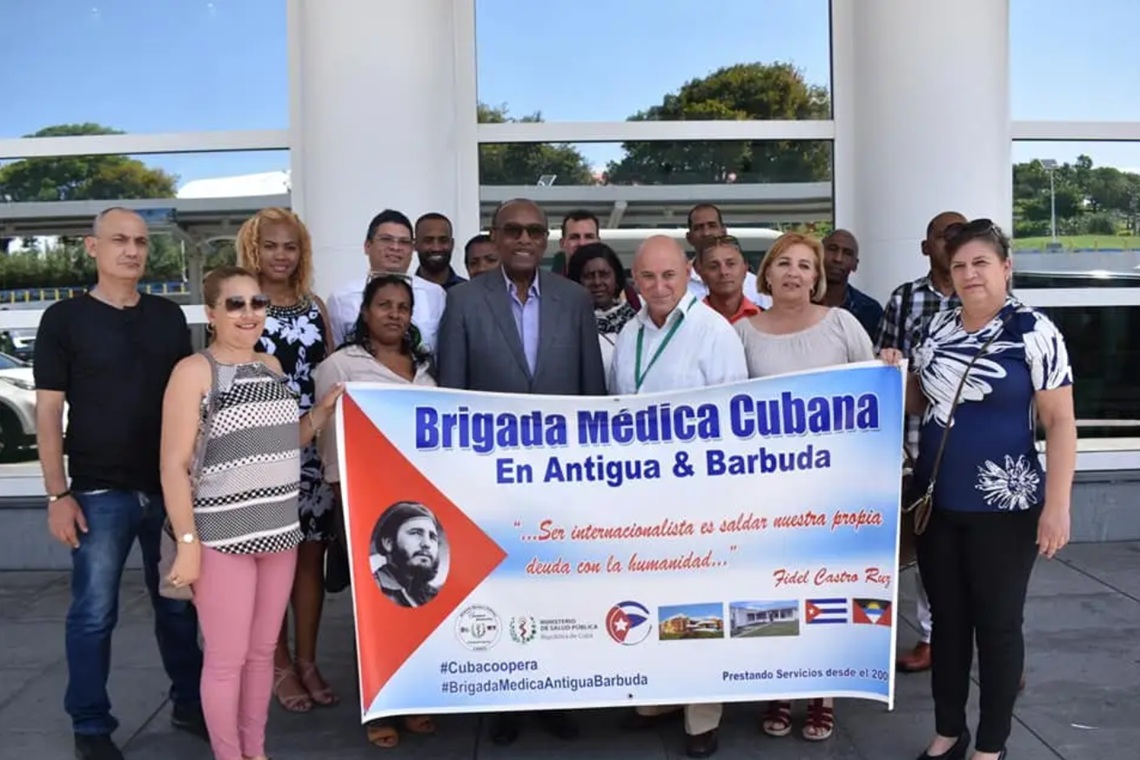
The medical collaboration of Cuba with Antigua and Barbuda would have been recently suspended by that last country, according to information disseminated by media in the Caribbean nation and by the United Progressive Party (UPP), currently in opposition.
The portal Old Newsroom reported this week that The administration of Prime Minister Gaston Browne suddenly ended that link with Cubaa cooperation that has been maintained for more than two decades and that has been key for the Antiguan health system.
The information was released through a statement from the UPP, without the Government of Antigua and Barbuda having confirmed it or offering explanations publicly.
Nor have the Cuban authorities commented on the matter.
This fact contrasts with the positions expressed for months by Browne himself, who had defended the program cuban doctor facing pressure from the United States and went so far as to affirm that the withdrawal of doctors from the island would “devastate” the country’s health services.
The prime minister had also rejected accusations that the program covered up human trafficking practices, as maintained by Washington and Cuban opposition organizations.
Opposition party thanks Cuban doctors
Old Newsroom published a UPP statement in which the party expressed its “deep gratitude” to the Government and people of Cuba for the contributions made over the years to the health systemthe training of professionals and programs such as ophthalmological care.
In the text, the political organization regretted that the “current administration has so abruptly put an end” to a relationship that it described as mutually beneficial.
The UPP also recalled that hundreds of citizens of Antigua and Barbuda benefited from scholarships in Cuba and the work of Cuban doctors in hospitals and communities.
In that sense, he recognized “the education and training of hundreds of our students in various disciplines, which, on their own, an average family could never have afforded. Consequently, Cuba has directly lifted many graduates and their families out of poverty, providing them with a better future.”
Finally, the opposition party assured the “Government and people of Cuba” that it would not be “ungrateful or forgetful” regarding this cooperation.
Granada makes “important changes” in hiring Cubans after a request from the US
Impact in the press
He newspaper Ancient Observer broke the news based on the UPP statement and questioned the “sudden change of position” of the Government of that country and its silence on the matter.
In his opinion, heThe abrupt termination of medical collaboration with Cuba “marks a surprising change in policy” by the ruling formation and “raises questions about American pressure and the stability of the health system” of the Caribbean nation.
“The departure leaves a significant gap in the public health infrastructure of Antigua and Barbuda. Cuban medical professionals have staffed clinics on both islands, providing services in areas where local doctors are scarce or unavailable,” the media highlighted.
For its part, the newspaper Dominica News Online also echoed the news and agreed that this is a “sudden” change, taking into account that the Browne administration committed throughout the year to protecting its relationship with Cuba, despite growing pressure from the US Government.
The publication noted that despite the president’s “apparently inflexible” stance, his administration suddenly broke off the relationship in December without giving any public explanation.
“Given that both Dominica and Antigua and Barbuda have been subject to visa restrictions by the United States this week, the question remains what other measures the United States could use to advance its policy in the region and what concessions our governments are willing to make in the face of this growing pressure,” the media concluded.
The US withdraws visas from international officials for hiring Cuban medical missions
Change of position due to pressure from the US?
The information about a possible suspension is striking if one takes into account that this year 25 years of Cuban medical collaboration in Antigua and Barbuda were commemorated.
Last April, during the anniversary events, Browne reaffirmed his Government’s support for Cuba in the face of the US blockade and described “unsustainable slander” campaigns against the Cuban medical brigades.
Even in November, the Minister for Health, Wellbeing and the Environment, Sir Molwyn Joseph, publicly expressed his Government’s interest in expand the levels of health cooperation with Cubaand praised the role of the Cuban medical brigade as one of the pillars of the public health system.
At the beginning of December, the Cuban Foreign Ministry announced the arrival of new members of the medical mission to that country.
Until now, No official statement has been made by the Cuban Government. nor from the authorities of Antigua and Barbuda about the supposed end of the collaboration.
The regional context, however, is marked by increased pressure from Washington on several Caribbean countries to end Cuban medical programs, in a scenario that includes recent visa restrictions imposed by the United States.