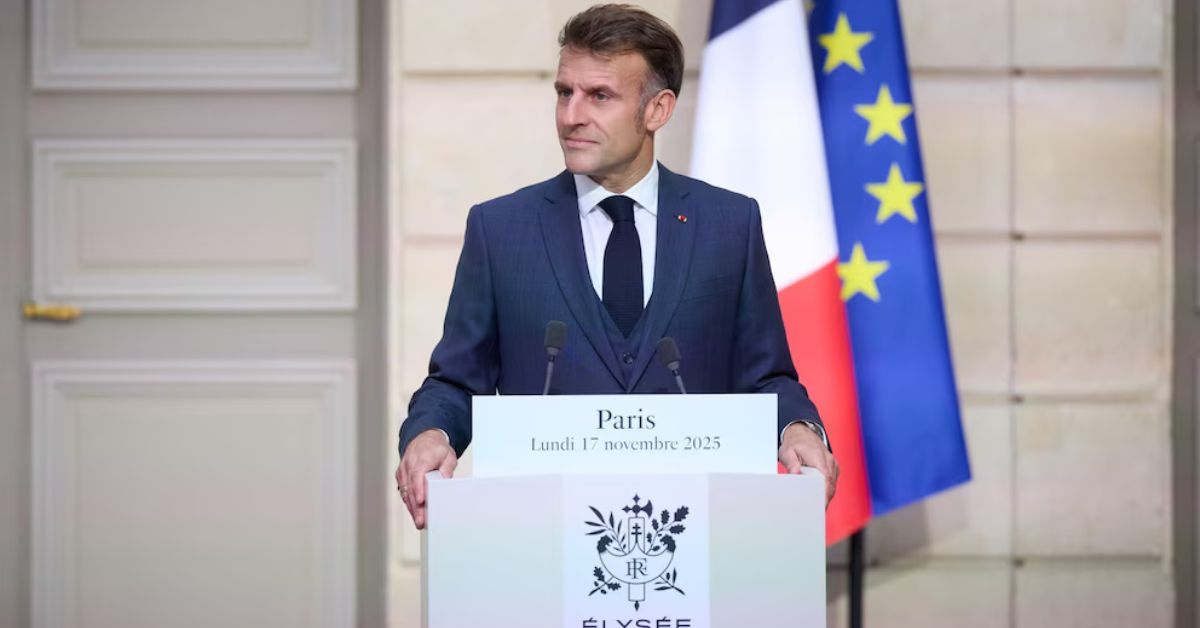
French President Emmanuel Macron announced on Sunday the construction of a new, state-of-the-art aircraft carrier for the French armed forces, which is expected to enter service in 2038.
The decision, unveiled during a speech to military personnel at the Zayed Military City base in the United Arab Emirates, aims to replace the Charles de Gaulle aircraft carrier, which has been operational since 2001 and was designed for a 40-year service life.
Macron emphasized that the new vessel will be a symbol of French national power and technological capability, and that its development will involve around 800 suppliers, 80% of them small and medium-sized enterprises.
According to reports on Sunday, Macron described the project as representing “the power of the technology industry” and “power at the service of freedom on the seas and in turbulent times.” He explained that the final decision was made last week and announced that he will visit the construction site of the new aircraft carrier in February.
The announcement comes amid increased defense spending mandated by France’s military programming law, which requires sustained increases in defense expenditures despite the country’s high budget deficit, projected at 5.4% of GDP for the current year.
On December 10, the National Assembly approved a resolution to increase defense spending, with 411 votes in favor and 88 against. However, a lack of political consensus prevented the full budget from being approved before year-end, forcing Prime Minister Sébastien Lecornu’s government to pass special legislation to cover the gap in the absence of a new budget.
The strengthening of France’s military capabilities also includes the launch of a new voluntary national service for 18- and 19-year-olds. Macron presented the program in November; it will begin next summer with 3,000 participants and aims to expand to 10,000 volunteers annually by 2030, with a target of 50,000 by 2035.
According to the president, selected young people will serve for ten months on French soil and overseas, with military status, salary, and equipment. After one month of training, they will be integrated into units for nine months, carrying out missions similar to those of active-duty personnel, before transitioning to the military reserve.
This national service, Macron said, responds to the need to strengthen defenses against the threats posed by the war in Ukraine and Russia’s stance toward Europe. General Fabien Mandon, Chief of Staff of the French Army, recently warned that the country might have to prepare to “lose its sons” in a potential conflict, after stating that Russia is preparing for a confrontation with European countries by 2030, viewing NATO as its existential enemy.
France plans to raise its annual military budget to €64 billion by 2027, double the 2017 figure. The plan for the 2026–2030 period also includes over €2 billion in additional funding for the new national service. Currently, the French armed forces have approximately 200,000 active personnel and 40,000 reservists, with the latter expected to increase to 80,000 by 2030.
Other European countries are also pursuing reforms to strengthen their military capabilities. Germany is considering introducing voluntary military service, Belgium is offering incentives to recruit young people, and Poland aims to train 100,000 volunteers annually starting in 2027, without reinstating mandatory service.
Within the European Union, ten countries maintain military compulsory service, with Norway applying it to both men and women for durations ranging from two to nineteen months.