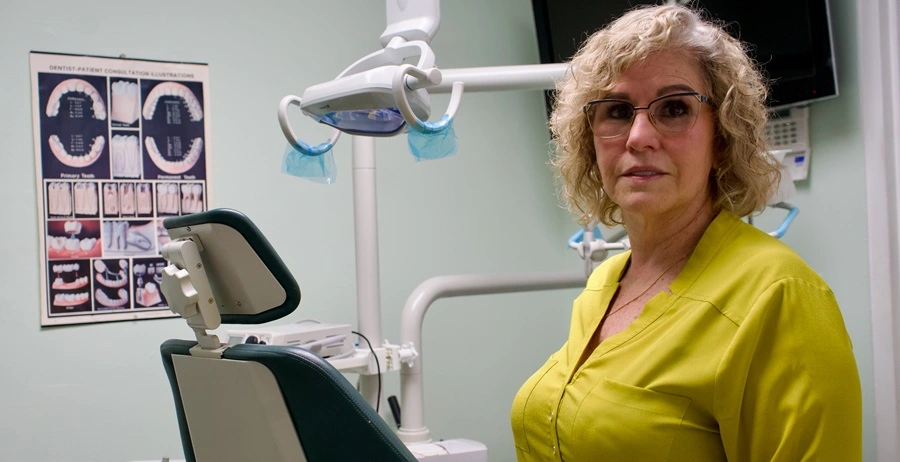
This is the story of Vilma, a Cuban dentist who arrived as a rafter in Florida and today has her own practice.
MIAMI.- About 17 times he tried to leave Cuba on a raft with his child. Vilma Quintana had studied at the prestigious Santa Clara vocational school, obtained a degree in Dentistry, then specialized in Biochemistry and taught at the university.
But the degree, the preparation and the years of study did not translate into a decent life. Without economic possibilities, without prospects for progress and with a small son, he did everything he could to get him out of there and give him the opportunity to have a life. This is the story of Vilma, a Cuban dentist who arrived as rafter to Florida and today he has his own practice.
How many attempts did you make to leave the country?
We tried to leave many times: finally there were 17 attempts. Several times we arrived at the place where we were supposed to meet to take the boat and it never arrived. Other times it arrived but there were more people than could fit. One time we went out and the boat broke down; We had to go back and that time they stopped us. I couldn’t return to work because they were going to repudiate me. A student called me and told me: “Teacher, don’t come because they are going to disown you.” Since then I haven’t worked anymore. I left with my parents and every day I went out on my bicycle looking for a way to get out of Cuba.
Were you afraid of being arrested again?
Yes. Everything was hidden because otherwise they would take you to prison. How do we go?, what do we go for?, how do we do it? Legally I couldn’t leave: no one was going to claim me and if you were a professional they punished you for five years without working in your profession in order to emigrate.
Did they call you from work to let you go?
They never called me for anything, I never got paid for that month or the vacations. When they arrested us it was in May. It didn’t take long because in August we came here. It was an intense few months in the search. We lived in a town near the coast, where many people went out. That made the attempts easier.
How was the last attempt?
On the 17th attempt we got out. The boat broke down and we were in a key for two days, but we finally got out to sea and a US Coast Guard boat picked us up. Five days later we disembarked at the Guantánamo naval base in August 94.
What were the decisive reasons for emigrating?
I had spent my life studying and to go to my family’s house I had to travel by train, bus or ask for a bottle on the road. He already had a son and didn’t see a future for him. Although he had studied and had a job, the salary was insufficient. We lived thanks to the fact that my father got food from the countryside. I had no transportation; In Santa Clara I got around by bicycle. I thought the opportunity was to go to the United States, start from scratch and give my son a future, even though I would never be a dentist or a teacher here. She was willing to clean houses if necessary.
How was the journey?
We left, the boat broke down, we ran out of water and food. Another boat arrived and brought us water and food. We got back on and headed out. Twelve hours later the US Navy picked us up and kept us for five days on the platform where the helicopters land, while they picked up other rafters. We reached 700 people. The captain spoke to us the night before and said that President Clinton ordered that the rafters would not enter the United States, but rather Guantánamo. There they disembarked us.
How long were you at the base?
From August 29, 1994 to March 24, 1995, when we arrived at the Homestead military base. There we entered the United States.
What expectations did you have when you arrived?
My brother had been here for a year. I didn’t know much about the life of an immigrant, but I knew that you had to work, learn English and start from scratch, forget about your career and work to pay for shelter, food and transportation. Then thinking about approaching the profession, something I never thought I would achieve. Honestly, I was thinking about my son’s future, not about me.
What were your first jobs?
I looked for work to pay my bills. I worked in a cafeteria and in a factory. It was difficult being a single mother and depending only on my salary. I remember that at the pizzeria I worked sometimes from 7 to 3, other times from 3 to 11 at night. We lived on tips; The salary was $10 a day and the tip was whatever you earned. I didn’t have a car, I walked or took the bus. I also had to pay for my son’s school transportation.
When did you resume your profession?
A few months later I got a job as a dental assistant. I stayed for five years and then decided to study to be a dental hygienist. I worked for seven years as a hygienist while my son was growing up. When I was already in college he told me: “Mom, don’t you want to be a dentist?” I thought it was impossible. He told me that I could enter a university and revalidate my degree. He supported me and guided me on how to apply.
I entered Nova University here in Miami. I stayed for three years and graduated as a dentist in the United States.

What challenges did you face after graduating?
It was difficult: no money and a lot of student debt. Unlike my son, foreign professionals are not given scholarships; You must pay for the race. I started looking for a job and got two days in a dental office. At that time, Colonia Medical Center, whose owner is Jorge Acevedo, from my town, was opening clinics and called me to work in the first dental clinic, first in Westchester, then in Hialeah and then Pembroke Pines. Three years later I was setting up my office, which had no patients. Little by little I created them. It was time to dedicate more time to it and I left the Colony. I thank Dr. Acevedo for the opportunity.
When did you open your own practice?
We opened this office in 2011. It is small, general dentist. I am not a specialist. A doctor comes to do implants and major surgeries, specialists also come. I refer some complicated cases. We do general dentistry – we serve local, insurance and low-income patients such as Medicaid and Medicare patients over 65 years of age. It doesn’t mean that we don’t do veneers or smile design, but it is not the focus.
What plans do you have for the future?
I don’t think I’ll be working until I’m 80. The years of work and the 17 attempts to leave Cuba were with a heavy backpack and a gallon of water through the mountains and mangroves. I have affected cervical and lumbar discs and rotator cuffs. I think I have already fulfilled my mission: raise my son, help him study and have a profession. My parents are alive at 88 and 94 years old. I help them as much as I can. I never dreamed of Rolex or Lamborghini; I want tranquility, a place to live, travel a little and a simple life. I don’t know if in three or five years, but this is over now. I don’t see myself sitting at home because I’m very active.
Do you think that in Cuba you would have achieved this?
No. She was a professor at the university who did not practice in an armchair. I would be teaching students, riding the same bicycle, living with my parents. Maybe creating a little room in my house to see patients and survive on two dollars, like many dentists do now.
Have you returned to Cuba?
I’ve been here for 30 years. I have renewed my Cuban passport all these years; It is now active for eight more years. I have never been to Cuba. I have cousins and friends; I help them and send them things, but I have not returned.
What do you miss?
I miss many things about Cuba. I see pages of Sagua the Great and Santa Clara. I miss the places and friends. I maintain relationships with my fellow students. This month, on the 21st, those of us who study at the Santa Clara vocational school will meet. I try to stick with the people I grew up with.
Even so, I am so grateful and happy to have made the decision to come to this country that if I had to do it again, I would do it again, to give my son a future. And it was also my future, because I have a better life here and I have been able to help my parents, repay them for what they did for us.