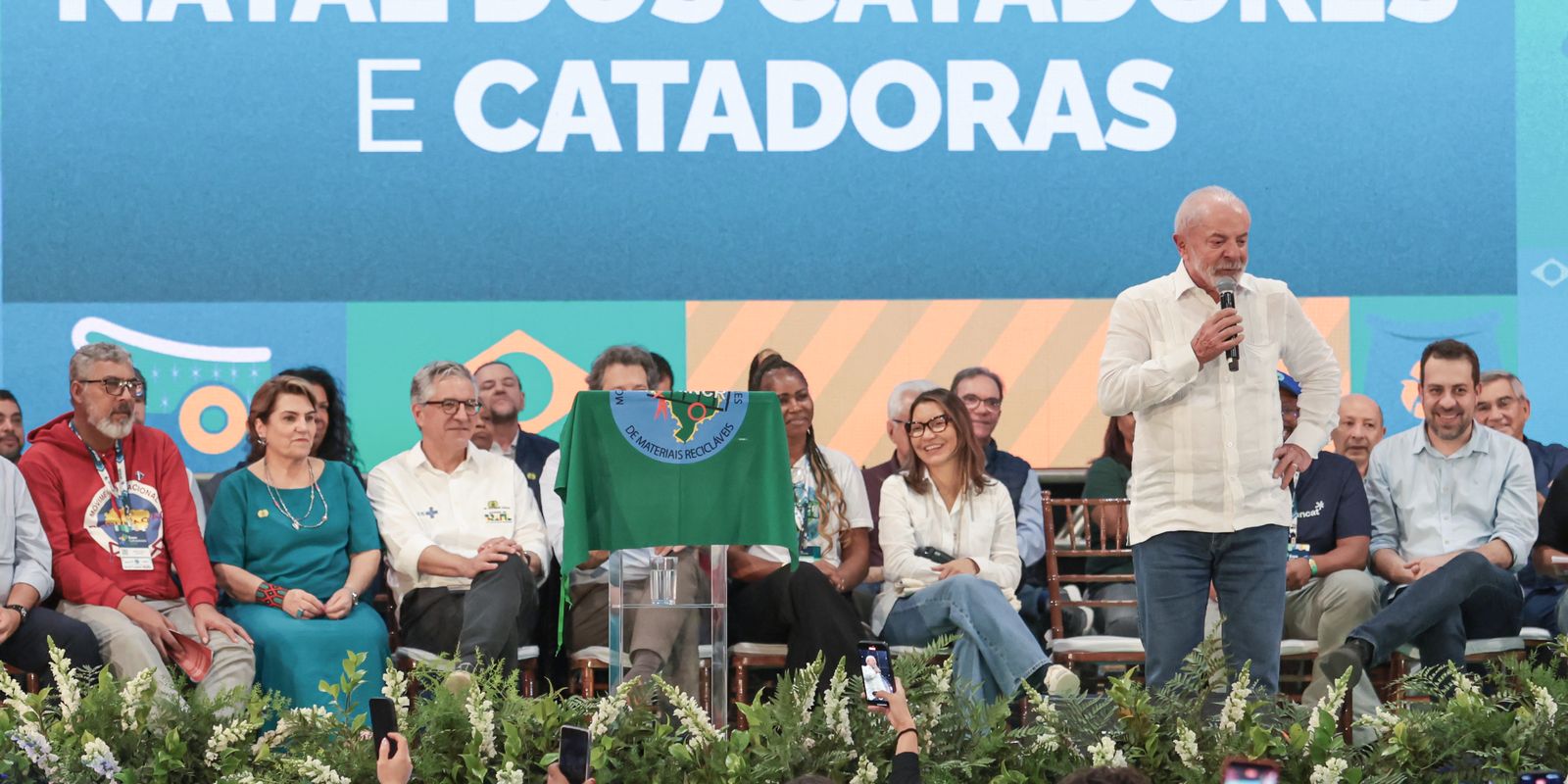
President Luiz Inácio Lula da Silva stated, this Friday (19), that collectors of recyclable materials need to be recognized for the “noble work” they do for the country. Lula participated in the closing of the 12th edition of Expocatadoresin São Paulo. During the event, the federal government announced several actions that represent around R$143 million for these workers.
“We have already done a lot, but at the same time we have still done little. Because the suffering and abandonment that you have experienced for centuries will not be repaired overnight”, said Lula, demanding that massive publicity be made so that collectors can access the services and policies that are being developed by the government.
In a meeting with the representative entities of waste pickers, Lula received an agenda of demands that will be articulated by the General Secretariat of the Presidency, which coordinates the Interministerial Committee for Socioeconomic Inclusion of Waste Pickers and Collectors of Reusable and Recyclable Materials (CIISC).
The president of the National Union of Solidarity Cooperative Organizations, Claudete Costa, said that President Lula’s government gave dignity to collectors of recyclable materials and recognizes the work they do for the environment. The movements ask, however, that they also be remunerated for these environmental services.
Claudete demanded that, in each municipality, a place with adequate and quality structure be guaranteed for workers.
“What we want within our states and municipalities is to have a decent warehouse for us to work in, to have quality of life, to have all the structure inside our warehouses, because we are qualified to be able to do business”, he defended.
“We talk about health, education, the right to equality, work and income, a chain that moves billions a year, it is no longer fair that we continue to experience difficulty, misery, within our municipalities and within our states”, he added.
Expocatadores is one of the main popular meetings on solid waste and recycling in the country. The event brings together more than 3,000 collectors of recyclable materials and 600 cooperatives, experts, international organizations and representatives of public entities.
Christmas for the collectors was also celebrated, a celebration event for the movement.
Acts
During the event, President Lula signed the decree regulating the National Solidarity Economy Systemcreated in December 2024.
The solidarity economy is an economic model formed mainly by solidarity cooperatives, in which workers have ownership of the means of production, machinery and equipment, and in which there is self-management, that is, participatory management and equal sharing of gains.
Lula also signed the decree that creates the National Investment Program in Popular Recycling (Pronarep). The program will provide financial, technical and social support to collectors, with the aim of promoting sustainability and social inclusion, equity and appreciation of work, with a focus on the circular economy and the humane eradication of landfills.
The third act signed by President Lula was the decree on the circularity of movable assets in public administration. The text deals with the movement, disposal and disposal of goods, updating the rules and incorporating principles of efficiency, circular economy and sustainability.
By expanding the hypothesis of assignment and donation, the decree includes cooperatives and waste picker associations as beneficiaries. For example, the National Institute of Metrology, Quality and Technology (Inmetro) is obliged to periodically change its scales, which will now be donated to these cooperatives.
Caixa and the National Association of Collectors (Ancat) signed an agreement to develop a project to include collector organizations in the market for reverse logistics recycling credit certificates.
The bank and the Center for Solidarity, Mutual Aid and the Environment also signed an agreement to implement the Restart with Solidarity and Organization project, worth R$2 million. The project will support the recovery of cooperatives and collectors’ associations in the Rio Grande do Sul municipalities of São Leopoldo, Canoas, Novo Hamburgo and the metropolitan region of Porto Alegre affected by the floods of May 2024.
The Ministry of Women and the Institute of Applied Economic Research (Ipea) signed a protocol of intentions for studies and research that guide public policies aimed at the socioeconomic inclusion of women waste pickers.
The General Secretariat of the Presidency of the Republic, Dataprev and the organization Pimp My Carroça signed an agreement for the development of the Cataki application. The objective of the tool is to connect collectors with people and companies that generate recyclable waste, facilitating selective collection.