With the recent departure of Just from Mexico, one of the main challenges of the entrepreneurial ecosystem is revived and it is scale without losing financial stability. The online supermarket announced its closure due to financial and strategic factors, a case that is not isolated among the startups that once managed to position themselves in the country.
In this context, the main reasons why a company goes bankrupt in Mexico are due to the lack of liquidity, poor administrative management and problems with partners, according to the Association of Entrepreneurs of Mexico (Asem).
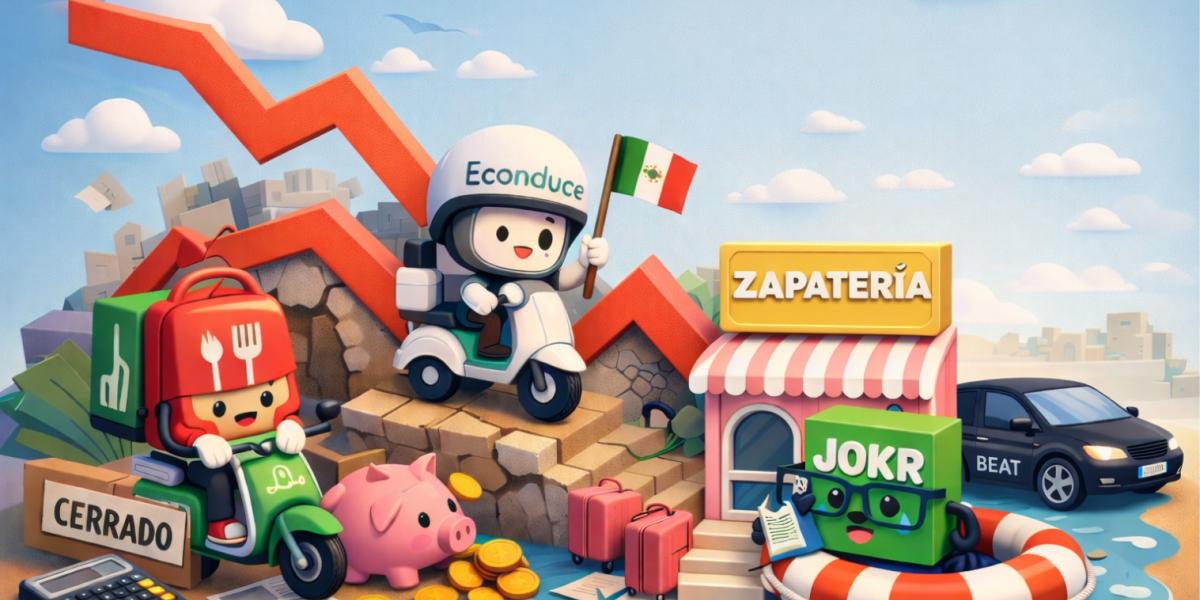
This is not the only case of a startup or business that established a presence in the Mexican market and subsequently withdrew. We present the case of some startups that grew rapidly but ended up closing their doors.
1. Apronless
Founded in 2012, SinDelantal was one of the pioneers in the home food delivery service in Mexico. Even though it was one of the first applications of its kind, it had to compete with UberEats and Rappi.
During 2020, it had 26 million users in the country who used the platform, according to Statista. Although the pandemic was key for online purchases, in December of the same year it announced that it would withdraw from the Mexican market and concentrate on other countries, such as Brazil.
The news was announced through a community of iFood, the parent company of Brazilian origin: “Many brands seek to win the heart and stomach of the Mexican consumer.”
2. E-drive
The mobility problems in Mexico City They are an everyday occurrence, since traffic is prolonged and street closures are common, but for Eduardo Porta and Alejandro Morales, this was a business opportunity that gave rise to Econduce.
After Edurdo returned from his master’s degree in England, the chaos of the city was a nightmare, so in 2015 he created the startup, which offered electric scooters to speed up transportation and at the same time it became an option that was less harmful to the environment.
However, in January 2024, a fire in a warehouse located in Colonia del Valle in Mexico City that, according to reports, it was all due to two lithium batteries catching fire.
The winery was owned by Econduce, in which the capital authorities announced the facts; However, the startup did not provide any explanations in this regard.
Although it obtained financing and recognition, over the years it began to disappear, until it closed operations. Although there was no official closing announcement, cannot access the official site and social networks stopped updating a year ago.
3. Loly in the sky
Loly in the sky had more than a decade in the Mexican market and they differentiated themselves by offering footwear with vegan materials and unique designs. Founded by Lorena Vázquez and her brother Eduardo Vázquez, they had online sales and physical stores.
Although it was a recognized and consolidated brand, little by little, consumer complaints reporting poor quality and delayed orders.
The situation began to gain strength when at the beginning of June 2024, lThe company unexpectedly stopped responding to messages and in a Zoom meeting the dismissal of all staff was announced because it would close operations.
4. Jokr
Similar to Sin Apron, Jokr was a startup that made home delivery of groceriesoday promised to place orders in less than 15 minutes.
The startup was founded in 2021 by Aspa Lekka and Ralf Wenzel. Despite its German origin, it was launched on the Mexican market in March of the same year.
As a result, it had 25 wineries in various cities such as Mexico City, Guadalajara and Monterrey. Despite this, in 2023 they decided to stop operating in the country and focus on Brazil.
5.Beat
The mobility startup was founded in Greece by Nikos Drandakis in 2011. The value proposition was that through an application you could order ride sharing and taxis.
When it arrived in Mexico in 2019, the company chose to have electric cars that were available in central neighborhoods from Mexico City, such as the Condesa neighborhood, Roma, Polanco, among others.
It finally closed operations in Latin America in November 2022 to focus on the European market.
Although many of the startups and businesses on the list shined in the market, they also reflect the challenges of the business ecosystem in which the competitive market and internal management are key to not going bankrupt.