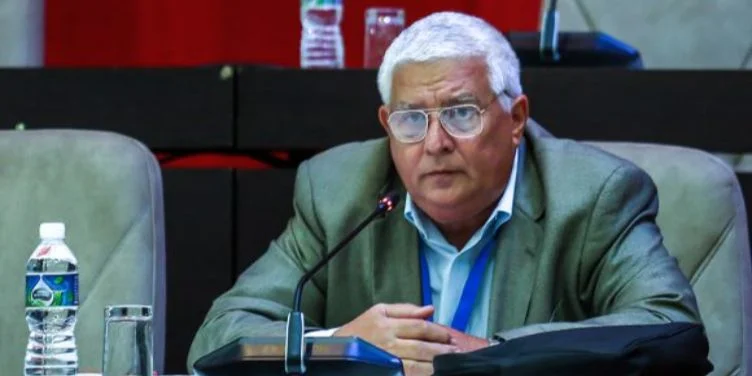
The official is 72 years old.
MIAMI, United States. – The deputies of the National Assembly of People’s Power (ANPP) “elected” this Thursday José Luis Toledo Santander as the new secretary of the Parliament and the Council of State, after a proposal presented in the plenary session during the VI period of ordinary sessions of the X Legislature, according to state media reports.
According to Havana Tribunethe president of the National Electoral Council, Alina Balseiro, informed the plenary session of the designation. The Cuban News Agency (ACN)for his part, alluded to a day of “cadre movements” within the parliamentary session and specified that the position of secretary of Parliament and the Council of State was decided “through the secret vote of the deputies.”
Toledo Santander, 72, is a deputy for the Plaza de la Revolución municipality and had served as president of the Parliament’s Constitutional and Legal Affairs Commission. He also has a degree in Law and a doctor in Legal Sciences.
The official has a long history in the legal and parliamentary activity of the Cuban regime. Professionally trained as a Law graduate and a Doctor in Legal Sciences, the official was also dean of the Faculty of Law of the University of Havana for 18 years and professor at the National Defense College.
In the same session, the president of Parliament, Esteban Lazo Hernández, announced the receipt of the resignations of Homero Acosta Álvarez (until this Thursday secretary of the Assembly and the Council of State), Ulises Guilarte de Nacimiento and Ricardo Rodríguez González.
Before his parliamentary career, he served for about 20 years in the Attorney General’s Office of the Republic, becoming the head of the Prosecutor’s Office in several provinces—including Sancti Spíritus, Ciego de Ávila and Havana—and reaching the position of deputy attorney general of the Republic.
This Thursday, other changes of direction were also reported: the incorporation of Litza Elena González Desdín as a new member of the Council of State, the election of Oscar Silvera Martínez as president of the Supreme People’s Court and the approval of Rosabel Gamón Verde as Minister of Justice.
The official story, however, left the central question unanswered: why are these departures and replacements occurring precisely now. In the case of Acosta, Guilarte and Rodríguez, Granma He limited himself to pointing out that “they presented their resignations” and that the Council of State “accepted” them, without offering causes, disagreements, new responsibilities, or verifiable public explanations for a change that affects the secretariat of Parliament and the composition of the body that represents it between sessions.
On the same day, the Cuban ruler, Miguel Díaz-Canel, presented to the plenary session the proposal for the “release” of Rubén Remigio Ferro as president of the Supreme People’s Court after 27 years in that responsibility and proposed Oscar Silvera Martínez, current Minister of Justice, to replace him.
Official coverage described the replacement of Rubén Remigio Ferro as a “cadre movement” and presented the change as a procedure for parliamentary approval.