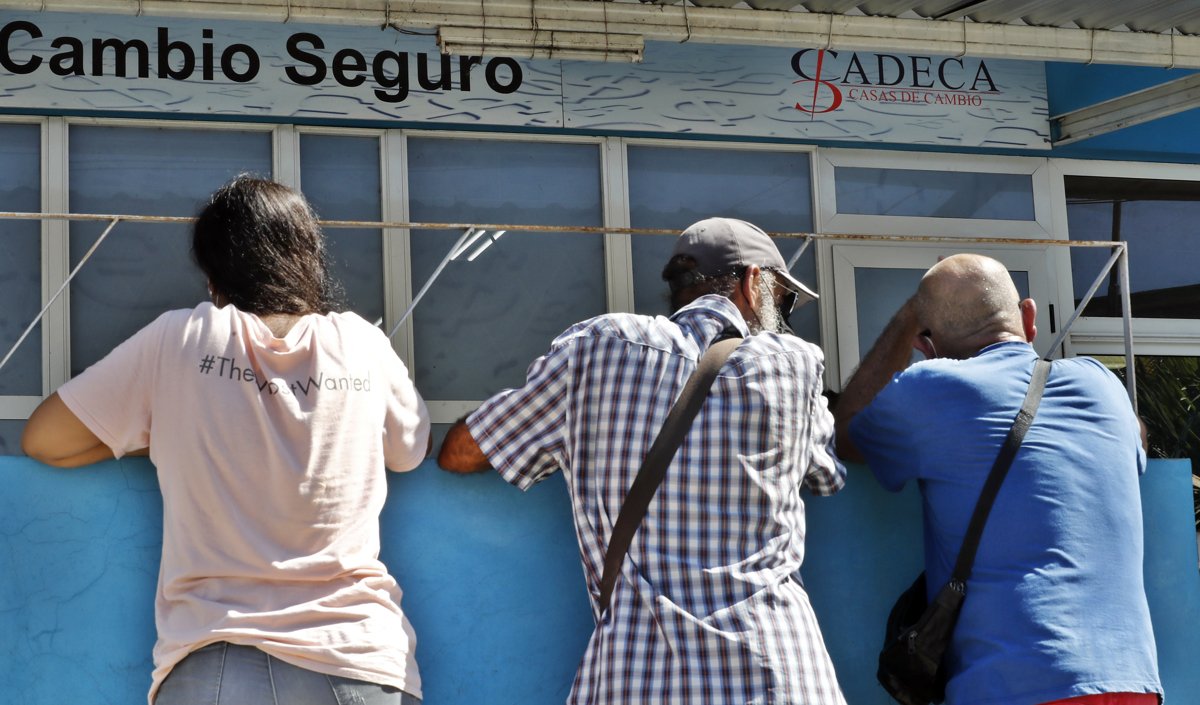
Cuba launches this Thursday a new exchange ratewhich will be floating and will coexist with the other two rates that remain officially in force.
The new rate will be published daily and seeks to facilitate “exporters and other foreign currency suppliers to sell at a competitive price, determined by supply and demand,” as explained by Juana Lilia Delgado, minister-president of the Central Bank of Cuba (BCC).
The measure seeks to “incentivize the entry of foreign currency into the exchange market, which will constitute a source for its operations and reduce the pressures and irregularities of the informal market,” Delgado explained during a television intervention last night
With this, far from unifying all existing rates into one, a third rate is created that for the moment must work on par with the others: the one that operates at 1 dollar for 24 pesos (1×24) and the one that operates at 1 for 120 (1×120).
However, the latter will no longer be allocated to natural persons as it had been until now, but rather, like 1×24, it will be used by certain entities defined by the Government, as specified to Granma Ian Pedro Carbonell Karell, director of Macroeconomic Policies at the BCC.
Individuals and private businesses must use the new floating rate if they wish to carry out their operations through legal mechanisms and not through the informal market.
A “gradual” process
In her speech, the minister-president of the BCC assured that at this time the country does not have the conditions to implement a single rate, so the process begun this Thursday will be “gradual and responsible.”
However, he did not say how long this first phase of “the transformation of the foreign exchange market” would continue, with the three coexisting official rates, nor did he give any indication of what the possible next stage would be.
“The combination of severe external restrictions, the abrupt drop in foreign currency income, the contraction of its supply in the official exchange market, as well as the accumulated imbalances, determine the beginning of the exchange transformation with a gradual and responsible approach,” he said.
According to the official, “an immediate unification of the exchange rate, without a transition stage, could cause a sudden devaluation, with inflationary effects greater than the current ones and a deepening of the loss of purchasing power of the national currency against foreign currencies.”
In addition, he confirmed that at the moment there will be three different segments on the island, each with its own rate. The first two, with fixed rates, “will be sustained in such a way that sudden devaluations of exchange rates do not occur” to “protect” the value of the national currency and the population “in basic and sensitive operations,” he noted.
The three segments
Delgado did not detail the composition of the three segments of the exchange market now established by the Government, but announced that this Thursday the new provisions in this regard would come into force as of their publication in the Official Gazette.
Much more explicit was Carbonell Karell. In statements published by Cubadebatethe official explained that the first segment, with the rate of 1×24, “concentrates the allocations made by the State through the Central Bank.” Meanwhile, in the second, with the 1×120 rate, “certain entities with the capacity to generate external income will participate.”
The exchange regime of this second segment, he asserted, “is aimed at stimulating the profitability and competitiveness of these entities, with the objective of strengthening the trade balance and expanding the availability of resources.”
Furthermore, he believed that its relevance is “strategic”, since from it the process of convergence towards a single exchange rate for the entire economy must be established “gradually”.
As for the third segment, he classified it as “innovative” by “modifying the exchange regime applicable to natural persons and non-state forms of management.” Regarding it, he confirmed that “it will be subject to periodic adjustments, in correspondence with the real conditions of the economy” and its rate “may be modified even on a daily basis” by the Central Bank.
With this, he considered, the reference rate is given “greater solidity and transparency for all actors in this segment, reducing the margins of manipulation and speculation to which both households and economic activities are currently exposed.”
A single rate as a “strategic objective”
Although far from unifying the rates, the Government chose to create a new one, Carbonell Karell said that the “strategic objective” of the process is to finally have only one. “This structure will gradually converge these three official exchange rates towards a single exchange rate,” he stated.
For her part, the minister-president of the BCC insisted that “the purpose is not to replace one distortion with another, but to gradually close the monetary gaps that affect the economy and families.”
The official assured that these transformations “are not an end in themselves, but a tool to organize the economy and strengthen the financial system,” as part of the set of measures taken by the authorities in search of alleviating the severe economic crisis on the island.
When analyzing the Central Bank’s announcement, the economist Pedro Monreal drew attention that the “’gradual approach’ does not clarify what the final goal would be in terms of the exchange rate regime or exchange rate unification, nor in terms of future sequences, nor about the duration of the process.”
In his opinion, “the reasonable argument that a sudden monetary and exchange rate unification would be negative is not enough to understand the preference for ‘multiple segments’ and not for an option of monetary unification followed by progressive devaluations towards exchange rate unification.”
3/7 The reasonable argument that a sudden monetary and exchange rate unification would be negative is not sufficient to understand the preference for “multiple segments” and not for an option of monetary unification followed by progressive devaluations towards exchange rate unification
— Pedro Monreal (@pmmonreal) December 18, 2025
The establishment of the new floating rate had been announced for the second half of the year by Prime Minister Manuel Marrero. However, as the months progressed and the worsening of the economic crisis in the country, it was suggested that the measure would be postponed again.
In the end this was not the case, although a unified rate was not launched either.
The announcement takes place in the midst of a government crackdown against the informal currency market and informal remittance mechanisms, in parallel with the authorities’ accusations against the opposition environment. The Touch and its exchange rate, used mostly by Cubans as a reference for the purchase and sale of currency.
It also occurs shortly after the Government itself approved a new system for the management, control and allocation of currency, which gives green light for transactions under your authorization in foreign currenciesas well as their circulation on the island.
This legal package, presented as a “temporary measure,” is in practice a new boost to the dollarization process on the island and, in the opinion of experts, prepared the ground for the establishment of the new exchange market, as in fact happened.