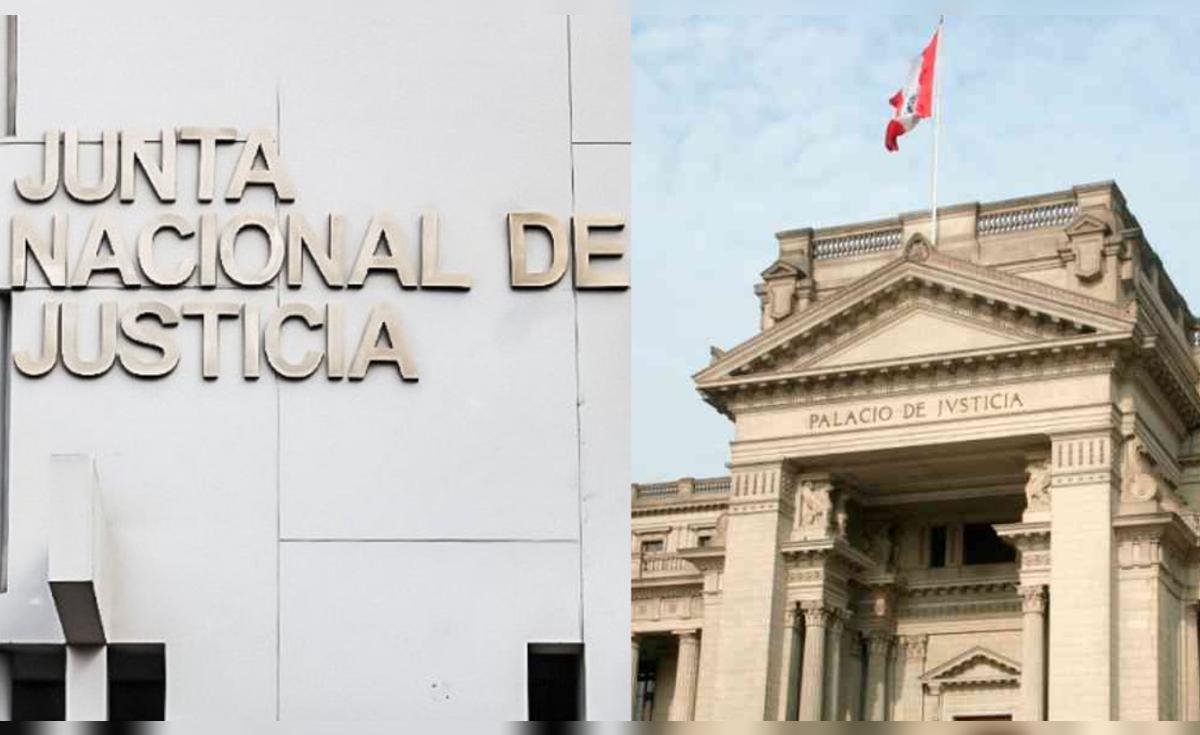
The National Board of Justice (JNJ) presented a bill to the Congress in which he seeks that Judiciary do not intervene in their decisions on appointments, sanctions, ratifications and evaluations against judges and prosecutors.
listen to the newsText converted to audio
Artificial intelligence
The JNJ proposal comes after the Ninth Constitutional Court granted a precautionary measure to Delia Espinoza —after having been suspended for 6 months by the JNJ for not reinstating Patricia Benavides as prosecutor of the Nation — to return to his position as head of the Public Ministry.
WE RECOMMEND YOU
ELECTIONS, JUDICIAL POWER AND PERU PROTEST | WITHOUT SCRIPT WITH ROSA MARÍA PALACIOS
In this way, the JNJ proposes to modify article 142 of the Political Constitution, in which it tries to put itself at the same level as the National Election Jury (JNE), an institution whose resolutions on electoral matters cannot be reviewed by the judicial system. Likewise, the initiative aims to establish the powers of constitutional judges in the aforementioned cases, in accordance with the provisions of article 42 of the New Constitutional Procedural Code.
However, the JNJ proposed that the Judiciary can only interfere in their resolutions when a judge or prosecutor files an action for protection if they consider that their human rights were violated.
JNJ against the Judiciary
With this bill, there are already two attempts by the JNJ to prevent the Judiciary from interfering in its powers. Last November, in the midst of the ups and downs over the return of Espinoza Valenzuela to the Prosecutor’s Office and after the PJ granted him two days – at different times – to comply with his reinstatement, the JNJ filed a jurisdictional claim before the Constitutional Court with the aim of stopping said judicial decision.
In the brief presented to the TC, the JNJ alleged an alleged “undermining of powers” by the PJ, by having granted a precautionary measure in favor of Espinoza, thereby suspending the execution of the temporary sanction.
Precisely, that is the same argument that the JNJ uses to support its bill before Congress. According to the institution, the intervention of the judicial body “affects legal security, undermines the functional independence that the Constitution wanted to guarantee to the JNJ” and causes “the system to lose structural coherence.”
“Judicial interference in the decisions of the National Board of Justice, in addition, produces an effect of fragmentation of disciplinary control, since through precautionary measures, sanctions of dismissal or suspension are suspended, generating the provisional reinstatement of magistrates whose conduct was declared incompatible with the judicial or prosecutorial function,” the document reads.
Other reasons of the JNJ in its bill
The JNJ also supported its proposal by indicating that the “proliferation of judicial resources” against the institution “generates a systematic delay in the execution of sanctions and appointments.” According to the entity, this affects the administration of justice.
“(…) while judicial measures are being processed, important vacancies remain in the courts or prosecutor’s offices, or judges and prosecutors sanctioned for serious misconduct remain in office,” the document mentions.