Santo Domingo.- The Bees usually prefer to build their nests outdoors.but a new study has found, in the Dominican Republic, the first known case of fossil nests which were made inside the jaws of prehistoric mammals, previously fossilized.
The discovery is documented in a study published Royal Society Open Science by the Field Museum of Chicago and the Florida Museum of Natural History (USA).
The researchers – led by ePaleontologist Lázaro Viñola López, from the Field, found the evidence in a cave in the south of the Dominican Republic.which about 20,000 years ago was the home of giant owls for generations, according to the bones and eggshells found there.
Those birds sometimes carried their prey, especially a rodent called hutía, into the cave or vomited up balls of hair containing their bones, which fell to the ground until they became fossilized.
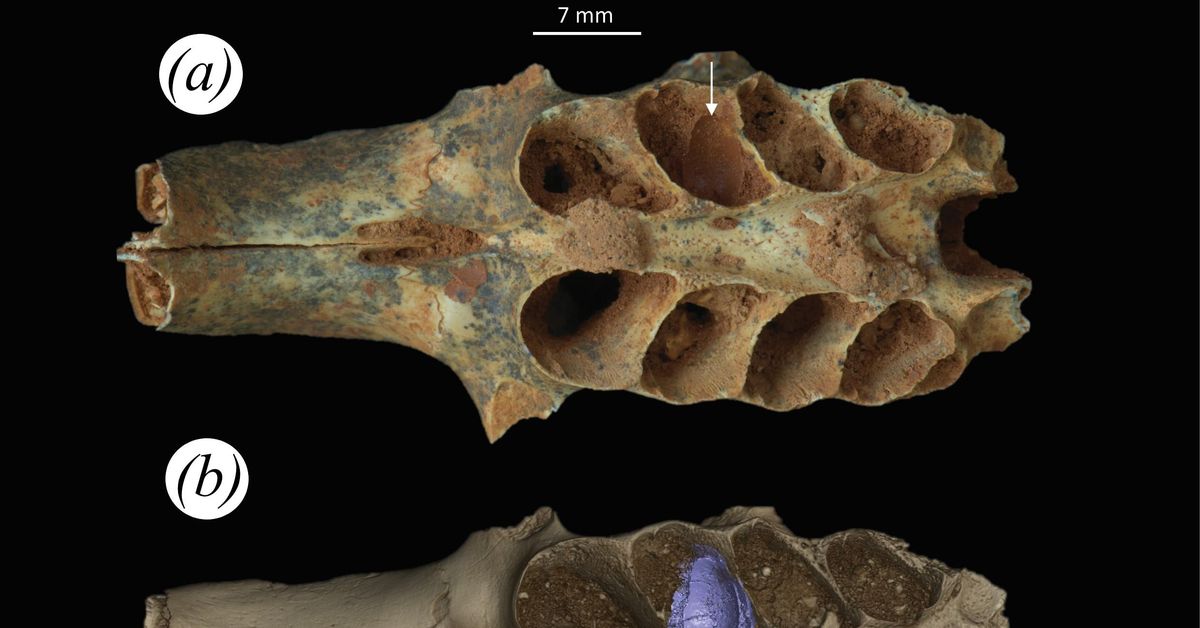
The researchers found fossil jaws in whose alveoli (the holes into which the roots of the teeth are inserted) there was a smooth inner lining, as opposed to the rough texture of the bone.
Viñola had already seen something similar in fossils of dinosaurs in montana (USA), which corresponded to wasp cocoons.
However, wasp remains They differ from those of bees in key ways. After various studies, the team concluded that the fossilized jaws housed nest fossils of the latter animal.
CT scans of the bones provided the team with images in 3D earth compacted within the cavities dental without destroying the fossils or altering the sediments and they came to find ancient pollen grains in the nests that the mother bees had sealed for their young to feed on.
The nests the scientists found did not contain fossilized bees due to the hot and humid conditions of the cave, so they could not assign a species to the bees that built them.
However, the nests were different enough from those already known that the researchers could give them a classification. taxonomic- Osnidum almontei in honor of Juan Almonte Milan, the scientist who discovered the cave.
Viñola cannot rule out that these bees were of a species that still exists today, but it is known that “Many of the animals whose bones are preserved in the cave are now extinct.””, so they could also have disappeared, he indicated in a statement from his university.
The study also gives a plausible explanation for why bees broke with tradition and built their nests inside a cave instead of outdoors and, furthermore, inside fossils.
The cause would be the lack of topsoil outside the cave, in a terrain of sharp and steep rock, together with the abundance of sediments accumulated inside.
It is possible that the bees will begin to dig tunnels through the fine clay silt accumulated in the cave to build their nests and stumble upon ancient mandibles.
As the teeth had been destroyed, the jaws had holes in the alveoli that would be of similar dimensions to the nests that the bees wanted to build, points out in a statement from the Florida Museum of Natural History.