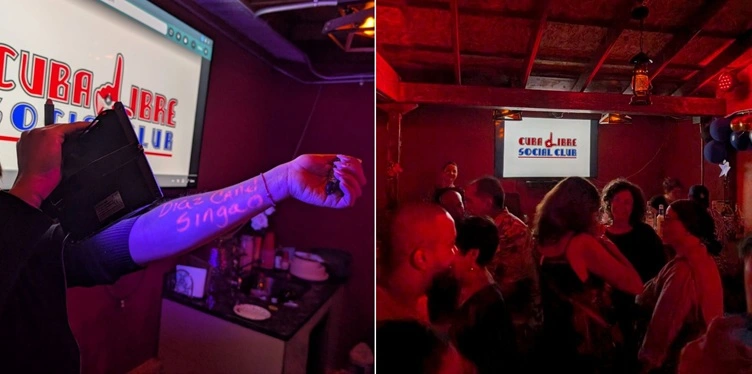
Born in the Cuban exile in New Jersey, the project organizes monthly cultural meetings that, for more than a year, have allowed families of political prisoners in Cuba to be accompanied.
MADRID, Spain.- In New Jersey, a community of Cuban exiles has found a unique way to articulate solidarity, activism and culture. Under the name of Cuba Libre Social Club, a community project organizes monthly meetings with a double purpose: to raise funds to support families of political prisoners in Cuba and strengthen the ties of a diaspora marked by uprooting and constant concern about the situation on the Island.
Far from the traditional format of humanitarian organizations, the initiative is committed to open social gatherings, conceived as dinners or parties in which music, food and conversation become tools to sustain systematic aid. The project is celebrated on the second Friday of each month and, its organizers highlight, it has managed to remain active for more than a year, progressively expanding its scope.
An idea born of exile and urgency
Activist and curator Meyken Barrero, one of the organizers, explains that the origin of the project was spontaneous and deeply linked to the experience of exile. “Cuba Libre Social Club is a fairly spontaneous initiative, the idea originally came from Armando Álvarez, son of a political prisoner,” he points out. Álvarez is the son of Armando Álvarez Castro, imprisoned for political reasons, and came into exile very young after the repressive offensive of the Cuban regime after the occupation of the Embassy of Peru and the Mariel exodus.
Barrero remembers that, in those informal meetings of Cubans in New Jersey, concern arose recurrently about how to help those who remain in Cuba. “Many of us Cubans here in New Jersey met from time to time, and the topic always came up of how to do something concrete for the people in Cuba, a charitable work,” he explains.
From that exchange was born the idea of organizing an event that would preserve the festive nature of these meetings, but with a clearly defined objective: to make visible and accompany families of political prisoners with less public exposure and to raise funds to alleviate their economic situation. “Then the idea arose to hold an event that would preserve that same festive and social energy with which we gathered to celebrate any reason, but in this case an event focused on making visible and accompanying families of political prisoners on the Island,” adds Barrero.
From informal meetings to a sustained project
The proposal was well received by the local community and began to be repeated on a monthly basis. The name of the project came later. “At some point the idea arose to call it Cuba Libre Social Club; it was an idea of the writer Enrique del Risco, a name that contains the patriotic and at the same time festive character of this idea,” he points out.
Over time, the initiative has been structured without losing its community spirit. The art historian and activist Anamely Ramos, also organizer of the project, emphasizes that one of the fundamental axes is sustained support. “It is a project that aims to accompany the families of political prisoners in Cuba and at the same time serve as a meeting space to strengthen the Cuban community in New Jersey,” he says.
Ramos highlights that the growth has been gradual, but constant. “We started little by little, we were a very small project and it has been growing. We are already accompanying more than 30 families monthly,” he explains. For her, one of the main achievements has been continuity: “It is a systematic project that has managed to maintain itself for more than a year. That is what makes us most proud.”
Financial aid and human support
Financial support is aimed mainly at families in highly vulnerable situations. The plastic artist Camila Lobóna member of the project and also exiled in New Jersey, points out in this sense that the selection of the cases responds to criteria of urgency. “It is about supporting people in situations of great vulnerability, even cases that we keep anonymous for security reasons,” he explains.
Beyond material support, the project incorporates a symbolic component that its members consider essential. Ramos summarizes this philosophy in a phrase that is repeated among the organizers: “The center of the project is that you can make your homeland with joy.” As he explains, it is about finding “pleasure in helping others” and consolidating ties between Cubans inside and outside the Island.
This approach has allowed us to integrate the Cuban reality without the encounter being dominated exclusively by pain or anguish. Lobón expresses it clearly: “The project has worked until now for that reason, because it integrates this reality not from the suffering and anxiety that it causes us all on a daily basis, but from an experience that can be fun and healthy for the community while at the same time being articulated to help.”
In parallel to the in-person meetings, the Cuba Libre Social Club has developed a digital platform that expands its possibilities of action. The project has a Web page and profiles in social networks where information is offered about some of the accompanied families, always with their consent. “Among the support we provide is also making visible the cases of political prisoners who have this family, as long as they want it, as long as the family authorizes it,” says Ramos.
The website also allows interested people to directly support a specific family without the mediation of the project. “We simply provide the information for that as well,” explains the activist. This model seeks to promote direct and decentralized solidarity.
Art, volunteering and solidarity networks
Another of the financing pillars is a virtual t-shirt store with designs donated by Cuban artists. Ramos details that these are “pullovers with some faces of some of the prisoners, with allegorical themes to Cuba, to popular protests.” Lobón expands on this information and highlights the voluntary nature of all collaborations. “Everything that is done is voluntary, that is, all the people who collaborate in the project do so voluntarily,” he emphasizes. And she adds that she herself summoned colleagues such as Hamlet Lavastida and Julio Llópiz Casal to donate designs, which are added to those created by artists from the community environment. The sale of these t-shirts allows us to diversify the funds and offer a way of collaboration to those who cannot attend the meetings in New Jersey.
The project has also received specific support from writers and creators who have decided to donate the entire proceeds from presentations or book sales. Lobón mentions, for example, the writer’s gesture Katherine Bisquetwho donated the sales of a literary presentation held in the area to the project.
A model that seeks to replicate itself
Although the Cuba Libre Social Club does not function as a formal organization nor does it intend to become institutionalized, its organizers consider that the experience can serve as a reference for other communities. “I believe that this experience could inspire other Cuban communities to carry out a charitable cause that they are interested in supporting on the Island,” says Barrero.
Ramos agrees and points out that one of the objectives is for the model to be replicated. “Another of the main ideas of the project is to try to inspire this model to spread, so that Cuban communities in other countries can also do something similar,” he explains. According to him, the organizers are willing to share their experience with those who want to promote similar initiatives.
With guests that have included figures of Cuban culture and activism, and a community that responds constantly, the Cuba Libre Social Club has established itself as a space where cultural celebration coexists with civic engagement. In a context marked by repression and structural crisis in Cuba, the project is committed to sustained solidarity, built from closeness and collective participation.