The towns of Larrondo and Mariana Grajales remain isolated, the latter with nearly 2,000 inhabitants.
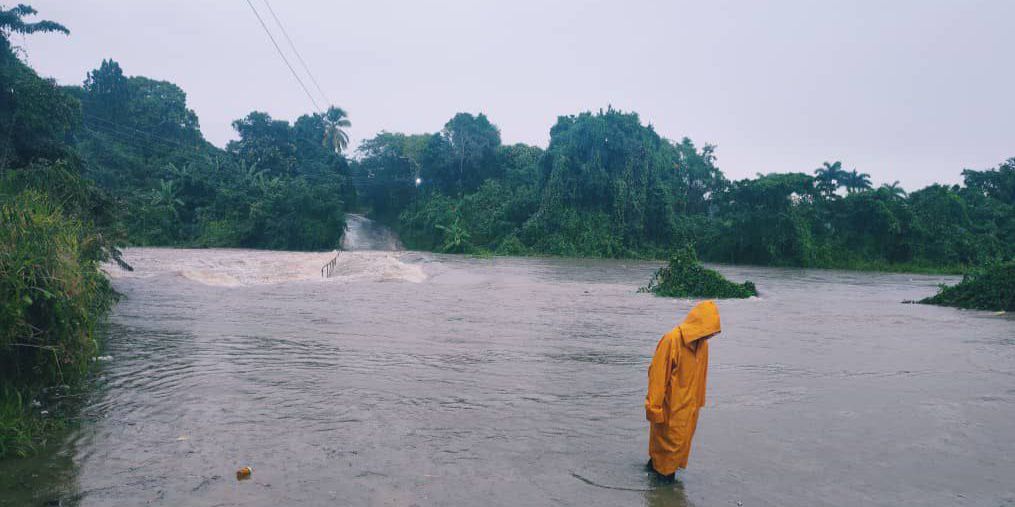
LIMA, Peru – The number of people evacuated exceeds 900 in the municipalities of Sagua la Grande and Cifuentes, in the province of Villa Clara, due to flooding caused by intense rains that keeps two communities inaccessible.
The state Cuban News Agency reported that as a result of the broken bridges, the towns of Larrondo and Mariana Grajales remain isolated, the latter with nearly 2,000 inhabitants.
Official reports from the Provincial Defense Council (CDP) indicate that in Sagua la Grande 17 people remain in evacuation centers and 689 are sheltered in the homes of relatives or friends, while in Cifuentes more than 200 residents are in a similar situation.
At the Mártires del 9 de Abril Hospital, in Sagua la Grande, affected by heavy rains, drainage work with specialized equipment continued until the early hours of the day before.
According to Amaury Machado Montes de Oca, head of the Forecast Group of the Provincial Meteorological Center, the rainfall on December 13 was intense, with records of 156 millimeters (mm) in Sitiecito, 91.8 mm in the Alacranes reservoir and 54 mm in the city of Sagua la Grande.
For its part, the Alacranes dam remained at 68.2 percent of its capacity when it closed last Saturday, without posing immediate danger, although the section of the Alacranes-Pavón magistral canal towards the town of Viana is vulnerable due to abundant runoff.
The current effects worsen even more the panorama on the islandaffected by the passage of Hurricane Melissa at the end of last October. Then, the system crossed eastern Cuba as a category 3 on the Saffir-Simpson scale, after hitting Jamaica as an extreme cyclone. The most affected provinces were Granma, Santiago de Cuba, Holguín, Las Tunas and Guantánamo, with severe interruptions of electricity, telephone, roads and water supply.
The context aggravates the situation: Cuba reaches the end of 2025 after more than five years of crisis with shortages of food, medicine and fuel, high inflation and long daily blackouts, which conditions the speed of recovery in the affected areas.