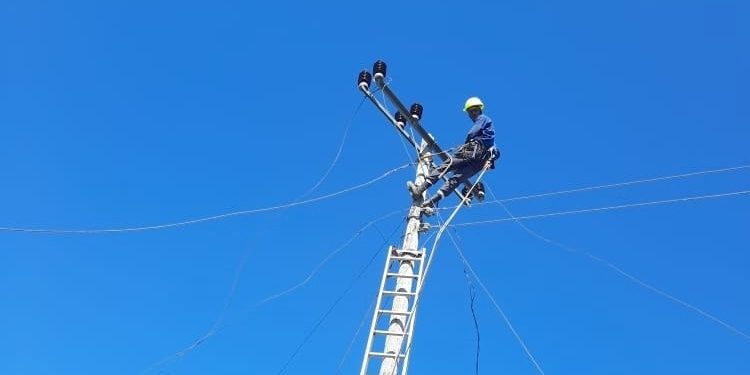
The reconnection occurs after energizing the last of the six high-voltage towers that link the municipalities of Cueto and Bayamo.
LIMA, Peru – The Granma Electric Company reported this Saturday on the completion of reconnection work in eastern Cuba by energizing the last of the six high-voltage towers that link the municipalities of Cueto and Bayamo.
More than 100 specialists and workers from the Electrical Industry Construction Company participated in the work after the devastating passage of Hurricane Melissa, thus preparing the steel lattice structures that support the 220 kilowatt transmitter wiring.
However, although the towers have already been reconnected to the national electroenergy system (SEN), it will be of little use to users, since the crisis in the sector continues in its peak stage, with prolonged cuts in service that are marked by the generation deficit.
The Electrical Union (UNE) predicted for this December 13 that simultaneous blackouts will reach around 56% of the national territory, with an impact of close to 1,915 megawatts (MW) during peak consumption hours.
According to the official report, the maximum capacity planned for peak hours is 1,565 MW, compared to an estimated demand of 3,450 MW, which would leave a deficit of 1,885 MW in the electrical system.
The company points out that six thermoelectric units remain out of service for maintenance or breakdowns, and that dozens of distributed generation engines remain inactive due to lack of fuel and lubricants.
Among the main incidents, the state electricity company reports breakdowns in units 5 and 8 of the Máximo Gómez thermoelectric plant (CTE), and unit 2 of the Felton CTE. Likewise, maintenance is carried out on units 2 and 3 of the Santa Cruz CTE and unit 4 of the Carlos Manuel de Céspedes CTE, in Cienfuegos.
Electricity outages exceed 20 hours a day in eastern provinces, while in Havana blackouts reach up to 10 hours a day. The lack of energy also influences the operation of other services such as water and health, which are of vital importance in the midst of the current epidemiological crisis on the Island.
The energy debaclewhich has been dragging on since mid-2024, is due to breakdowns in obsolete thermal power plants, scheduled maintenance, lack of fuel and lubricants, in addition to the paralysis of dozens of distributed generation engines and poor government management.