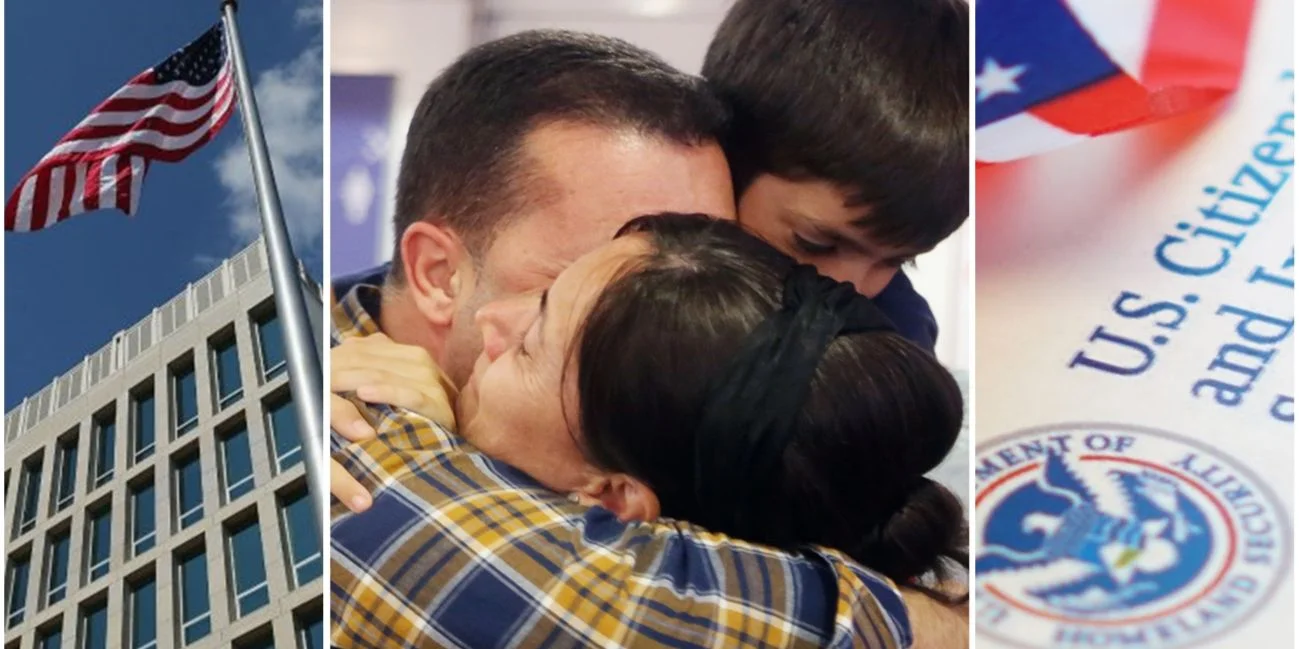
The closure of the program is a direct blow for thousands of Cuban families.
MIAMI, United States. – The United States Department of Homeland Security (DHS) announced this Friday the elimination of family reunification programs (Family Reunification Parole, FRP) for nationals of Cuba, Colombia, Ecuador, El Salvador, Guatemala, Haiti and Honduras.
The decision, which will be formalized in a notice in the Federal Register next mondayrepresents the closure of one of the main legal routes used by thousands of Latin American families to regroup in the United States.
According to DHS itself, the measure seeks to “end the abuse of parole humanitarian”, under the argument that these programs allowed the entry of foreigners with “insufficient verification” and that, in practice, they served to “bypass the traditional process of parole“. “He parole It was never intended to be used this way. We are returning to a case-by-case system, as Congress mandated. It is a return to common sense and the America First policy,” says the agency’s official communication.
The announcement represents a radical change in the immigration policy of the Donald Trump administration regarding family reunification mechanisms. The FRP was designed to allow early entry for family members of U.S. citizens and legal permanent residents while awaiting the availability of an immigrant visa, and became a key tool for migration from Cuba and other countries in the region since the mid-2000s.
Deadline for current beneficiaries
The notice that DHS will send to Federal Register details the termination schedule for those who are already in the United States under the reunification programs: the document establishes that on January 14, 2026, the parole of all people admitted through the FRP, unless they present a Form I-485 (Application for registration of permanent residence or adjustment of status) before December 15 of this year, and that that form is still pending on the court date.
“If he I-485 is duly presented, the parole will remain in effect until a final decision is made on the case, or the parole period expires, whichever occurs first,” the text states. In the event that the adjustment request is denied, the parole It will be terminated immediately and the person must leave the country without delay.
The termination of the FRP also implies the revocation of work permits linked to that status. According to the notice, the federal government will individually notify each beneficiary of both the cancellation of their temporary stay and the loss of employment authorization, which opens the door to a wave of immigration irregularity if people do not obtain another legal avenue before the deadlines.
DHS emphasizes that FRP beneficiaries who have no other legal basis to remain in the United States after the termination of the program must leave the country before January 14, 2026. Those who stay beyond that date, without a pending or approved adjustment of status, may be subject to expedited removal processes and other immigration control measures.
The agency also encourages migrants to report their departure through the CBP Home application. According to the notice, the use of this platform will allow those who meet the requirements to access an “exit bonus”, financial assistance and support in obtaining travel documents, as well as forgiveness of certain civil fines associated with immigration violations.
A blow to one of the main means of reunification for Cubans
The closure of family reunification programs parole It represents a direct blow for tens of thousands of families in the region who had opted for this route as an alternative to irregular routes. For Cubans, in particular, the impact is twofold: the specific program of Cuban Family Reunification Parole (CFRP), operational since 2007, had allowed family members of citizens and legal residents to travel to the United States for years.
The decision means that thousands of pending FRP applications will become void. Families that were already in the country under this mechanism will have to make quick decisions: initiate an adjustment of status before December 15, seek another immigration category or prepare their departure within the deadlines set by the DHS to avoid remaining in an irregular situation and exposing themselves to deportation.