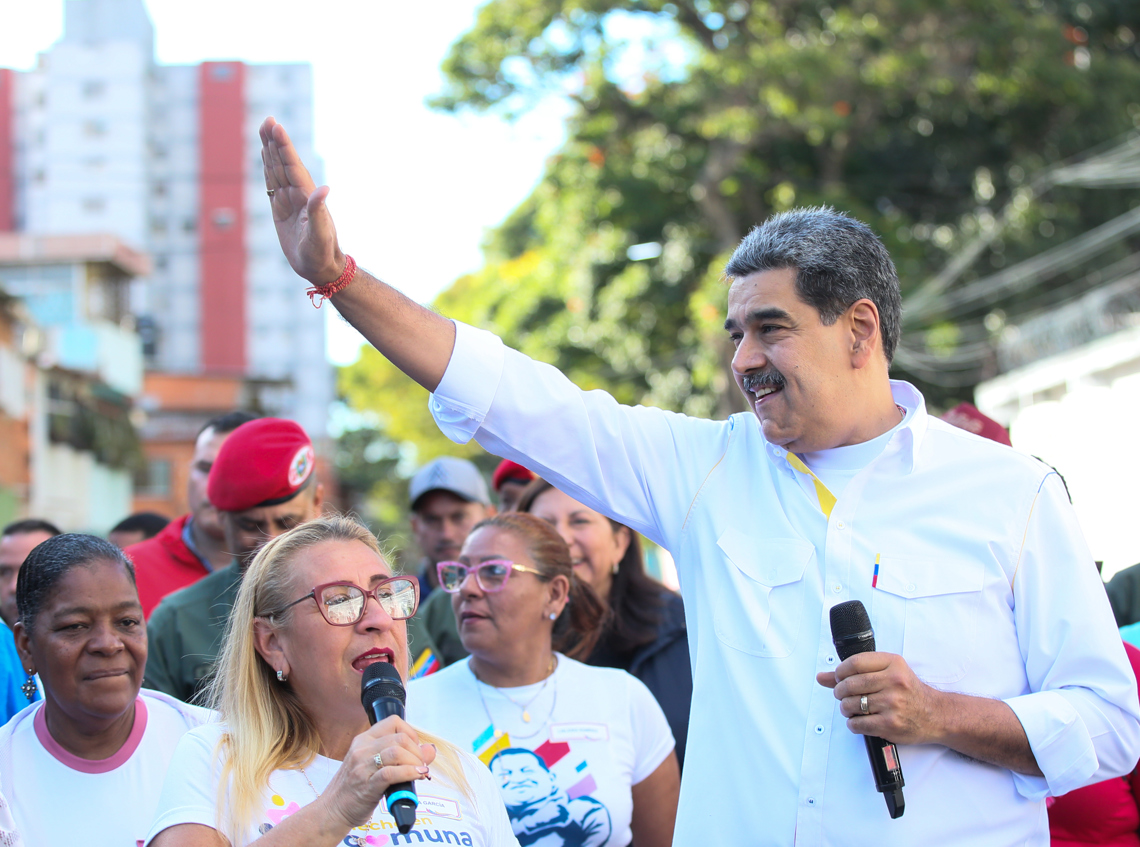
President Nicolás Maduro accused the United States this Thursday of wanting to “steal” the Venezuelan oil after the seizure of a tanker ship in the Caribbean Sea, in what some analysts see as the first test of an air-naval blockade against Venezuela.
“Their mask has fallen (…) it is the oil that they want to steal and Venezuela is going to defend its sovereignty over its natural resources,” he said in an event broadcast on state television.
Maduro described the operation as “criminal piracy” and denounced that the ship’s crew members are “disappeared.” The president announced that Venezuela will file complaints in international bodies to secure its ships and guarantee free trade in crude oil.
Despite the escalation, Maduro affirmed that the destiny of the United States and Venezuela must be “respect, friendship, cooperation” and called on American citizens to “tie the hands of the extremist, supremacist and war-mongering sectors.”
The president insisted that Venezuela will defend its sovereignty and that the confiscation of the ship will not stop the export of oil. “Victory belongs to us today, tomorrow and forever,” he assured.
The Skipper ship and the confiscation
The tanker, identified as Skippersailed under a false flag and transported between 1.1 and 1.9 million barrels of Venezuelan crude oil, according to different sources.
It was intercepted by US forces in an operation with helicopters and speedboats, and taken to a US port so that the cargo could be seized.
Putin supports Maduro after the seizure of the Venezuelan oil tanker by the US
The White House confirmed the operation and noted that there is a legal process for the confiscation of the oil. “The ship will go to a US port and the United States does intend to seize the oil,” said spokeswoman Karoline Leavitt.
According to the American Association of Jurists, it is an “internationally illicit act” and an “act of aggression”, according to UN Resolution 3314/1974, by configuring an invasion and attack on ships of another State.
Furthermore, he pointed out that this action is part of a unilateral escalation by the United States against Venezuela, which includes the air blockade, the military deployment on its coasts and the illegal appropriation of Citgo, a subsidiary of PDVSA, without Caracas having responded with violence.
The seizure occurs after months of US military deployment in the Caribbean, under the argument of combating drug trafficking, for which Washington has intensified operations against suspicious vessels, with at least 22 attacks since September. More than 80 deaths have been left in the operation, considered “extrajudicial executions” by American experts in international legality.
President Donald Trump affirmed that action will soon be taken against land routes to combat drug trafficking from Venezuela, and warned that the airspace over the country should be considered “completely closed.”
For its part, the Pentagon has increased naval, air and land resources in the region, with aircraft carriers, fighters and thousands of marines deployed under Southern Command.
International reactions
The seizure of the ship generated criticism in several countries. UN Secretary General António Guterres expressed “concern” about the operation.
Russia, through its Foreign Minister Sergei Lavrov, asked Washington for explanations, while President Vladimir Putin reiterated his support for Maduro in a phone call.
In turn, Iran described the action as “state piracy” and warned that such behavior will have consequences for international peace and trade. Cuba also expressed solidarity with Caracas, denouncing the seizure as an act of piracy.
María Corina Machado aligns herself with Washington
Maduro also attacked the opposition leader María Corina Machado, who from Oslo —where he received the 2025 Nobel Peace Prize—expressed support for Trump’s military campaign against the Venezuelan government.
“Today he came out applauding and supporting the armed hijacking of the oil tanker carrying Venezuelan oil,” Maduro said.
Under the excuse that Venezuela is already “occupied” by forces of totalitarian regimes – among which he mentioned Russia, Iran, Cuba, Hezbollah, drug cartels and the Colombian guerrilla -, Machado did not reject in Oslo a possible US intervention on Venezuelan territory.
In parallel, the United States Treasury Department announced new sanctions against Maduro’s nephews and six shipping companies that transport Venezuelan crude oil.
Homeland Security Secretary Kristi Noem defended the operation in a congressional hearing, calling it “successful” and part of the campaign to “strike back against a regime that systematically fills our country with deadly drugs.”
Petro criticizes the “invasion”
Colombian President Gustavo Petro questioned that no Latin American leader has reacted to the United States attacks in the Caribbean and the Pacific, which have left dozens dead. “Not a single Latin American president has called another to ask what to do about the fact that we are being invaded,” he said in San Andrés, a resort island 775 kilometers northwest of Colombia’s mainland coast.
Petro, a critic of Maduro for his lack of democratic legitimacy, described the operations as an “invasion” and denounced that “there are no international waters in the Caribbean,” insisting that the people of the region are the legitimate owners of those spaces. His stance has deteriorated relations with Washington, which included him on the sanctions list of OFAC, the US office that is responsible for administering and enforcing US economic and trade sanctions against countries, organizations and individuals considered a threat to national security or foreign policy.