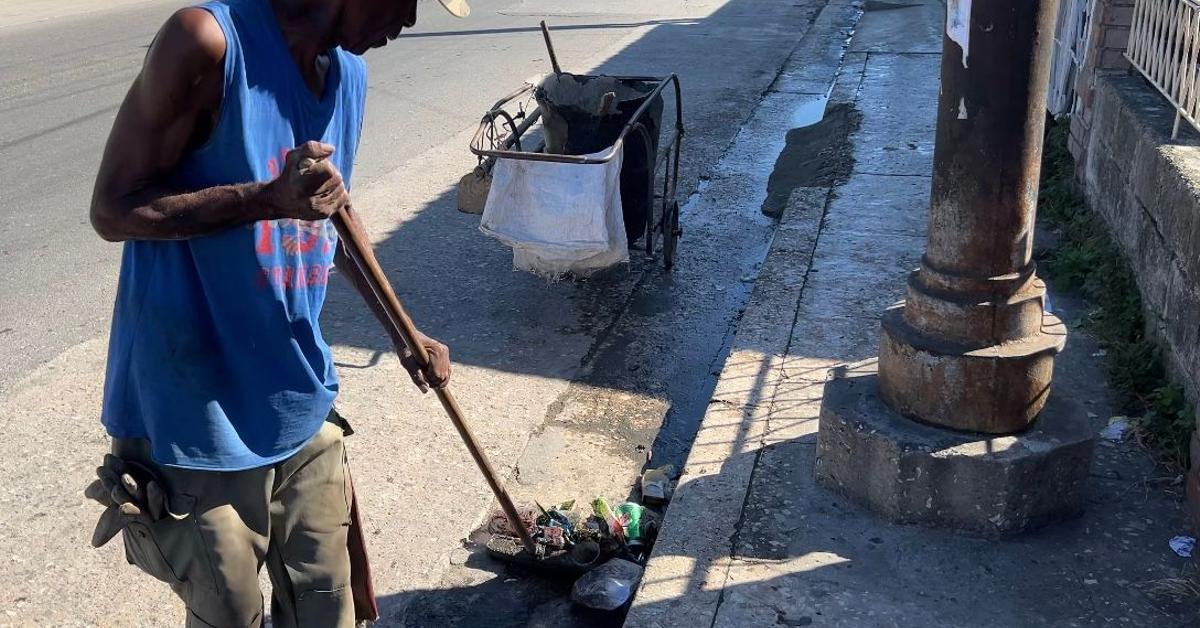
Havana/On the streets of Havana, dirt no longer surprises anyone. What is shocking is to look closely at those who, despite everything, continue sweeping. This newspaper approached two street sweepers who, with broom and dustpan in hand, maintain – as best they can – a public service in ruins. Both are vulnerable, physically worn men for whom trash has become destiny, not choice.
One of them, a Regla worker, explains that he has been in the trade for “a year or so,” working six days a week. His job is to “keep his area clean,” as he himself describes. In practice, it is a daily and unequal fight against the accumulation of waste, a shortage of trucks and institutional apathy. Despite everything, he maintains a certain pride in his town: “Regla is one of the cleanest municipalities,” he says. But his sentence immediately collapses: “People don’t want to work in the garbage.”
According to the authorities, the worst municipalities in Havana are Marianao, Centro Habana and Plaza de la Revolución. The Prime Minister, Manuel Marrero Cruz, recently complained that trucks were not making enough trips to landfills and threatened to review “truck by truck.” The head of government was also “interested,” according to the official newspaper Granmafor the salary of “front-line workers”, some 900 sweepers, but no increase was determined at the meeting, although greater demands were made.
/ 14ymedio
The street sweeper from Regla details his salary to 14ymedio bluntly. The basic one is 2,500 pesos, but it can go up “if you do other sections.” However, he has had hip surgery and can barely walk while leaning on the broom. “I charge 4,000 a month (about nine dollars at the informal exchange rate),” he says, and shrugs his shoulders: “You know what Cubans are like, they adapt with little. It’s not that that’s enough, that’s not enough at all.”
According to him, in the last payment there were those who received between 7,000 and 10,000 pesos, figures that – in the country’s rampant inflation – do not cover basic needs. Truck workers earn slightly more, but collection vehicles are even more scarce than staff.
A second sweeper, this time from Guanabacoa, is deaf and mute and uses signs and gestures to communicate. He has been sweeping for twelve years because “he has no other choice.” When asked about the salary, he makes a gesture of displeasure and lowers his thumb, an unmistakable sign that the pay is miserable. His face, weathered by the sun and fatigue, says more than a thousand words.
Both cases are people with physical or social difficulties, trapped in a job that no one wants. “And who are those who work in the garbage? People like me, who are already old,” acknowledges the street sweeper from Regla. His testimony is a portrait of the country’s deterioration, with aging, sick workers, without job alternatives and hired by an essential service that is falling apart.
In Regla, the worker himself explains, residents have to bring their waste “in a box or a bag” due to the lack of containers and trucks. In other areas of eastern Havana, microlandfills are growing at an accelerated rate.

/ 14ymedio
In contrast to this reality, the bureaucracy gathered in neat offices says that Havana “does not give up comprehensive solutions to improve its services and cleanliness.” The phrase, repeated from time to time, comes with promises of reparations, reorganization, “gradual” implementations and “intersectoral” strategies.
The data shows very poor results. From an identified need for 126 garbage containers (ampliroll), the industry planned 32 with “available resources”, and only 31 have been completed. As for the street sweeper carts (piker), there is a plan to manufacture 1,000 units, but to date 40 have been produced.
The distance between speech and the street widens even further in the face of epidemiological risk generated by the accumulation of garbage. These reports recognize, between the lines, that the problem is not temporary but chronic. The deterioration of the Communal service in Havana is not only due to the lack of equipment or financing. There is a decisive human factor, since there is no one who wants to do the work. The salaries do not compete with any informal alternative, the physical exhaustion is enormous and the lack of means is humiliating. “Personal foul,” repeats Regla’s sweeper, as he walks slowly, with difficulty, leaning on his work tool.