The national survey of Proethics 2025 reveals that the Congress It is seen as the most corrupt institution in the country by 85% of the population. The study, applied in urban areas, also shows that this perception has grown by 25% since 2022 and places Parliament at a critical point.
The report also identifies a worsening of distrust towards the main entities of the State. Citizens evaluate with strong disapproval the PNPto the Public Ministry and to the government of Dina Boluarteconsolidating a scenario of rejection that crosses all regions and socioeconomic levels. This climate contributes to collective pessimism and fuels the impression that corruption will continue to increase in the coming years.
For the majority of Peruvians, the problem is no longer abstract: it affects the family economy, limits access to essential services and deepens the institutional crisis. The conclusions of Proethics They point to a country where institutions lose legitimacy, while citizens assume that the deterioration will be difficult to reverse.
The study also delves into everyday experiences such as bribery, the use of contacts, sexual corruption and the advancement of illicit economies. These factors form a broad picture of how corruption impacts daily life and conditions the electoral scenario leading up to the 2026 elections.
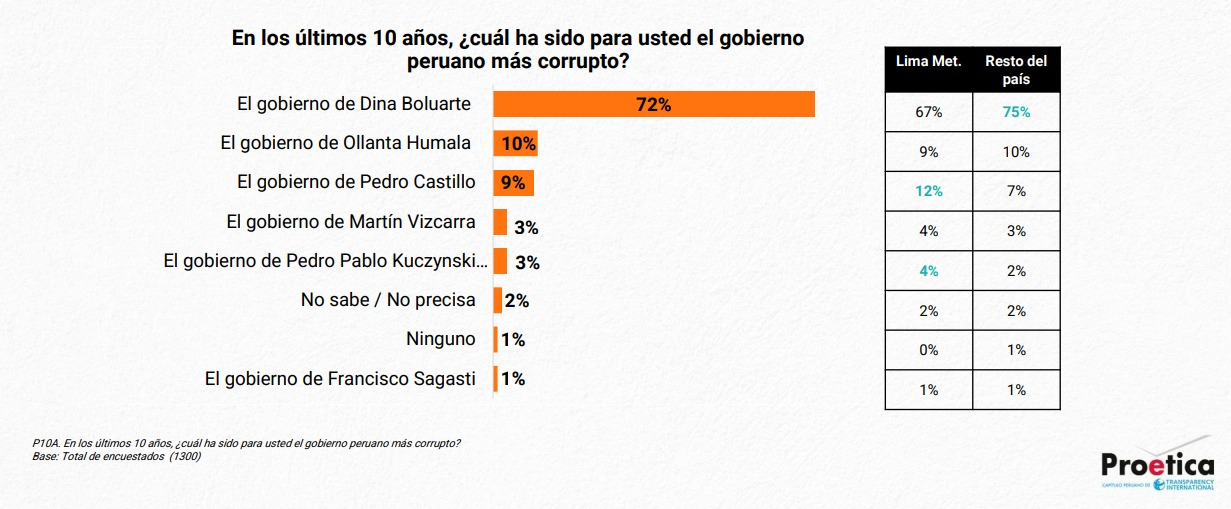
Dina Boluarte’s government is classified as the most corrupt in the last 10 years
The survey shows an almost unanimous consensus: corruption has increased in recent years and will continue to do so. Eight out of ten citizens believe that the situation will worsen or remain the same, reflecting a pessimism that is taking root in all regions of the country. This panorama affects political stability and feeds the idea that the State lacks the capacity to stop the crisis.
The government of Dina Boluarte concentrates an unprecedented level of disapproval. 72% of those surveyed affirm that his administration is the most corrupt in the last ten years, far surpassing past administrations involved in tax investigations. This perception is stronger outside of Lima, where the population feels greater distance from central power.
Distrust also translates into citizen expectations about the immediate future. Most maintain that corruption will continue to affect their daily lives, from access to public services to loss of job opportunities. With this scenario, the institutional crisis is established as a structural problem that conditions the governability of the country.
Public Ministry, Judiciary and PNP are also perceived as corrupt by the population
The survey of Proethics confirms that the Congress concentrates the greatest citizen rejection, followed by Public Ministrythe Judiciary and the PNP. These entities, key in the fight against corruption, appear among the worst evaluated due to their lack of results and their inability to stop abuses, bribery or internal criminal networks.
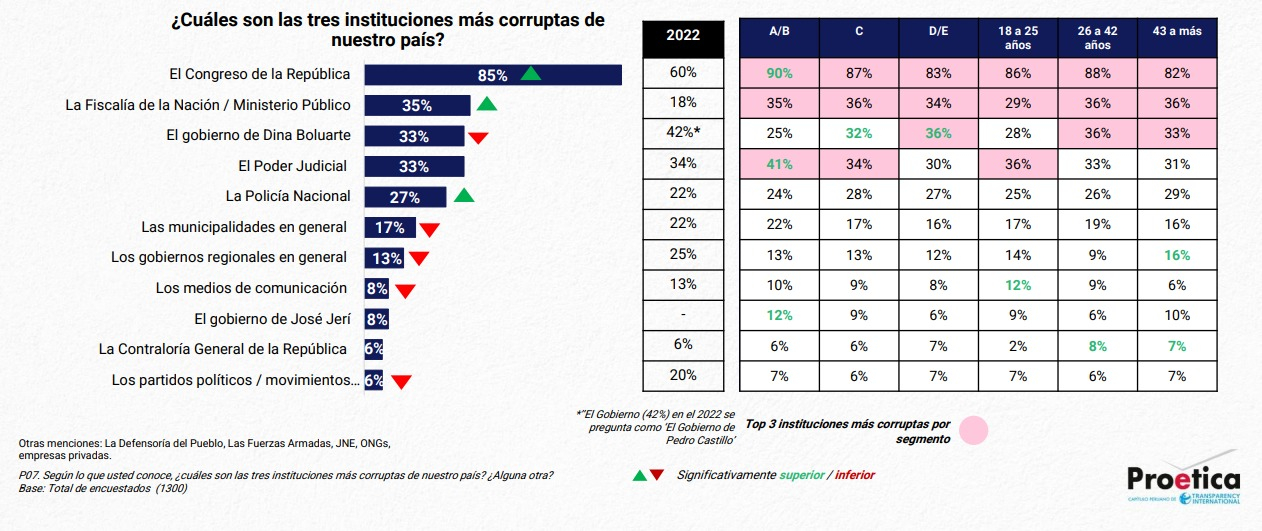
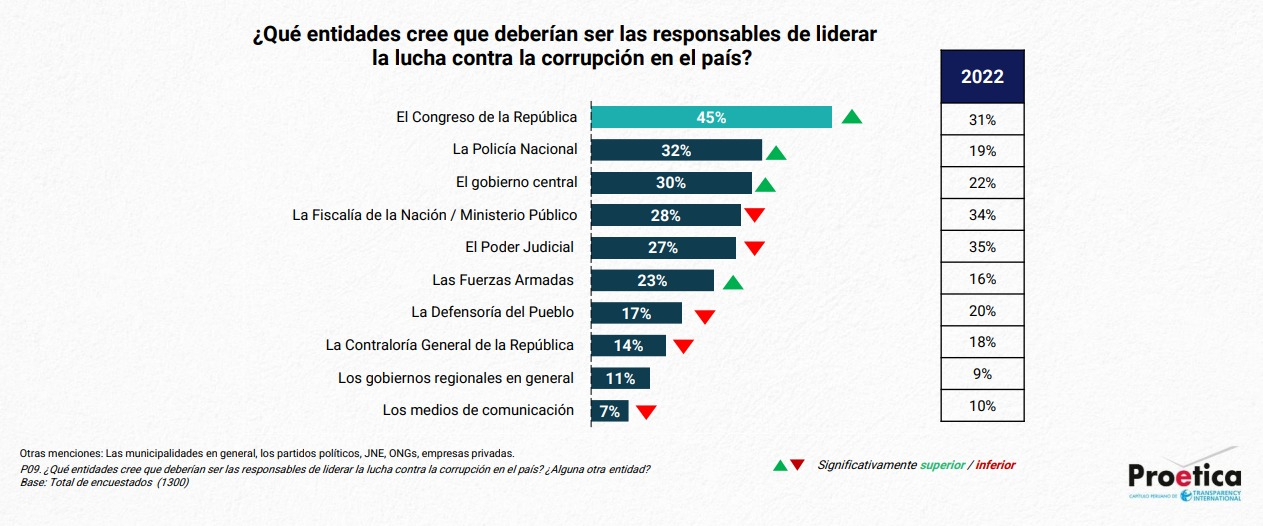
Respondents also consider that the entities that should lead the anti-corruption fight are, paradoxically, the same ones they identify as the most corrupt. Parliament, the Police and the Executive appear as the main people responsible for leading reforms, despite having the lowest credibility indices. This shows a deep contradiction between citizen expectations and institutional reality.
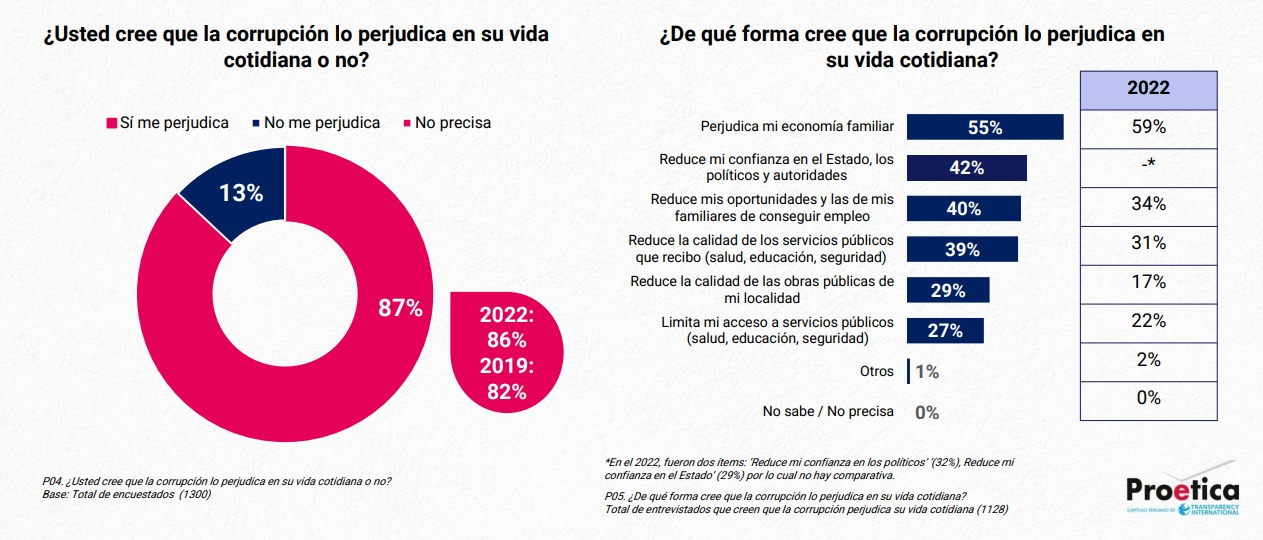
87% of the population blames corruption for the lower quality of life
87% of citizens affirm that it affects their daily lives, especially their family finances and access to public services. The feeling of prejudice is stronger among women, people over 43 years of age and inhabitants of the north and Metropolitan Lima. Citizens associate corruption with poor quality works, poor health and education care, and lack of job opportunities.
The study also shows an externalization phenomenon: while the majority consider Peruvians to be corrupt, almost all perceive themselves as honest. This gap reveals a structural problem in understanding the phenomenon and fuels practices that perpetuate everyday corruption.
In addition, many citizens normalize the use of contacts to resolve procedures or access urgent services, especially in hospitals. These practices, although considered morally questionable, are seen as responses to a slow, bureaucratic and inefficient State.
YOU CAN SEE: Elections 2026: the new faces of the parties for the next elections
Citizenship recognizes that it paid bribes or knows someone who did so in the last year
31% of those surveyed admit to having paid or knowing someone who paid a bribe in the last year. The most common scenarios are State procedures, traffic fines and care in public hospitals. The main trigger is the idea that “if you don’t pay, things don’t work”, a phrase that crudely describes the decomposition of public services.
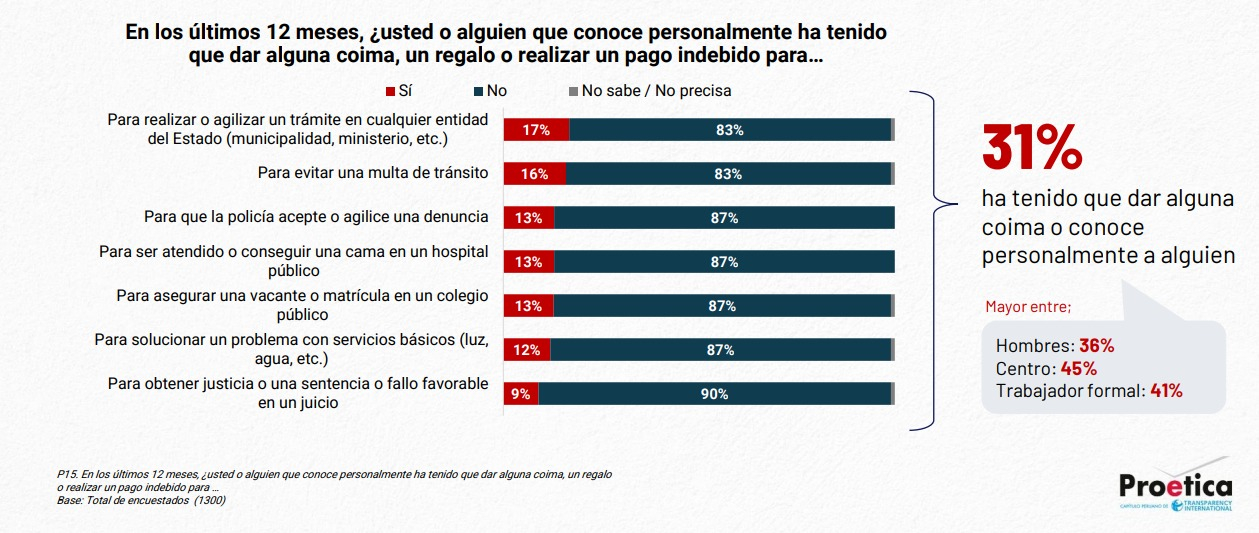
Tolerance towards certain forms of corruption also remains high. Many people find it acceptable to use personal relationships to expedite paperwork or get medical appointments. In contrast, direct bribes to police officers or municipal inspectors generate greater rejection, although even these cases do not reach absolute consensus.
The majority of victims of bribery do not report due to distrust in the system, fear of reprisals or lack of knowledge of formal channels. This lack of complaints contributes to impunity and the persistence of corrupt practices in the State.
YOU CAN SEE: Farmers in Arequipa demand that José Jerí stop Southem operations in Valle Tambo
PNP and educational institutions concentrate cases of sexual corruption
The survey records that 13% of citizens have been a victim or know someone who has suffered requests for sexual favors in the last year. This type of abuse is concentrated mainly in educational institutions and in the PNPwhere a significant risk is reported. Women and young people appear to be the most vulnerable to this type of attacks linked to power.
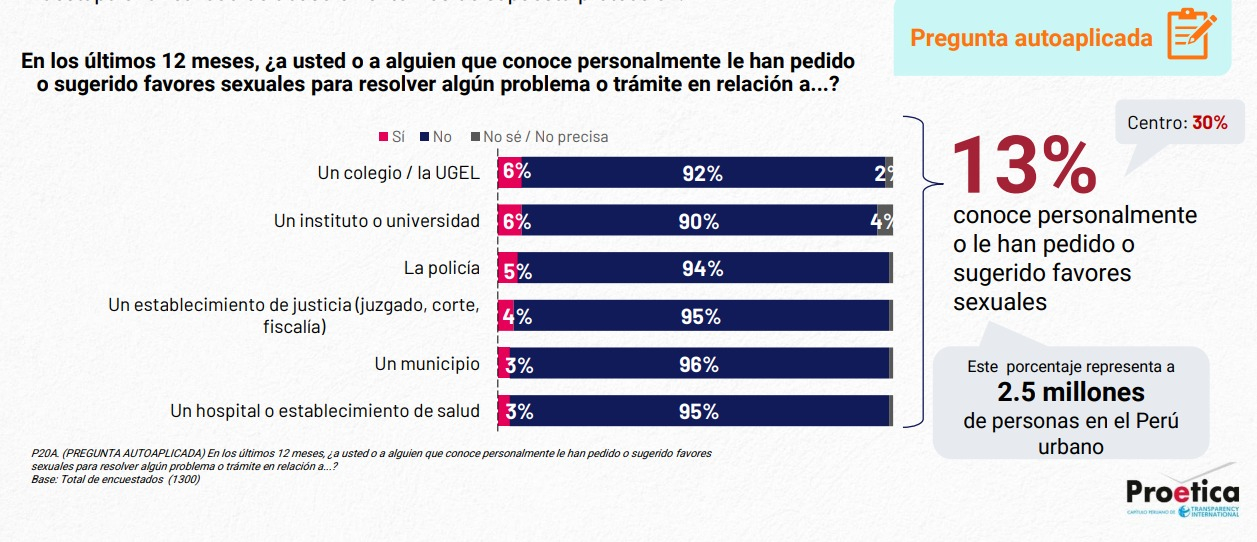
The majority of victims do not report due to fear, mistrust or ignorance. In this case, the fear of reprisals is the main barrier, which generates a circle of silence that facilitates impunity. Sexual corruption is consolidated as an extreme expression of abuse of power, which especially affects vulnerable populations.
This phenomenon also reveals a State that does not guarantee effective protection or sanction mechanisms. Although citizens recognize the seriousness of the problem, the lack of concrete measures reinforces the perception that reporting is useless.
YOU CAN SEE: Tomás Gálvez announces the dissolution of the Lava Jato, Cuellos Blancos and Eficcop Special Teams
Citizenship links illegal mining and drug trafficking with corruption
94% of those surveyed affirm that corruption is linked to illegal economies such as illegal mining, indiscriminate logging or drug trafficking. The majority believes that these activities proliferate due to the weakness of institutions and the lack of state control. Furthermore, four out of ten consider that, in some regions, these economies are the only job option available.
Deforestation and illegal mining are perceived as serious problems that the State is not adequately addressing. More than 90% maintain that no effective measures have been taken to combat these threats, despite their social, environmental and economic impact.
The survey also shows concern about violence against environmental and indigenous leaders. Although many citizens admit to being poorly informed, there is majority support for the creation of protection mechanisms for these people, who often face risks for reporting illegal activities.
YOU CAN SEE: Elections 2026: know the list of the 37 presidential candidates and political parties
Elections 2026: citizens seek honesty in candidates
Heading towards 2026, honesty is the most valued quality in a candidate. This attribute surpasses political experience, efficiency or technical capacity. The crisis of confidence has led to integrity being seen as the main requirement for holding public office.
The survey also registers strong questioning of political parties. Seven out of ten citizens believe that they hide information about the financing of their campaigns. This perception feeds the idea that there is little transparency in electoral processes and that private contributions influence public decisions.
Finally, citizens demand that parties expel their members involved in acts of corruption and establish stricter filters to select candidates. The demand for punitive measures reflects an accumulated fatigue with political impunity.