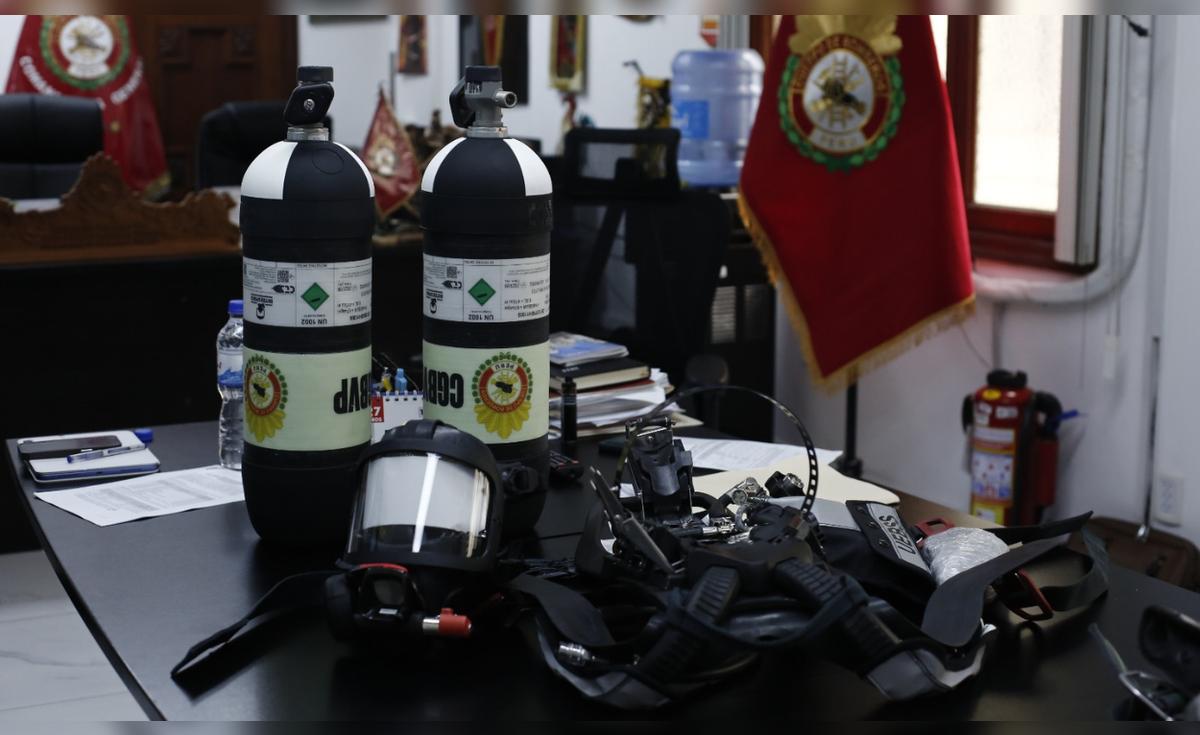
The General Corps of Volunteer Firefighters of Peru (CGBVP) awarded the KPN Peru and KPN Colombia consortiumthe purchase of 500 Self-Contained Respiratory Protection Equipment (EPRA), 800 masks and 400 spare cylinders, for approximately S/15 million, on March 17 of this year.
listen to the newsText converted to audio
Artificial intelligence
Sources from the firefighting organization itself provided La República with documents according to which the company that won the award delivered a heavier cylinder and a different brand, which were not part of the tender.
WE RECOMMEND YOU
DELIA ESPINOZA FIGHTS BACK AND CRITICAL ELECTIONS | WITHOUT SCRIPT WITH ROSA MARÍA PALACIOS
Despite the differences between what was requested and what was acquired, on April 16, the National Fire Department of Peru, represented by Edwin Coraquillo Ayala, signed a contract with the KPN Peru and KPN Colombia consortium.
According to the contract, KPN Peru committed to delivering the breathing equipment within a period of 120 days. That is, by July 16, 2025, the equipment should have already been stored in the warehouses of the CGBVP Logistics Unit, on Salaverry Avenue, in the San Isidro district.
But the KPN Peru did not comply with the agreed date and only supplied the equipment in October of this yearthanks to the extensions granted by the National Fire Department without applying any penalty for lateness, as provided by the regulations. KPN Peru received unacceptable different treatment.
The CGBVP technical team, when reviewing the components purchased from KPN Peru, detected that they did not correspond to the technical specifications of the award process.
According to the technical requirements of firefighters, breathing apparatus (EPRA) must be designed for use by firefighters in indoor structural fires, which must guarantee the user respiratory protection and exposure to high-risk scenarios.
This meant that the air cylinder was one of the most important components.
Those affected. With heavier air cylinders, firefighters will have difficulty operating in an emergency.
Worrying differences
At first glance it seemed that KPN Perú met the technical specifications, so the Selection Committee awarded the acquisition for S/15 million.
The documents indicate that What KPN Peru really delivered to the CGBVP were cylinders whose characteristics correspond to Type 3 and not Type 4 which is what the company offered and for which it won the tender.
La República repeatedly contacted KPN Peru and did not receive a response. This newspaper will insist with the supplier to explain why it supplied equipment different from the one it offered and for which the CGBVP paid S/15 million with public funds.
In addition, the cylinders have a weight of 5.05 kilograms, when KPN Peru offered a weight no greater than 3.9 kilograms.
As if that were not enough, the cylinders were covered with aluminum, when what firefighters need is carbon.
This is verified with the Single Administration Document (DUA), declared by the company KPN Perú, dated October 10, 2025.
The document indicates that KPNP Peru imported Interspiro carbon fiber cylinders covered with aluminum, and not completely carbon.
In addition, the supplier assured that the fire equipment would be imported from the United States. But The cylinders stored in the warehouses of the National Fire Department are manufactured by the company Composite Technical Systems (CTS), from Italy.. They are not DOT-SP 10915 cylinders, whose nomenclature is exclusively manufactured by the Luxer company, in Florida, United States.
Firefighters requested equipment from the United States, not Italy.
The head of the National Fire Department, Juan Morales Carpio, defended the purchase and stated that KPN Peru won due to the price unlike what was offered by the company Sekur Perú.
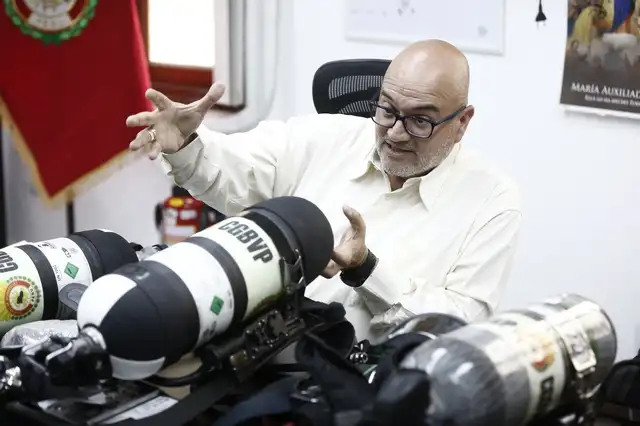
In order. Carlos Malpica of the CGBVP assured that KPN complied with the technical characteristics.
The price contest
These were the proposals presented by the main equipment suppliers:
- KNP Peru: S/ 11,950,568.
- Sekur Peru: S/ 11,962,498.
KPN Peru offered a DOT Super Lihgt -HP cylinder modelultralight, designed for the EPRA with a weight of 3.9 kilograms and constructed entirely of type 4 carbon fiber, without aluminum. With a duration of use of 45 minutes and a useful life of 15 years.
In addition, KPN offered a DOT approved cylinder – SP 10915/T with a certification from the United States Department of Transportation (DOT) that guarantees a series of burst tests, pressure cycles and impact resistance.
With these descriptions, KPN Peru sold the idea to CGBVP of a technologically advanced, lightweight cylinder to reduce firefighter fatigue backed by a DOT –SP 10915 approval with strict tests and trials in the United States. That is, they were offering an American standard cylinder, tested to the highest level.
Carlos Malpica Coronado, general director of Training of the CGBVP, argued that KPN won because it met the characteristics of the bases.
When asked, because The cylinders purchased were covered in aluminum and not carbon fiber as indicated in the technical specifications.Carlos Malpica alleged that both cylinders fulfilled the same function.
“The brand is different, but the cylinder does have DOT certification, it is just that it is not printed on the cylinder because it is not an obligation in a country other than the USA, for that reason the code USA-M 0852 is printed,” explained Carlos Malpica.
YOU CAN SEE: Chilean model Di Mondo: “I left the reality show because they wanted me to work illegally”
Technical requirements of firefighters
- Cylinder manufactured with thin walls and without seams of type 3 or 4. Withstand 4500 psi of pressure and have a maximum weight of 5 kilograms with empty valve.
- Cylinder should be wrapped in carbon fiber with epoxy matrix, carbon coated with a sacrificial impact and abrasion layer. Additionally, it must have wrappers coated with resin or resin-impregnated filament.
- Regarding Respiratory and Protection equipment, they must have accreditation from the National Influenza Protection Association (NFPA) and the National Institute for Occupational Safety and Health (NIOSH), according to the technical bases of the process.