“Once again, those who should promote talent end up stopping it, limiting it and conditioning it…”, denounced the media ‘Pelota Cubana’.
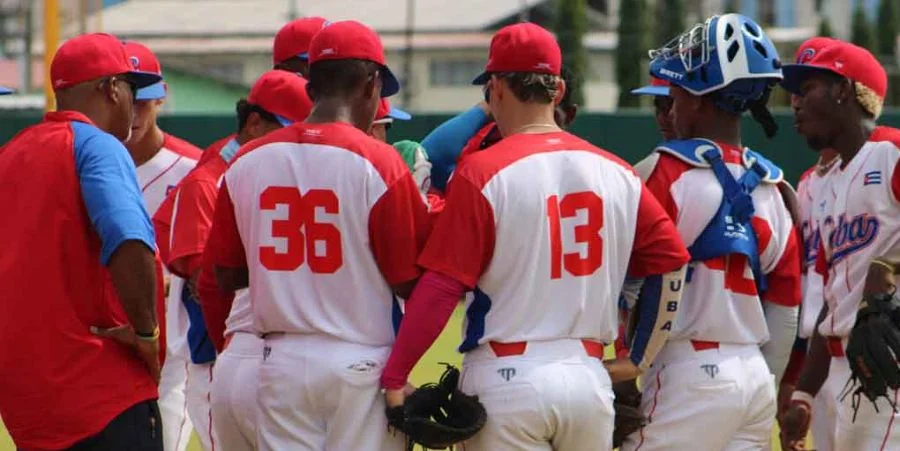
MIAMI, United States. – The Cuban Baseball and Softball Federation (FCBS) establishes itself, by life contract, as the holder of the “training rights” of the players in the under-18 category, which it values at 10 million US dollars (USD).
This is stated in a document titled “Agreement between the Cuban Baseball and Softball Federation and the under-18 category athletes in training”whose images were posted on Facebook for the specialized profile Cuban Ballwhich presents itself as “media accredited by the MLB and the Baseball Writers Association of America (BBWAA).”
“According to official documents obtained by Cuban ball USAthe FCB forces U-18 players in Cuba to sign a contract where the Federation itself is awarded rights over the player’s ENTIRE career… even before the boy becomes of age,” the media denounced.
Furthermore, he stressed that the document “establishes that the FCB has the right to charge up to 10 million dollars for the ‘training’ of the athlete during his professional career” and summarizes the mechanism as follows: “In a few words: the FCB turns each prospect into a token under its control, decides their sporting future and imposes itself as a ‘mandatory agent’ in any international negotiation. That is not development… it is abuse.”
What does the contract say?
On the first page of the contract model released, the “Cuban Baseball and Softball Federation” is identified, represented by its president, Juan Reinaldo Pérez Pardo, as one of the parties. On the other side, space is left for the names of the parents or guardians of the player, defined as “the ‘legal representatives of the athlete’, who jointly exercise the legal representation of the minor, an athlete in training by the FCBS, in the under-18 category.”
The document establishes that the FCBS and the player’s legal representatives recognize his legal capacity to sign the agreement.
Clause I of the contract describes the FCBS as “the federative entity of Cuban baseball, affiliated with the World Baseball and Softball Confederation (the ‘WBSC’)” and notes that the Federation allocates “significant economic, educational and human resources to the training of thousands of athletes in Cuba from an early age, so that they can aspire to become high-performance athletes and elite professionals.”
At that same point, the parents or guardians recognize that, thanks to these efforts, “the athlete in training has accessed and accesses high-level coaches and training in sports facilities prepared for this purpose, as well as first-class academic training, which allows his progression in the high-performance pyramid until becoming a professional athlete without abandoning his education (the ‘Comprehensive Training System’).” As a consequence, they declare that they recognize the FCBS “as the holder of the training rights of the athlete in training throughout his career to date, valued at 10 million US dollars (USD 10,000,000).”
In clause II, the agreement links these training rights with the international projection of the athlete. From the images released, it is observed that the text foresees the possibility that the player “joins or intends to join any professional baseball league in the world” and, in that scenario, the legal representatives recognize the FCBS as his agent.
In the part of that clause that appears on the second page, the contract establishes that the FCBS “commits to ensuring the best interest of the athlete in training in the negotiations carried out with any team of any professional baseball league in the world, and when appropriate, to subcontract or delegate to Cuban and foreign professionals authorized to do so, the exercise of its rights and obligations as an agent.”
Cuban Ball interprets this design as a control mechanism over the player’s future: “The FCB ties young people from the age of 16 or 17 with contracts that no country in the world would allow and that define their path long before their career really begins.”
Clause III introduces the relationship between the contract and the athlete’s participation in national teams. According to the text visible in the document, the FCBS “commits, taking into account the sporting results and physical conditions of the athlete in training, as well as the conditions agreed upon with the teams in which he or she may be or will be hired internationally, to take into consideration the athlete in training in the formation of the preselections and national teams that participate in the highest level international tournaments of each category, offering them greater promotion and international visibility.”
In turn, the legal representatives are obliged to guarantee the participation of the player in the international tournaments to which he is summoned by the FCBS, “to the extent that his international contracts allow it (if applicable), and except for justified cause at the discretion of the FCBS.”
Clause IV defines the consequences of the athlete cutting off the relationship with the Cuban sports structure without the consent of the Federation. The contract indicates that the legal representatives “accept that, in the event that the athlete in training leaves the Cuban pre-selection or selection, or otherwise interrupts his high-performance training in Cuba, to continue it abroad with the objective of joining a professional baseball league, without the express authorization of the FCBS, or fails to comply in any other way with what has been agreed in this AGREEMENT, he will have caused serious damage to the Comprehensive Training System.”
In such case, the Federation “may demand from the legal representatives of the athlete, or from the athlete in training once the age of majority has been reached, compensation for the training rights described in section I.” The payment of this compensation, the document details, will be paid directly by that party or “through an interested third party.”
The contract adds that the parties “recognize and accept that the right of compensation recognized in favor of the FCBS may be assigned by it, without requiring prior consent from the other Party to the Agreement.” That is, the Federation reserves the possibility of transferring its right to collect up to 10 million dollars in training fees to a third party.
Clause V establishes that the “agreement, its terms and any information that is exchanged between the parties, prior to or as a consequence of this, will be considered[n] ‘confidential information.’” Unless legally required, this information “may not be revealed to third parties without the prior authorization of the other party.”
Cuban ball summarizes the effect of the agreement in very harsh terms: “Once again, those who should promote talent end up holding it back, limiting it and conditioning it… while the ballplayer’s dream remains in the background.” The media concludes with a question addressed to the Federation: “The question is hard: how can a Federation that claims to ‘protect the athlete’ justify a contract that imposes 10 million dollars on a minor and forces him to hand over his future as a teenager?”