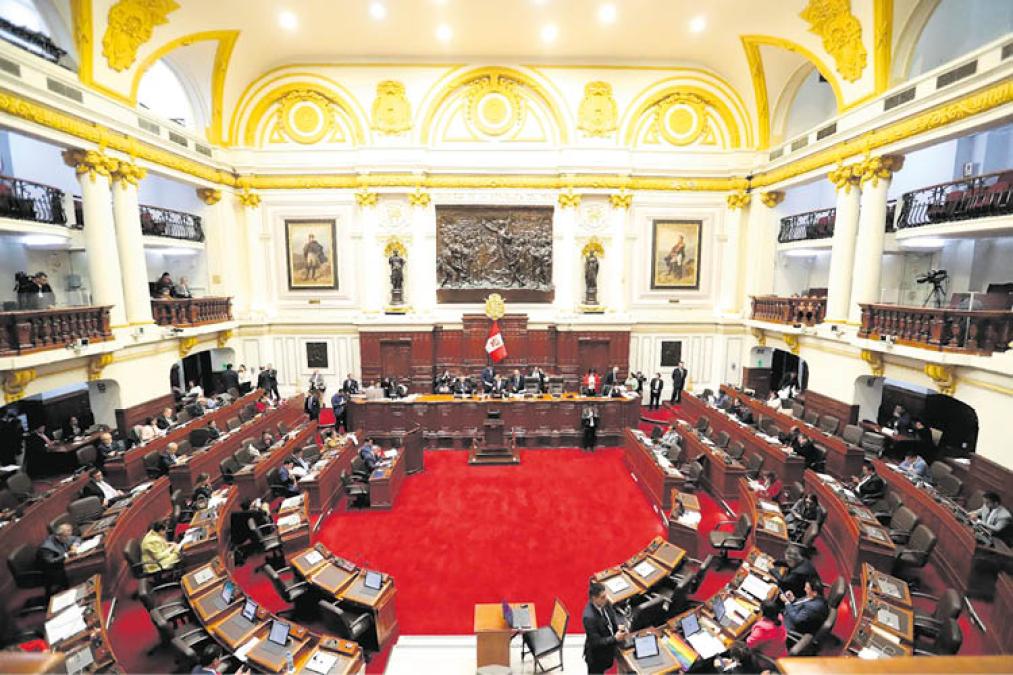
It’s hard to believe, but in a Congress marked by constant disputes and fragile alliances, the issue that has managed to weave unexpected coincidences is precisely that of the expansion of the Comprehensive Registry of Mining Formalization (Reinfo). In a scenario where almost everything generates clash or rupture, the defense of this pattern—and the mechanisms that sustain it—has operated as a silent glue between groups that on other issues have been public enemies.
Far from remaining a provisional tool to organize small mining, Reinfo ended up becoming an axis of parliamentary cohesion. In a deeply fragmented Legislature, it has become one of the few issues capable of articulating sustained majorities and activating agreements that are rarely seen in other debates. In the last four years, 14 bills have been presented aimed at extending deadlines, making conditions more flexible or reopening the registry, promoting illegality.
It has not been necessary to show one’s face or raise a flag in favor of illegal mining to support the initiatives presented since 2021. The faces and groups that promoted the regulations that have allowed the registry to be extended for the fifth time and those few who were staunch opponents of Reinfo and its dangerous tentacles have already been identified. But it is the hidden actors that have played a determining role.
A systematic review of projects, authors, signatures and votes processed through the Dapper platform for Perú21 allows us to identify that the groups of Juntos Por el Perú-Bloque Magisterial (JPP-BM), Perú Libre, Podemos Perú, by José Luna Gálvez, and Acción Popular shared the presentation of these 14 projects, approaches that did not seek to reform the system, but rather to preserve it.
Precisely members of these parliamentary groups are linked to regions where informal mining is a central economic actor.
THE ALLIES
The names that appear the most as authors of these projects are those of Wilson Quispe and Víctor Cutipa, the current president of the Energy and Mines Commission, both from the JPP-BM bench, who have put their signatures on five of these initiatives. Jorge Coayla (4) and the former Castilian minister Roberto Sánchez (3) also appear from this parliamentary group.
Another frequent promoter of projects to protect illegal mining is Guido Bellido, who in his time on three benches – today in Podemos – has participated in the presentation of four proposals, and Jaime Quito (3) from the socialist bench.
But not only the extreme left did its generous part to please the interests of illegal mining. At the time when they were part of the acciopopulist bench, Jorge Flores Ancachi, Elvis Vergara, Juan Carlos Mori, Luis Aragón, José Arriola and Edwin Martínez joined their signatures on a project that gave respite to those who had no intention of becoming formal. The list of authors and composers who sang to the Reinfo extension also includes Digna Calle Isabel Cortez and Luis Picón, in addition to the two-time vice president of Congress, Waldemar Cerrón, from Perú Libre.
There have been 35 congressmen who have authored at least one bill in favor of illegal mining.
But there are 130 legislators. Since the first project of the four approved on the Reinfo there are groups that never supported initiatives, but spoke when voting in the Plenary and influenced the approval of these favors for illegal mining.
Thus, when the Plenary discussed these four projects — 09597/2024 (Law that guarantees the continuity of the formalization process of small and artisanal mining), 09579/2024 (which extends the Reinfo term until the promulgation of the ASM law), 09393/2024 (which establishes a new registration period in the Reinfo) and the law that restructures the registration in the Reinfo — something happened that rarely happens in a fragmented Congress: an almost automatic majority is created.
In addition to the left-wing groups that proposed these regulations and supported them in the plenary session, others such as Fuerza Popular always voted in favor and always as a block, ensuring between 18 and 23 votes for illegal mining. Something similar was the behavior of Renovación Popular and its 13 votes in support of the extension of mining informality and of Alianza Para el Progreso. Podemos Peru supports the initiatives without hesitation. Popular Action remains favorable despite some fractures. Even the smallest benches added votes so that the expansions advance without major resistance.
It was only this last Thursday that some benches were divided after voting separately on the proposal to extend the Reinfo until December 2026, one year less than that proposed by those in favor of illegal mining (approved) and, on the other, that of seeking to reincorporate the 50,000 miners already excluded from the process (rejected).
ON ANOTHER LANE
For Augusto Rey, country manager in Peru for Dapper, Congress maintains a stable political majority in favor of making Reinfo more flexible, a majority that does not appear in the speeches or ideological confrontations that dominate day-to-day life, but that is expressed in legislative events.
“It is a coalition that transcends the left and the right; it integrates provincial, magisterial and conservative benches, and finds in the indefinite expansion of this mining registry an extraordinary point of coincidence in a context of political fragmentation. It is not an improvised majority: it is structural. The logic is evident: to keep alive a registry that began as a temporary mechanism, but that in practice operates as a permanent system whose cumulative expansion compromises the State’s ability to order mining activity,” says Rey.
The Dapper manager believes that the Executive, this one and the next, should observe this dynamic carefully, because “while public opinion discusses the need to formalize mining that is not yet formalized and combat illegal mining, as well as deforestation and environmental crime, Congress is moving along another track, quieter, but more effective, building by accumulation a permanent reform of the Reinfo.”
Receive your Perú21 by email or WhatsApp. Subscribe to our enriched digital newspaper. Take advantage of the discounts here.
RECOMMENDED VIDEO