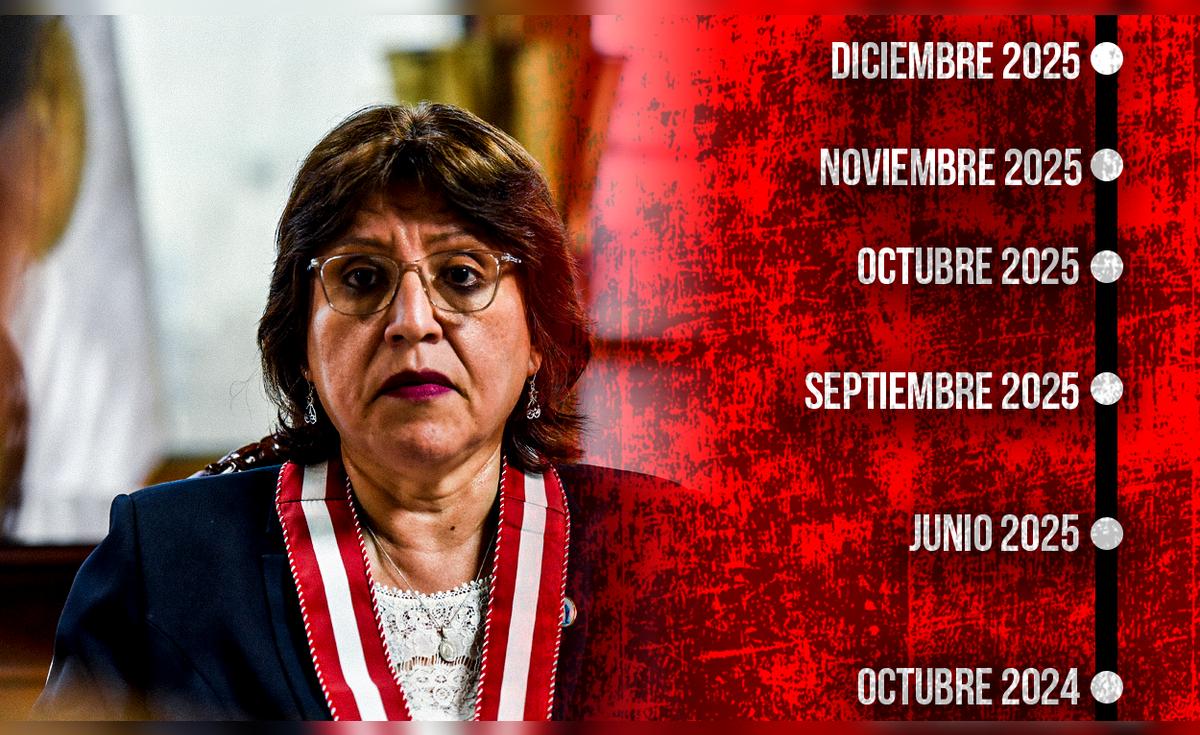
Delia Espinoza, the chronicle of the disqualification and announced suspension of a prosecutor of the Nation. Espinoza Valenzuela was left out of the Prosecutor’s Office – for now – due to the sanction that Congress imposed on him for 10 years for not exercising public office and the suspension that the National Board of Justice (JNJ) imposed on him for 6 months and which was never lifted despite the fact that the Ninth Constitutional Court granted him a precautionary measure to return to the Public Ministry.
listen to the newsText converted to audio
Artificial intelligence
It all began on Monday, June 16, the day that the now supreme prosecutor, Patricia Benavides, went to the Prosecutor’s Office headquarters to resume her position after a questioned decision by the JNJ. At that time, it was reported that said resolution supposedly did not have all the necessary signatures of the Plenary of the JNJ to endorse the return of Benavides. For that reason, Benavides did not return to the institution.
WE RECOMMEND YOU
DELIA ESPINOZA FIGHTS BACK AND CRITICAL ELECTIONS | WITHOUT SCRIPT WITH ROSA MARÍA PALACIOS
In this context, the JNJ, on September 5 of this year, the vice president of the entity, María Teresa Cabrera, proposed the suspension of Espinoza. It was decided to apply this measure against Espinoza for “having ignored” the replacement of Benavides as prosecutor of the Nation and that he remained as head of the institution “illegally.” Likewise, the JNJ detailed, Espinoza “instigated the fiscal and administrative staff of the Public Ministry on June 16 on the 9th floor of the institution.”
On September 19, the JNJ evaluated said suspension request against Espinoza. At said hearing, the National Prosecutor defended herself. “It is a forced disciplinary procedure,” he claimed.
One day later, on September 20 of this year, the attack against Espinoza was completed. The JNJ decided to suspend Delia Espinoza for 6 months.
That same day, the government led at that time by Dina Boluarte, decided to withdraw the police security designated for Espinoza.
On September 26, a precautionary measure was presented that sought to annul the suspension against Espinoza. The Ninth Constitutional Court, through Judge Juan Torres Tasso, was the one that evaluated and decided on said request.
On Monday, October 13, the judicial plot between Delia Espinoza, the JNJ and the Judiciary began. That day, the Court granted the precautionary measure to Espinoza and ordered his reinstatement as prosecutor of the Nation.
On the 15th of the same month, the JNJ announced that it would abide by the ruling, but that it would appeal. The Judiciary, in order for its decision to be carried out, granted 5 days to the JNJ.
However, on September 22, the JNJ decided not to reinstate Espinoza, stating that they do not have the authority to reinstate her as prosecutor of the Nation because it is the responsibility of the Board of Supreme Prosecutors. However, in the case of Benavides, they themselves bypassed the JFS.
On October 30, the Ninth Constitutional Court granted an appeal filed by the JNJ against the resolution of the amparo action that ordered the reinstatement of Espinoza.
On November 10, the Judiciary gave the JNJ two days as a maximum period to comply with replacing Delia Espinoza as prosecutor of the Nation. According to the Court, the JNJ did not comply with the precautionary measure that ordered his return.
In parallel, the JNJ continued to investigate Delia Espinoza. On November 12, he summoned Espinoza on the 17th of the same month to testify for an alleged obstruction to Benavides’ return to the Prosecutor’s Office. However, he did not attend said summons.
However, on November 18, something unusual happened. The Ninth Constitutional Court of Lima, led by Judge Juan Torres Tasso, once again notified the JNJ of its decision because it had made a mistake when notifying that said institution has two days to comply with the judicial order.
That same day, the JNJ filed a jurisdictional lawsuit before the Constitutional Court (TC) to stop Espinoza’s reinstatement in the Prosecutor’s Office. According to the JNJ, the Judiciary committed a “undermining of powers” by intervening in Espinoza’s disciplinary process.
On the 21st of the same month, the JNJ requested a precautionary measure from the TC to stop the amparo action that Espinoza presented to return to the Prosecutor’s Office. According to the JNJ Attorney General’s Office, Judge Torres Tasso “seriously affects the powers and powers” of the institution by suspending the disciplinary process that was opened against Espinoza.
On November 25, the Judiciary granted two more days to the JNJ to replace Delia Espinoza as prosecutor of the Nation. This despite the fact that the deadline initially granted was met. According to the Ninth Constitutional Court, this notice to the JNJ was “for the last time” to execute its decision.
On December 2, something unexpected happened. Judge Torres Tasso asked the TC for information on the jurisdictional claim filed by the JNJ. According to Espinoza, “it was to save time.”
However, this reinstatement never materialized because Congress disqualified Espinoza for 10 years.
Congress also played its part against Delia Espinoza
On October 24, 2024, congressmen Fernando Rospigliosi (Fuerza Popular), José Cueto (Honor and Democracy) and Alfredo Azurín (Somos Perú) presented constitutional complaint 528 against Delia Espinoza, Juan Carlos Villena, Pablo Sánchez and Zoraida Ávalos.
The reason was for allegedly having committed the alleged abuse of authority, prevarication, generic falsehood and usurpation of functions by ignoring law 32130 that empowers the PNP to carry out the preliminary investigation of a case.
Six months later, on April 8 of this year, the Subcommittee on Constitutional Accusations (SAC) approved the report that recommended disqualifying the supreme prosecutors from public service for 10 years.
However, on May 23, 2025, the Permanent Commission granted the SAC 15 more days so that they could carry out a broader investigation and present a final report.
On July 18, a hearing was held at the SAC, in which the accused attended together with their lawyers to exercise their right to defense for the alleged acts.
Four months later, on November 18, the SAC agreed by majority to approve the final report against the supreme prosecutors to disqualify them and lift their jurisdiction to be investigated by the Public Ministry.
However, on the 25th of the same month something unusual happened in the Permanent Commission. From this report, which included the 4 prosecutors, only the votes were reached to disqualify Delia Espinoza.
According to the report, it was proven that in the issuance of Resolution 2246-2024-MP-FN, there were provisions contrary to Law 32130 approved by Congress and which empowers the PNP to investigate a case. However, this document does not show that Espinoza Valenzuela has signed.
The suspended prosecutor denounced on multiple occasions that Congress had plotted to disqualify her for something she did not do.
Finally, the key day arrived: December 3, 2025. Delia Espinoza went to Parliament to defend herself with her lawyer. The Legislature debated and voted on the report. However, he did not obtain the 68 votes necessary to disqualify her. Fujimori, APP, Perú Libre, Renovación Popular and allies only reached 63.
However, two congressmen, Norma Yarrow (Popular Renewal) and Jorge Montoya (Honor and Democracy) presented reconsiderations of the vote as part of a last attempt to disqualify her.
And so they achieved it, the Plenary Session of Congress approved with 71 votes in favor, 17 against and 3 abstentions to disqualify Espinoza for 10 years.