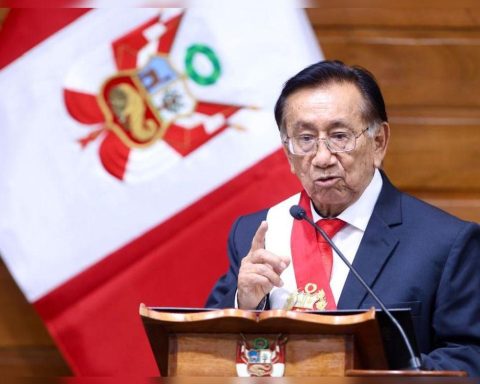
The Constitutional Court (TC) declared unfounded, due to lack of votes, the claims of unconstitutionality presented by the Lima Bar Association and the Public Ministry against the Congress of the Republic for the Law that prescribes crimes against humanity (Law 32107), the norm that limits the application of crimes against humanity and allows the statute of limitations for crimes committed before 2002. With four votes in favor and three against, the TC It did not reach the five votes necessary to annul the law, so it remains in force.
listen to the newsText converted to audio
Artificial intelligence
The votes of the magistrates Pacheco Zerga, Morales Saravia, Ochoa Cardich and Hernández Chávez allow the norm to be constitutional, while Domínguez Haro, Gutiérrez Ticse and Monteagudo Valdez They spoke out against this decision through their vote.
WE RECOMMEND YOU
DELIA ESPINOZA FIGHTS BACK AND CRITICAL ELECTIONS | WITHOUT SCRIPT WITH ROSA MARÍA PALACIOS
After learning of this ruling, the criminal lawyer Caesar Azabache He pointed out that it does not prevent judges from disapplying the law in specific cases. “The TC has declared the lawsuit against the law on the statute of limitations for crimes against humanity unfounded due to lack of votes,” he said.
“But this does not prevent it from being applied: the application is based on a previous ruling, from 2001, issued by the Inter-American Court of Human Rights. This ruling, that of the TC, which declares insufficient votes to rule, is not enough to remove the binding nature of the ruling of the Inter-American Court,” he added through his social networks.
For its part, Gisela Ortizformer Minister of Culture and sister of one of the victims of the case La Cantuta, He warned that the next steps of Congress and its allies will be aimed at consolidating the effects of the so-called Amnesty Law, a norm that, according to him, ends up benefiting those convicted of human rights violations and creating a scenario in which impunity could prevail.
“What it does is weaken the TC much more than defending other political favors and not defending the law or norms and even less human rights. I think that this should be made evident. It is more of a favor to benefit human rights violators. The risk is for the new processes that the Prosecutor’s Office has and that can no longer accuse them of crimes against humanity and the courts of justice can no longer convict. The lawyers of the accused will rely on this decision of the TC,” he declared for this medium.
Along the same lines, the Executive Director of Fedepaz, David Velascopoints out that “in the vast majority of cases, the judicial bodies have already ruled that this statute of limitations by violating the Inter-American Convention on Human Rights is not applicable and I consider that in the face of new attempts they will reiterate that position, pointing out that there is no internal norm (not even a Judicial or TC Resolution), not even of a constitutional nature that can contradict an international treaty, much less a human rights treaty.”
CNDDHH rejects decision of the Constitutional Court
The National Human Rights Coordinator expressed its rejection of the recent ruling of the Constitutional Court that declared unfounded the lawsuit against the Law that prescribes crimes against humanity, a rule that allows the prescription of crimes committed before 2002. According to them, the decision directly affects the processes linked to serious human rights violations committed during the internal armed conflict.
“This ruling ignores the pronouncements of the Inter-American Court of Human Rights and ignores the warnings of prosecutors specialized in human rights, who have indicated that these crimes are imprescriptible and cannot remain without justice,” they noted.
With the decision of the Constitutional Court to declare the lawsuits against Law 32107 unfounded, it opens the way for crimes committed during the internal armed conflict, such as the cases La Cantuta, Barrios Altos, El Santa, Pativilca, Accomarca, Putis, inter alia, may be declared time-barred, which could harm ongoing investigations and trials for serious human rights violations.
The ruling of the TC also strengthens the position of the Congress in front of the judges, since Law 32107 obliges the judicial authorities to apply this temporal criterion directly. With this, the door is opened for defendants in these emblematic cases to request the prescription of their processes, as mentioned Gisela Ortiz. This would pose a scenario in which Prosecutors’ Offices and courts could see their ability to continue investigating events that international law considers imprescriptible restricted.