Pedro Castillo He had planned the coup d’état a day before announcing it. It was not an impulse given the revelations made by Salatiel Marrufo, the former advisor to the Ministry of Housing who confirmed before Congress that the former president received monthly bribes of S/50,000. That statement only hastened the execution of the plan, which did not turn out as the now convicted ex-president and his henchmen expected on December 7, 2022.
Yesterday, the Special Criminal Chamber of the Supreme Court made public the writing of its historic ruling and establishes that the Chotano professor had the premeditated intention of attacking democracy by taking power by force.
On December 6, 2022, three years ago, Castillo met overnight at the Government Palace with his premier Betssy Chávez and his advisor Aníbal Torres to, according to the judicial resolution, “coordinate the preparatory and executive acts to attack the Powers of the State.”
It was proven that that Tuesday they created a Word file called “message.docx”, which they accessed at 3:52 am and was modified at 6:42 am the next day, hours before the president read it to the entire country.
Desperation had taken over the Chotano professor and his leadership. In the first week of that December, they were exposed to sustained acts of corruption.
Businesswoman Sada Goray told the press that she paid S/4 million to Salatiel Marrufo, at the request of Castillo Terrones, in exchange for the Housing sector granting real estate projects to her company Markagroup.
Meanwhile, José Luis Fernández La Torre, head of the National Intelligence Directorate (DINI), assured that the president asked him to remove his secretary Bruno Pacheco and his nephews Fray Vásquez and Gian Marco Castillo from the country. All involved in the illegal distribution of contracts and public works.
And the cherry on the cake was the explosive demonstration that Marrufo shared with the Congressional Oversight Commission.
While the former advisor narrated the circumstances in which cash was delivered to the head of state, he once again summoned his trusted people to the Palace and began to give the disastrous message to the nation.
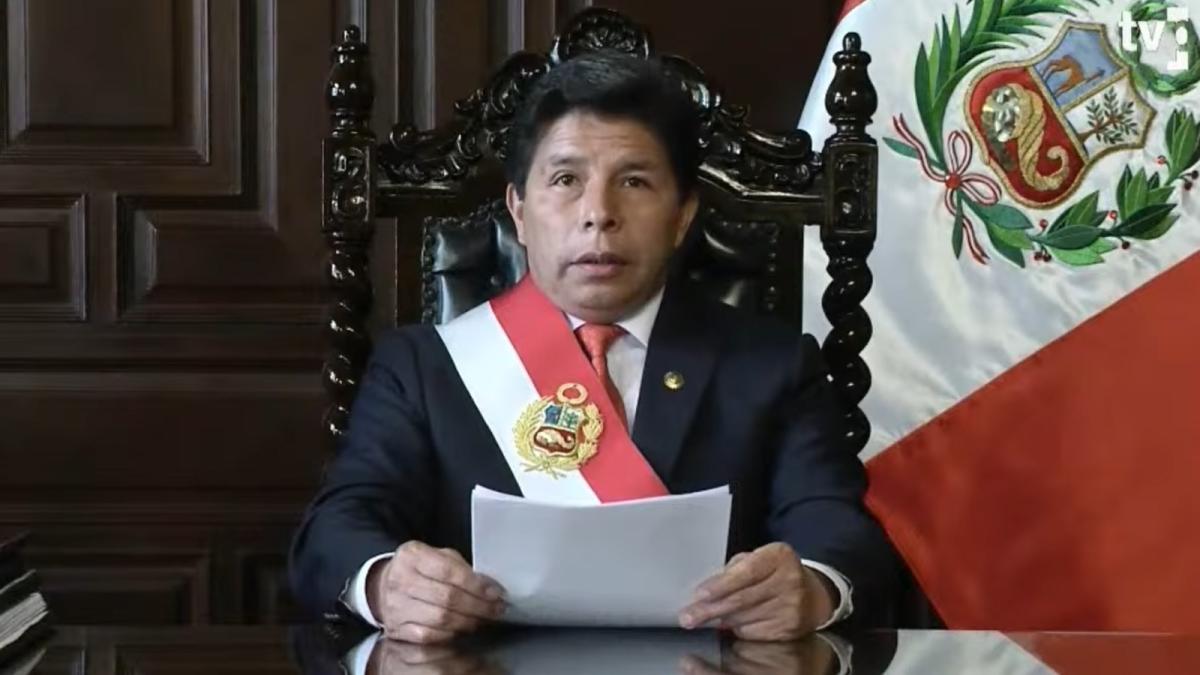
In his speech, Castillo announced the imposition of a “government of exception”, the temporary dissolution of Parliament and the reorganization of the justice system that had him against the wall.
To achieve the latter, he ordered the capture of the nation’s then prosecutor, Patricia Benavides, according to the testimony of former PNP commander Raúl Alfaro.
The retired general said that he received the order from the president himself through a phone call that initially involved the Minister of the Interior, Willy Huerta.
Due to this complicity, Huerta’s participation in the criminal acts was corroborated.
In addition, the now sentenced former ruler decreed a nationwide curfew, which meant the taking over of the streets by law enforcement.
However, neither the Police nor the Armed Forces paid attention and Castillo only had to flee. He could not go very far, when he was escaping towards the Mexican embassy he was detained by the Police and since that moment he has not been free again.
Special report
The supreme court concluded that the coup did not materialize because there was no uprising, but the crime of conspiracy to rebel was committed.
The constitutionalist Aníbal Quiroga told Cecilia Valenzuela on Perú21TV that a coup d’état is not carried out in 24 hours but requires a fraction of time and a set of wills.
“What I have seen, that day, is a person eager to start, a person who urges the speech to begin, a person totally aware of what he was doing and what he wanted to do. Whether he was wrong or that he had not measured the magnitude of what he was doing is another thing but he was aware that he wanted to say it, that he wanted to do it and he wanted to assume those omnipresent powers, because there is a common element in a coup d’état (…) which is to close the congress,” he said in the special that will be published this Sunday on all digital platforms. from Peru21.
Castillo, Chávez and Huerta received 11 years, 5 months and 15 days in prison. Torres, meanwhile, was sentenced to 6 years in prison.
For psychologist Jorge Yamamoto, it was already clear that the Cajamarcan teacher received help because the message used technical terms.
“That speech could not have been made by Castillo, it is too sophisticated and prepared. That does not mean that he was not to blame, he commissioned it and was part of it,” he said on Perú21TV.
This is an exemplary sentence that warns those who try to put democracy at risk again, what could happen to them.