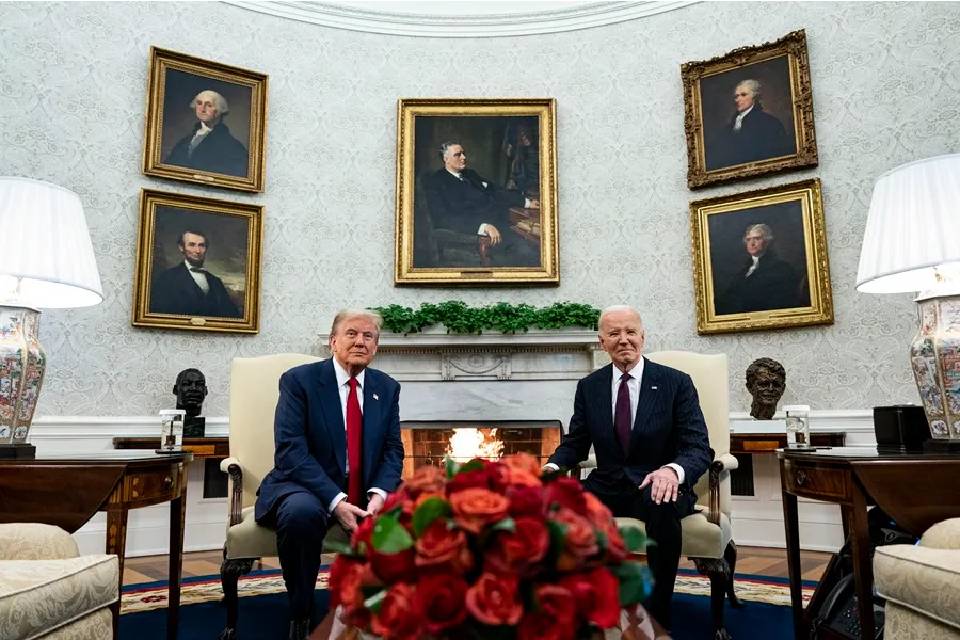
The new National Security Strategy of the United States, published in November 2025 by the Donald Trump administration, marks a frontal break with the vision that had defined Joe Biden’s foreign policy from 2022. While Biden’s NSS described the Western Hemisphere as a space of “shared prosperity”, democratic cooperation and social development, Trump redefines Latin America under a harsh logic of security, geoeconomics and strategic control.
In Biden’s strategy, the chapter dedicated to the Western Hemisphere presents a narrative of alliances, multilateral institutions and democratic strengthening. The document stated that the region is key due to “family, cultural and economic ties,” and maintained that the United States must work with Latin American governments to “strengthen democracy,” “foster inclusive economies” and confront climate change.
Biden described Latin America as a partner with which Washington wanted to build economic resilience and modernize regional institutions. Migration was framed there as a human and structural challenge that had to be addressed “with dignity”, through legal channels, social investment and cooperation.
Trump’s Strategy, on the other hand, replaces that approach with an openly securitized one. The document presented in November declares that the hemisphere is “vital space” for the United States and announces a “Trump corollary” to the Monroe Doctrine. The priority becomes preventing extrahemispheric actors—especially China—from controlling critical infrastructure, energy, telecommunications or strategic minerals in the region. Where Biden talked about development, Trump talks about “direct threats” linked to foreign presence, transnational crime and geoeconomic disputes.
While Biden’s strategy stated that the United States must “support democratic institutions, combat corruption and promote human rights” in the region, Trump’s document abandons that narrative as a priority. Cooperation is no longer articulated around shared values, but rather strategic interests. NSS 2025 affirms that the United States will work with any government “to protect American interests”regardless of their internal political orientation.
Another key difference appears in the treatment of migration. The Biden-Harris strategy understood migratory flows as a consequence of economic crises, insecurity and lack of opportunities, and proposed investing in the region to address structural causes. Trump, for his part, declares that “The era of mass migration is over.” The document instructs Latin American governments to collaborate to stop migratory flows and combat trafficking networks, under the approach that “border security begins beyond the southern border.”
On the economic level, Biden proposed coordinating resilient supply chains through regional alliances that reduced dependence on China, but always under a win-win approach between hemispheric partners. Trump states something different: the region stops being a partner and becomes an operational component of American self-sufficiency. In the 2025 strategy, Latin America appears as a territory to ensure energy, critical minerals, sensitive manufacturing and strategic ports for the United States economy. It is a much more vertical geoeconomic projection than that of its predecessor.
In military matters there are also notable differences. Biden proposed strengthening cooperation in citizen security, combating criminal organizations and responding to natural disasters. Trump, on the other hand, proposes redirecting military and intelligence capabilities towards “hemispheric threats”, reinforcing naval presence in the Caribbean and having an “expeditionary capacity” to act quickly in the region, something absent in the 2022 strategy.
The conceptual distance widens when each document explains the global role of the United States. For Biden, American security depended on alliances, institutions and international norms. For Trump, it depends above all on strong borders, internal reindustrialization and strategic control of his immediate environment. Biden described China as a competitor, but also an actor with whom it is necessary to coexist and negotiate; Trump defines him as a systemic rival at all levels.
*Read also: Trump’s National Security Strategy revives the Monroe Doctrine for Latin America
*Journalism in Venezuela is carried out in a hostile environment for the press with dozens of legal instruments in place to punish the word, especially the laws “against hate”, “against fascism” and “against the blockade.” This content was written taking into consideration the threats and limits that, consequently, have been imposed on the dissemination of information from within the country.
Post Views: 171