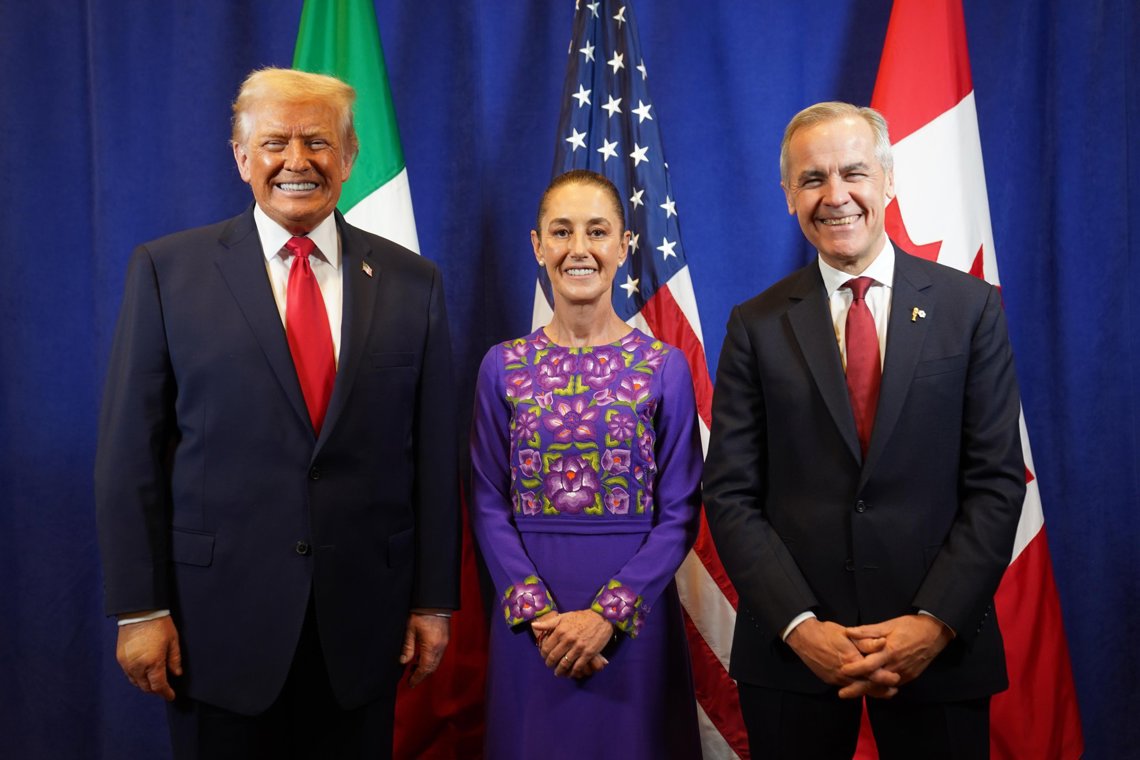
The president of MexicoClaudia Sheinbaum, assured that her first face-to-face meeting with the president of the United States, donald trumpwas “cordial and positive.”
Trump even invited Sheinbaum to return to Washington to hold another meeting, the Mexican president explained. according to an agency report Associated Press (AP).
“‘We talked about many issues and we agreed to continue working. The good thing is that it was a very cordial meeting and I am leaving very positive,”‘ he told the press about the three-way meeting he had with Trump and with the Canadian Prime Minister, Mark Carney, after the draw for the 2026 World Cup, held this Friday in the American capital.
Sheinbaum’s statements are interpreted by analysts as a new gesture that seeks to set a constructive tone in the bilateral relationship with Washington, despite the trade and immigration tensions that have tormented the agenda between both countries.
The president of Mexico, Claudia Sheinbaum, says that the meeting with Trump and Mark Carney went “very well” and they will work on trade issues. https://t.co/01d69YPWiG pic.twitter.com/0LinZIzQj7
— EFE News (@EFEnoticias) December 5, 2025
Bilateral trade and the future of the T-MEC
Although the meeting between the North American leaders focused on the opportunity that the World Cup represents for the three countries, trade was present in the conversations.
Trump reiterated his intention to let the Treaty between Mexico, the United States and Canada (T-MEC) expire in 2026, considering that his neighbors “have taken advantage” of Washington economically.
Sheinbaum, however, stressed that the teams of both governments will continue working on trade issues.
“We agreed to maintain dialogue and advance on issues of common interest,” declared the Mexican president, who also acknowledged that her country seeks to negotiate the exemption of US tariffs of 25% on automobiles and 50% on steel and aluminum.
U.S. Trade Representative Jamieson Greer has already begun a preliminary review of the deal ahead of the joint review scheduled for July, anticipating a complex process in which Mexico and Canada will try to preserve the pact’s benefits.
Tariffs, economic tensions and immigration raids
Trump’s tariff policy has been one of the main points of friction. Shortly after taking office, the US president threatened to impose massive levies on Mexican assets, although he later reversed himself in most cases.
In October, Sheinbaum announced that Washington had granted another extension to avoid 25% tariffs on Mexican exports, although not all products were exempt.
The president acknowledged that her government works intensely to protect the automotive sector, vital for the Mexican economy, as it manufactures around 3.3 million vehicles a year, according to the most recent data for 2025, from large firms such as Nissan, Ford, Honda and Mazda, General Motors and Stellantis, among others.
Immigration, traditionally the most sensitive issue in the bilateral relationship, took a secondary place in the meeting, although it continues to mark Trump’s policy towards Mexico.
The White House has stepped up deportation operations in Democratic-run cities, deploying the National Guard and increasing arrests of immigrants, many of them Mexicans without violent criminal records.
Sheinbaum asked for “good treatment” for his compatriots in the United States during a meeting with the Mexican community in Washington. “We are workers, honest people and we want respect for those who live in this country,” he stated. He also urged people to report any mistreatment to the Mexican consulates, which his government seeks to strengthen to provide greater support.
Remittances, vital for millions of Mexican families, have also been affected. The US Congress approved a 1% tax on money transfers, a measure that will take effect on January 1 and which Mexico tried unsuccessfully to stop.
Fentanyl and security cooperation
Another axis of the relationship is the fight against drug trafficking, particularly fentanyl. Trump has pressured Mexico to step up its efforts, even threatening tariffs if smuggling is not combated more effectively.
Sheinbaum has responded by granting more authority to his security chief, Omar García Harfuch, and extraditing key cartel figures, such as Rafael Caro Quintero. These actions have been seen in Washington as signs of goodwill.
However, the Mexican president flatly rejected Trump’s proposal to send US troops to Mexico to stop drug trafficking. “There is no way for another country’s army to carry out attacks on our territory,” he said, drawing a clear limit on cooperation.
On her visit to Washington, Sheinbaum met with Mexican community leaders at the Mexican Cultural Institute, where she was welcomed with flags and mariachi music. There he reiterated his government’s commitment to defending migrants and recognized the difficulties they face under Trump’s immigration policy.
“I know it hasn’t been easy for you in recent times, but we are working to improve the consulates and provide more support,” he told his countrymen.
The 2026 World Cup, which will be co-organized by the United States, Mexico and Canada, appears as common ground for cooperation and the opportunity to show an image of unity.
However, trade tensions, immigration raids and security differences remain challenges that will test Trump and Sheinbaum’s ability to maintain a constructive dialogue safe from toxic rhetoric.