The Cuban Government rejected this Thursday any type of link with the drug trafficking and assured that he maintains communication with the US authorities on this issue.
However, he pointed out against the United States by denouncing that the majority of drugs seized in Cuba come from the North American country and he regretted that the bilateral agreement to confront drug trafficking is practically frozen by Washington.
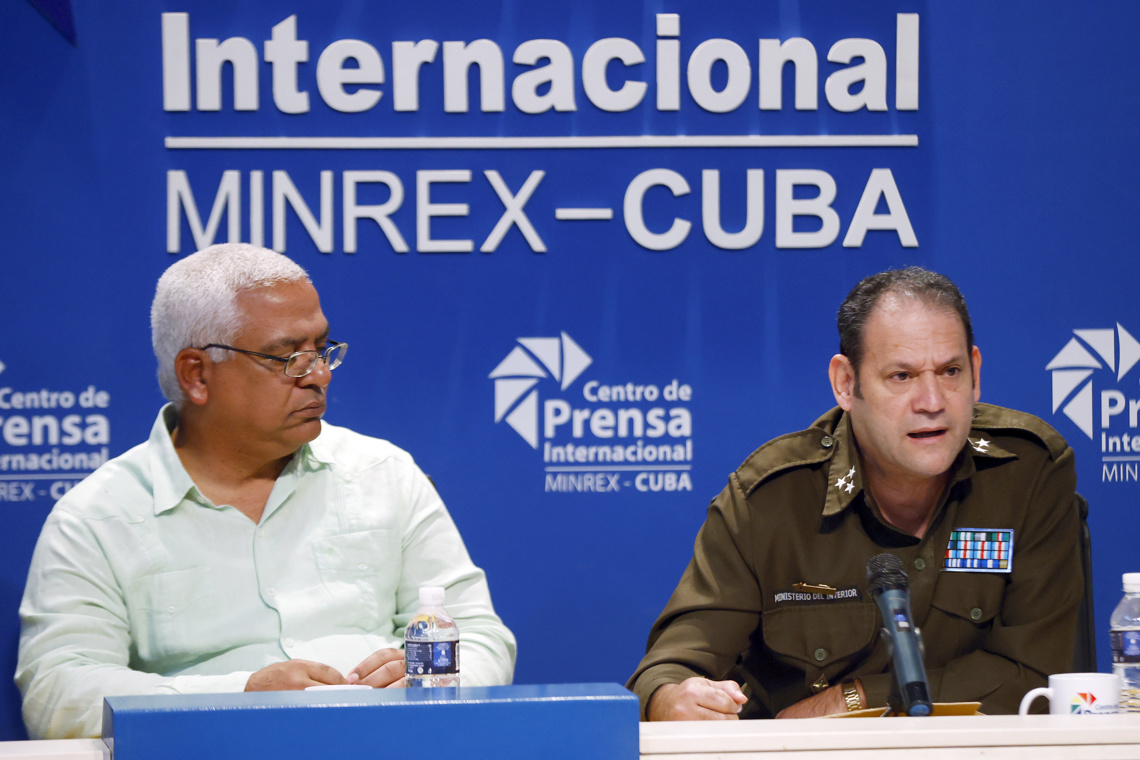
This was stated to the press this Thursday by senior officials from the Ministry of the Interior (Minint) and Justice, in a regional context of intensification of military pressure by the Trump Administration against Venezuela, supported by arguments of the fight against drug trafficking.
The press conference, in which the authorities reaffirmed the policy of “zero tolerance” with this scourge, took place after accusations by a former head of Venezuelan intelligence against Havana for alleged involvement in drug trafficking to the United States emerged.
In a letter addressed to Donald Trump and disclosed in the pressVenezuelan General Hugo Carvajal, known as “El Pollo” and who is detained in the United States, stated that in the mid-2000s the Cuban authorities had conceived a strategy to send drugs to the United States as a political weapon. It would have been carried out by the Chavista Government with international collaborators.
Without mentioning these accusations, the island’s authorities denied any institutional relationship with drug trafficking and assured that Cuba “is not a drug producing or transit country.”
Frozen cooperation
Colonel Juan Carlos Poey, head of the Specialized Anti-Drug Confrontation Body of the Minint, stated that despite attempts at cooperation, Washington has not implemented the planned operational mechanisms. This, he said, leaves Cuba in a vulnerable position in the face of the growing flow of narcotics, according to reports from international press agencies.
Poey recalled that the collaboration agreement on drugs was signed in July 2016 during the rapprochement between former presidents Raúl Castro and Barack Obama, but was paralyzed under the Administration of Donald Trump, in his first term (2017-2021).
Since then, bilateral contacts were reduced to sporadic exchanges and formal cooperation was never reactivated, according to the senior official.
“We have had a cooperation agreement on drugs with the United States since 2016 and we have not been able to implement its operational procedures for the exchange,” Poey lamented. “Although Cuba maintains its willingness to collaborate and has not stopped reporting incidents,” he added.
According to official figures, between 1990 and November 2025 Cuba sent more than 1,500 alert messages about drug trafficking movements to the US Coast Guard, while it received only 468 in response.
“The relationship is three to one,” noted Colonel Ybey Carballo, chief of the Border Guard Troops General Staff.
The “chemist”: the most visible face of synthetic drugs
Cuban authorities warn that the greatest current impact comes from synthetic drugs, especially cannabinoids popularly known as “chemical.”
Poey explained that more than 40 different formulations of these substances have been detected, many of them coming from the United States and mixed with dangerous compounds such as animal anesthetics, formaldehyde, fentanyl and phenobarbital.
The consumption of these drugs among young people has set off alarms on the island, which traditionally did not have a significant domestic narcotics market.
In response, the Government launched a national prevention campaign and created the National Drug Observatory to monitor the rapidly expanding phenomenon.
“The largest country that emits drugs into the national territory is the United States of America,” stressed Poey, who insisted that Cuba is not a producer, warehouse or transit point to third countries, but rather a victim of external introduction attempts.
Cuba toughens penalties against the growing trafficking and consumption of the “chemical”
Seizures and frustrated operations
Between 2024 and so far in 2025, law enforcement forces thwarted 72 drug trafficking operations from 11 different origins, according to Cuban authorities.
In these attempts, marijuana, cocaine, methamphetamines and synthetic drugs were detected. This year alone, more than two tons of narcotics were seized.
Colonel Carballo highlighted that in 2025, 14 speedboats were intercepted and 39 drug traffickers were arrested, all of them handed over to the judicial authorities without any deaths. “Great importance is placed on respect for due process,” he stressed.
In the last 14 years, Cuba claims to have confiscated some 40 tons of drugs from marine finds, especially cocaine and marijuana. These stops occur when traffickers throw shipments into the sea during chases, and later reach the Cuban coast.
Cuba’s geographical location, in the middle of the South-North route between the main producers in South America and the US market, makes the island a vulnerable point. Although it is not a producing country, its maritime space is used by vessels seeking to reach the United States.
Carballo emphasized that Cuban cooperation contributes to both regional and American security. “Our proactive approach fundamentally benefits the security of the United States, because many times the boats are headed there,” he said.
Cuba extradites a Chinese drug trafficker to Mexico, which then delivers him to the US
Zero tolerance within a harsh legal framework
For his part, the Minister of Justice, Oscar Silvera, ratified the “zero tolerance” policy against drugs and explained that the National Drug Commission articulates efforts by government institutions, social organizations and families to raise awareness and rejection of illicit substances.
Cuban legislation contemplates penalties of up to 30 years in prison or life imprisonment for serious crimes of sale, distribution or trafficking, in addition to the confiscation of property. “You win against drugs,” said Silvera, who insisted that the preventive approach is key to avoiding the expansion of consumption.
However, despite the government’s results in this field, a growing number of consumption experiences are reported on social networks, especially of designer drugs, such as the chemical or papelito, in peripheral neighborhoods of Havana and other cities in the interior that have adolescents and young people as the most active clients of this illegal market.
Although the official press has been addressing the phenomenon in recent times, it has been citizen complaints that have most strongly highlighted the consumption of synthetic narcotics, a phenomenon that represents a challenge for a country that has historically boasted of its prevention and control policy.
Minister of Justice and President of the National Drug Commission @OscarCubaMinjus and other Cuban authorities presented, in a press conference, comprehensive results in the fight against drug trafficking. The zero tolerance policy and preventive approach were reaffirmed. pic.twitter.com/LrCjgoqNUb
— Chancellery of Cuba (@CubaMINREX) December 4, 2025
Regional tensions
The US military deployment in the Caribbean, under the justification of combating drug trafficking, is seen by Havana as a serious danger for the region and, in particular, for the island.
In this regard, Colonel Poey warned this Thursday that the US military presence near Venezuela is “a serious threat to the security and sovereignty” of Cuba and its South American ally.
Cuban officials maintain that, beyond the rhetoric, Washington has not fulfilled its cooperation commitments and that its military presence responds to political objectives.
In parallel, Washington accuses allies of Cuba, such as Venezuelan President Nicolás Maduro, of profiting from drug trafficking and leading a transnational organization known as the Cartel of the Suns.
However, Cuban authorities insist that the island has not seen a drastic change in drug trafficking activity in its surroundings, despite the increase in military operations in the area.