Joaquín Sabina has made many people’s lives musical. In fact, Spotify has just reported that three of his albums were the most listened to by me this past year. Quite a few scenes of love and heartbreak, of melancholy and domestic inspiration, have featured his songs in the background.
Therefore, now that he said goodbye to the big stages, to the intense tours and to hotels-sweet-hotels, those of us who owe his music and his lyrics were directly or indirectly by his side until the last of the shows.
The final point was last Saturday, and Carlos Marco described the event for the Madrid newspaper The Countrywhere assured that it had been a show “of high emotional voltage” and highlighted “the dedicated predisposition of the public, who took the night as a full-fledged farewell, a farewell to someone who has been giving them music and poetry with a popular acceptance that only Joan Manuel Serrat is capable of surpassing.”
“The 71st concert of a tour, Hello and goodbyewhich began in January and its tenth (ten!) Movistar Arena of the year was a delight for the emotional palate of the public, with Sabina making efforts not to collapse, which was what her faithful audience was already there for, who filled the venue in its 12 thousand seats, all seated, also the part of the dance floor, although the public left their seats on many occasions to cheer on the protagonist and dance,” the editor wrote.
We had already seen the wave of sensations after the show, since the groups that proliferate on social networks to highlight Sabina’s work, overflowed with allusions to her work, or to this concert in particular; which happened, by the way, in the same place where the maestro took a bad step in February 2020 that made him fall from the stage, adding another stripe to the tiger or subtracting a life from the cat, depending on how you look at it.
But, striped tiger or shorn cat, the singer-songwriter born in Úbeda 76 years ago, and today pulverized throughout the planet thanks to his lyrics, his melodies and his legend, pursued a career and, instead of being intimidated, announced another global tour, Against all odds. I went to see him with my family while he was passing through Buenos Aires.
It is known that this city kills the teacher, and that it even inscribed on one of its sidewalks the lyrics of a song that even the dogs sang in my house in Holguín; so also then, assuming it almost as a last tour, we went to accompany him.
My son, seven years old in 2023, was impressed with Sabina’s elegance, her jacket and her bowler hat, and although logically desperate at moments of the show, he applauded with delight at the endings and learned to hum many of the lyrics that I had heard for the first time on the radio in Cuba.
It was back in the early nineties when Joaquín Sabina arrived on the island with the help of Pablo Milanésand it was then that my interest in his poetry was born. I remember that one late night I saw it on television, which was broadcasting a live performance from the Plaza de la Revolución, where Sabina covered the iconic “Yolanda” by Milanés.
Since then I have followed him in such a way that Sabina became my hospital companion when I was recovering from a fateful accident, and also my confidant in times of love affairs. The first show I went to when I was already living in Buenos Aires was a concert of his at Luna Park, a gift from my dear Mai, also a Sabine native, although we almost broke up before getting married because, coincidentally, of a verse by the maestro that he misinterpreted after I had given it to him with such good intentions.
But, enough to remember that it is not necessary to live again, but to live. And to my point: let’s return to the last waltz of the most literary cat in the world. One day, already back in Madrid for this tour, he announced from his social networks that his farewell show had passed through half the world and that he was ready to “end where it all began”: Madrid.
He wrote: “We started in Mexico, we went through New York, Miami, Los Angeles, almost all of Latin America to Buenos Aires. We crossed the pond again to go to London, Paris and almost all of Spain; and it will end where it all began. It will end in Madrid with these last shows that are going to be, without a doubt, the most important of my life. Because they are the last and the ones that I will never forget.”
Once the time was up, and the spirits satisfied, Sabina himself sent another message from Instagram: “It has been an enormously grateful goodbye because I have been seeing, by living and traveling, how my songs have traveled and grown and I have grown with them. And how they have managed, in a mysterious way, to sneak into the sentimental memory of several generations. I have to thank you for all of this, because without you the songs would not exist. Eternal thanks.”
Some have calmed those saddened by this withdrawal or retirement. The poet Benjamín Prado, who shared a photo with his friend Sabina after his last concert, has already said: “Don’t worry: he will continue making incredible songs. One can retire from the stage, but one cannot retire from one’s own genius.”
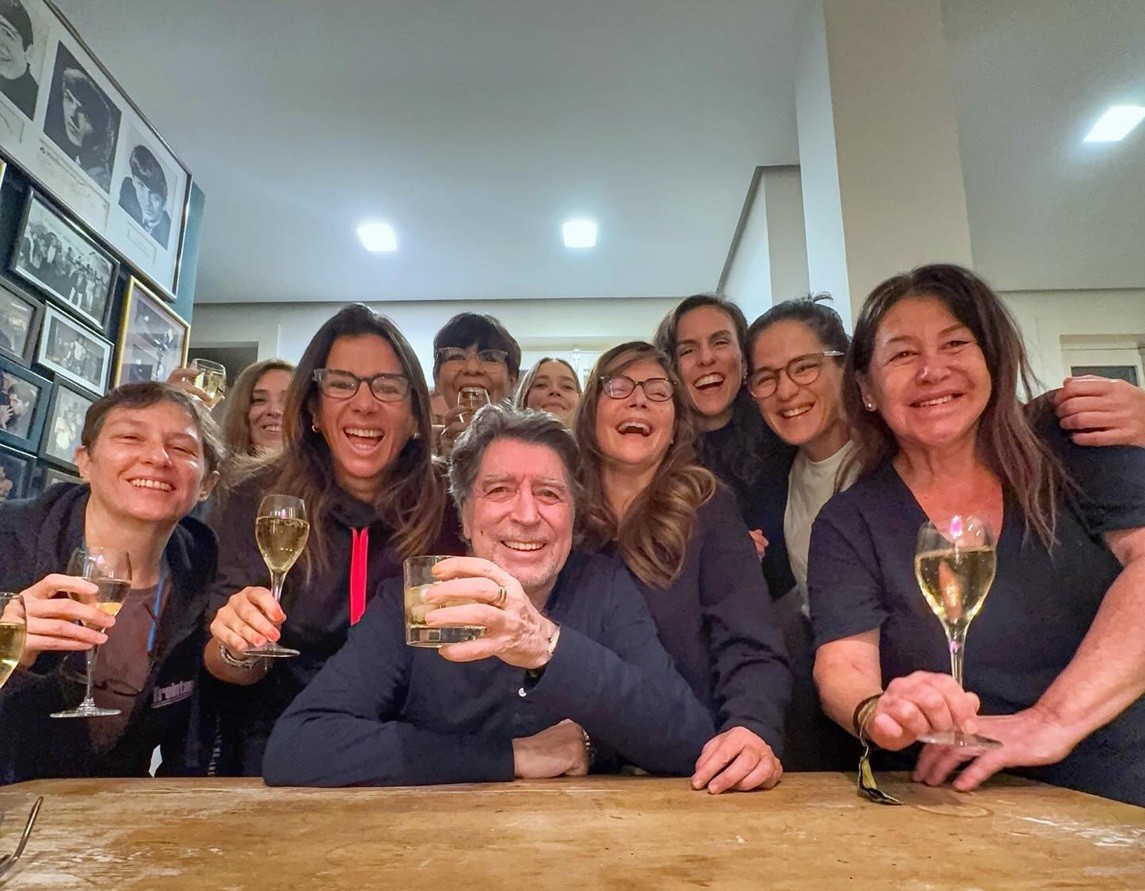
This Monday, the singer-songwriter’s partner, Jimena Coronado, shared on Instagram the first image of withdrawal hours. He is surrounded by women and has a drink in front of him. With all irony, and also Sabinean malice, he titled it: “the retiree’s home.”
I hope that now, having fulfilled the commitment to beat the crowds on the big stages, the Madrid cat is ready to appease those who also gather crowds in the world’s bookstores; and, if the Spanish Ministry of Culture is encouraged, I advise that the next Cervantes award be, in fact, for the couple that make up Joaquín Sabina and Joan Manuel Serrat, who have so much enriched the Spanish language by mixing words from all regions to mark us with their powerful and inspiring poetics.