✅ With 85 votes in favor and 36 against, the general and non-reserved articles of the minutes that create the General Water Law and reform the National Water Law are approved.
— Senate of Mexico (@senadomexicano)
December 5, 2025
The minutes arrived this afternoon at the Senate, but since they were considered an urgent resolution, the modifications were not sent to committees for analysis and voting, but were discussed directly in the Plenary Session of the Upper House.
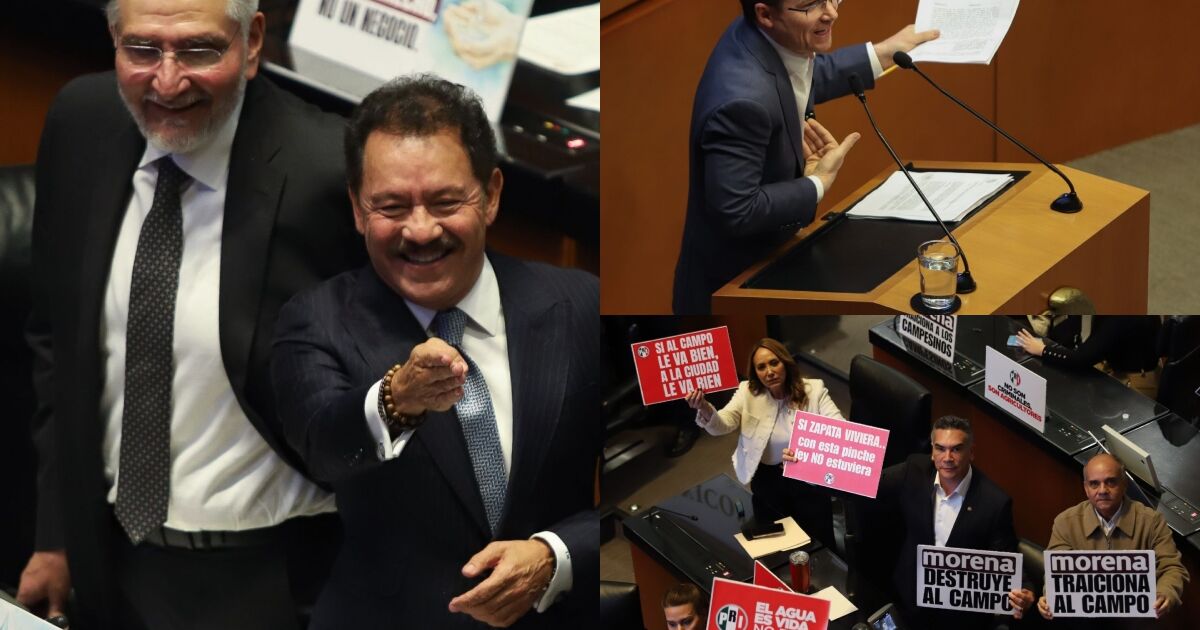
Morena and allies voted in favor of discussing it once and for all, while senators from the PRI and the PAN protested with posters and in their interventions on the platform, as they consider that the constitutional modifications are ”centralist” and ”regressive”.
During the discussion, the opposition parties confronted the legislators of Morena and allies, and even hung a banner that read: “Expropriating water is condemning the countryside to poverty and lack of food for the people.”
(Photo: Daniel Augusto/Cuartoscuro)
Senator Ángel García Yáñez commented that this law was born ”tainted with unconstitutionality” and political haste, because, according to him, the reforms were not built by listening to citizens or consulting indigenous peoples as required by the Constitution.
“There was no dialogue with the producers or with irrigation districts, nor with those who depend every day on this very important resource. There were express forums, simulations and a ruling that came with more doubts than certainties,” said the PRI member.
Verónica Rodríguez commented that Morena uses the flag of human rights ”to politically control water, take away powers from states and municipalities and concentrate power” in the federal government in matters of water.
According to her, the approved reforms give the federal government, through the National Water Commission, the possibility of discretionally deciding who keeps their water concession, who loses it, and whose volumes of this liquid are reduced.
Morena defended these changes, since Senator Manuel Huerta Ladrón de Guevara said that the concessions market between individuals is put an end and a reserve fund is created to recover volumes of water and reallocate them with criteria “of public interest”, as well as strengthen sanctions against water theft.
“It is good news for those who turn on the tap and nothing comes out, it is not so good news for those who made water a business,” commented the Morenista.
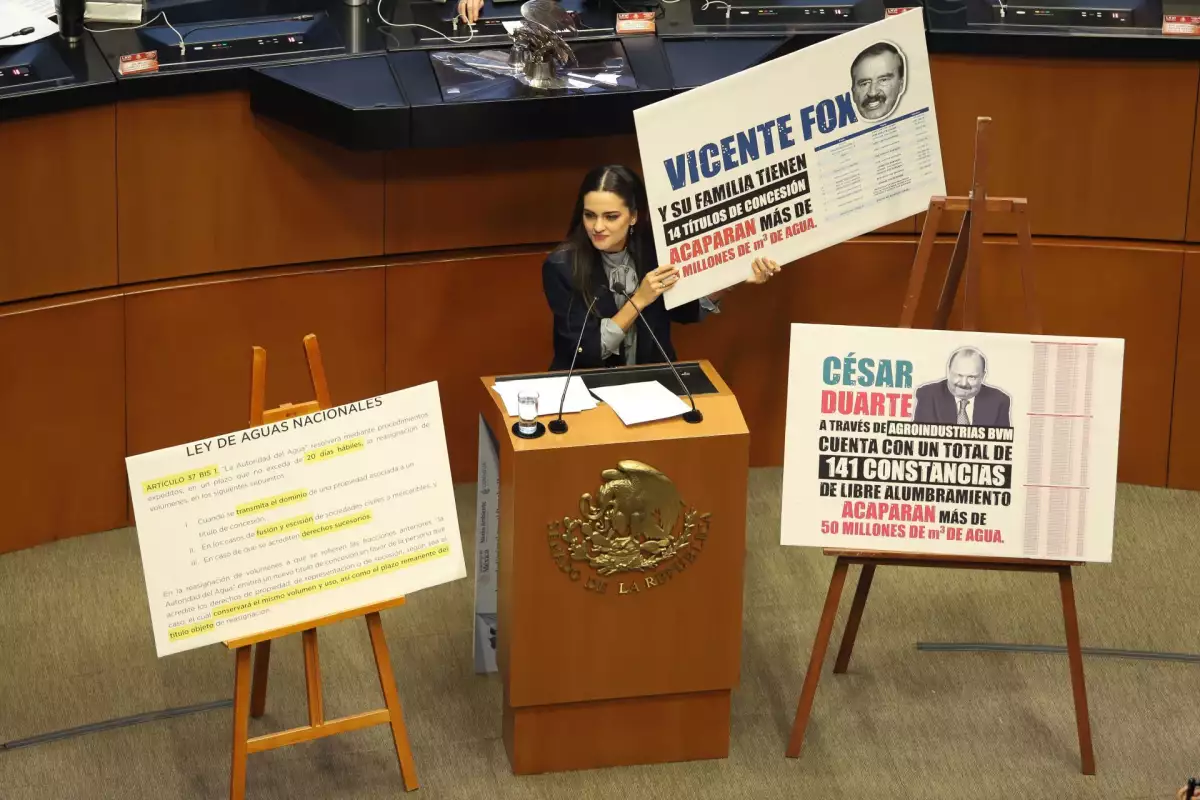
Senator Andrea Chávez Treviño, from Morena, assured that these reforms guarantee the human right to water for Mexicans, but mainly for the producers who feed our country.
(Photo: Daniel Augusto/Cuartoscuro)
With this law, he highlighted, “overexploitation of aquifers will be eliminated, hoarding, inequality in distribution and the black market for the sale of this valuable resource of the nation will end.”
Mario Humberto Vázquez Robles, PAN senator, considered that the countryside is dismantled and now betrayed with this reform, which was not even consulted with the producers or the communities.
“This law is built on a false narrative of hoarding the liquid and that there are supposedly people who get rich from the commercialization of the resource, but if that is the case, say who they are,” he said.
Senator Mely Romero Celis, of the PRI, pointed out that “we are experiencing a moment that will go down in history as the greatest betrayal of the people of Mexico”, a betrayal of those who trusted in the Fourth Transformation, since they decided to see the farmers as a “nuisance” and not as the productive heart of the country, since they simulated dialogue when the decision had already been made, that is, to concentrate all the power of water in the hands of the federal power without transparency and without accountability.
For the Green Party, Maki Esther Ortiz Domínguez stated that in the minutes that are submitted for consideration, many of the requests from the countryside were incorporated, which allows a balance between the productive interest and ensuring the superior interest of the right to water, so the minutes recognize the possibility of inheriting concession titles, clarifies the procedure for the reallocation of volumes, respects the permanence of the rights in the agrarian and livestock context, among others.
Voting in San Lázaro
Hours before, with specific changes, the Chamber of Deputies approved the opinion that issues the General Water Law and reforms, repeals and adds various provisions of the National Water Law.
The document, which derives from an initiative presented by President Claudia Sheinbaum Pardo, was endorsed in particular with 324 votes in favor, 118 against and two abstentions.

(Photo: Andrea Murcia Monsivais/Cuartoscuro)
The package of 18 reservations presented by deputy Ricardo Monreal Ávila was accepted, in his own name and on behalf of the coordinators of the PVEM and PT parliamentary groups, deputies Carlos Alberto Puente Salas and Reginaldo Sandoval Flores, respectively.
Ricardo Monreal highlighted that the changes are very notable, and “we attended to the people, we listened to the people of various states of the country, from various sectors, from the north, from the south, from the Bajío, from the center.”
The 18 reserves, he specified, complement what was done a few days ago in 50 modifications to the original project of the President of the Republic, Claudia Sheinbaum Pardo, which contains two sets of regulations: the National Water Law and the General Water Law.