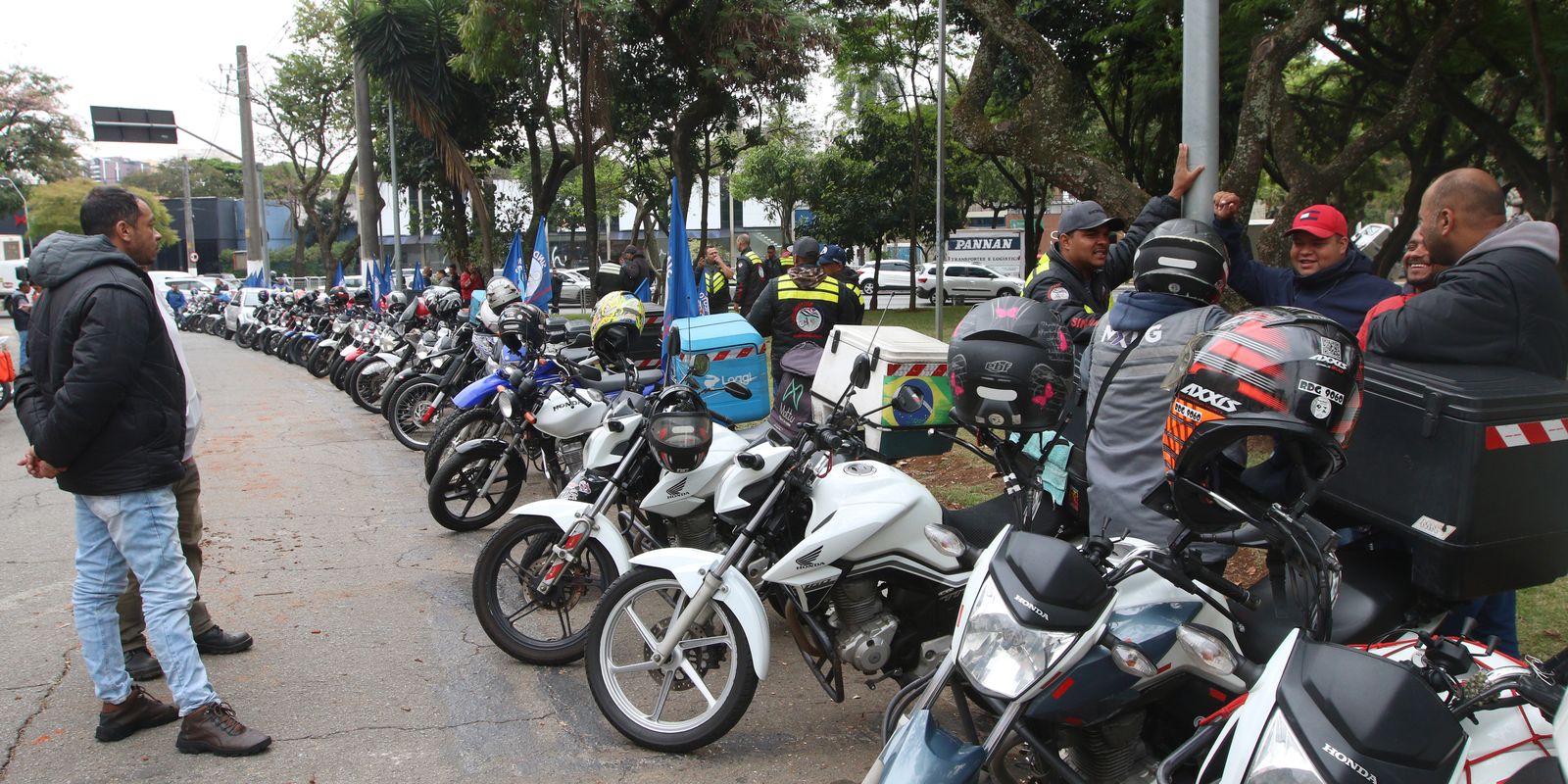
The federal government will establish a working group (GT), coordinated by the General Secretariat of the Presidency of the Republic, to formulate labor regulation proposals for app-based delivery drivers.
The group will also be composed of the Ministry of Labor and Employment (MTE), the Ministry of Development, Industry, Commerce and Services (MDIC) and representatives of delivery organizations and entities from all five regions of the country, in addition to representatives of trade unions.
The announcement was made this Thursday (4), by minister Guilherme Boulos, who met with representatives of these workers.
According to the minister, one of the main objectives of the initiative is to improve the remuneration of these delivery people.
“Today they work too much and earn too little”, he summarized.
THE group must also propose some social security insurance for the category.
“The format of this we want to discuss exactly in the working group for these workers who today, if they suffer an accident, it’s up to God, no one is responsible,” said Boulos.
The third agenda point involves transparency of platforms in the use of algorithmswhich are the platforms’ digital schedules that define issues such as value and distribution of deliveries to these self-employed professionals.
“Both Uber drivers and ifood delivery people, and this also applies to all other platforms, these workers are today controlled by the algorithm, which even uses their data, but there is no transparency in this algorithm. And it is a demand from workers that there be this transparency”, observed Boulos.
Representatives of the Superior Labor Court (TST), the Public Ministry of Labor (MPT) and the Ministry of Health will be invited to participate in the working group meetings. The Special Committee of the Chamber of Deputies on App Workers Regulation, through its president, deputy Joaquim Passarinho (PL-PA), and the collegiate’s rapporteur, federal deputy Augusto Coutinho (Republicanos-PE), will also be called upon to contribute to the debate.
At first, according to Boulos, the group will only deal with the demands of app-based delivery drivers, separate from the agendas of independent drivers.
“We took the definition of separating motorbike delivery drivers from drivers because there are specific agendas for each one. So, although the bill that is being discussed in the Chamber of Deputies and that will be processed in the National Congress, deals with both together, here in the government of President Lula we are separating the debate”, he explained.
Nicolas dos Santos, representative of the National Alliance of Employers for Applications, hopes that the creation of the group can unlock a debate that has been going on for around four years.
“It was a campaign promise from the current president Lula and we hope that this delivery will actually be carried out. The debate in Congress is not progressing satisfactorily, it is as if the streets said it, but it was not heard”, said the worker.
“We need to earn well, we need to be able to access what is our right, to be able to have access to decent work, decent housing, the ability to provide education for our children,” he added.
The GT will last 60 days, with the possibility of being extended, if necessary.
Mobilizations
Demonstrations by app delivery people have been recurring in the country. Last week, a group of delivery people protested against a new iFood work modality.
In March, a national mobilization took place in several capitals in the fight for a minimum fee of R$10 per delivery.
It is not the first time that the government has tried to advance the category’s agenda, without success. Throughout 2023, another working group, coordinating the MTE, brought together representatives of platforms and delivery people, but there was no progress.
In the Chamber, the special committee on the topic analyzes Complementary Bill 152/25, which defines standards for the operation of individual passenger transport and delivery services operated by digital platforms, such as Uber, 99 and InDrive.