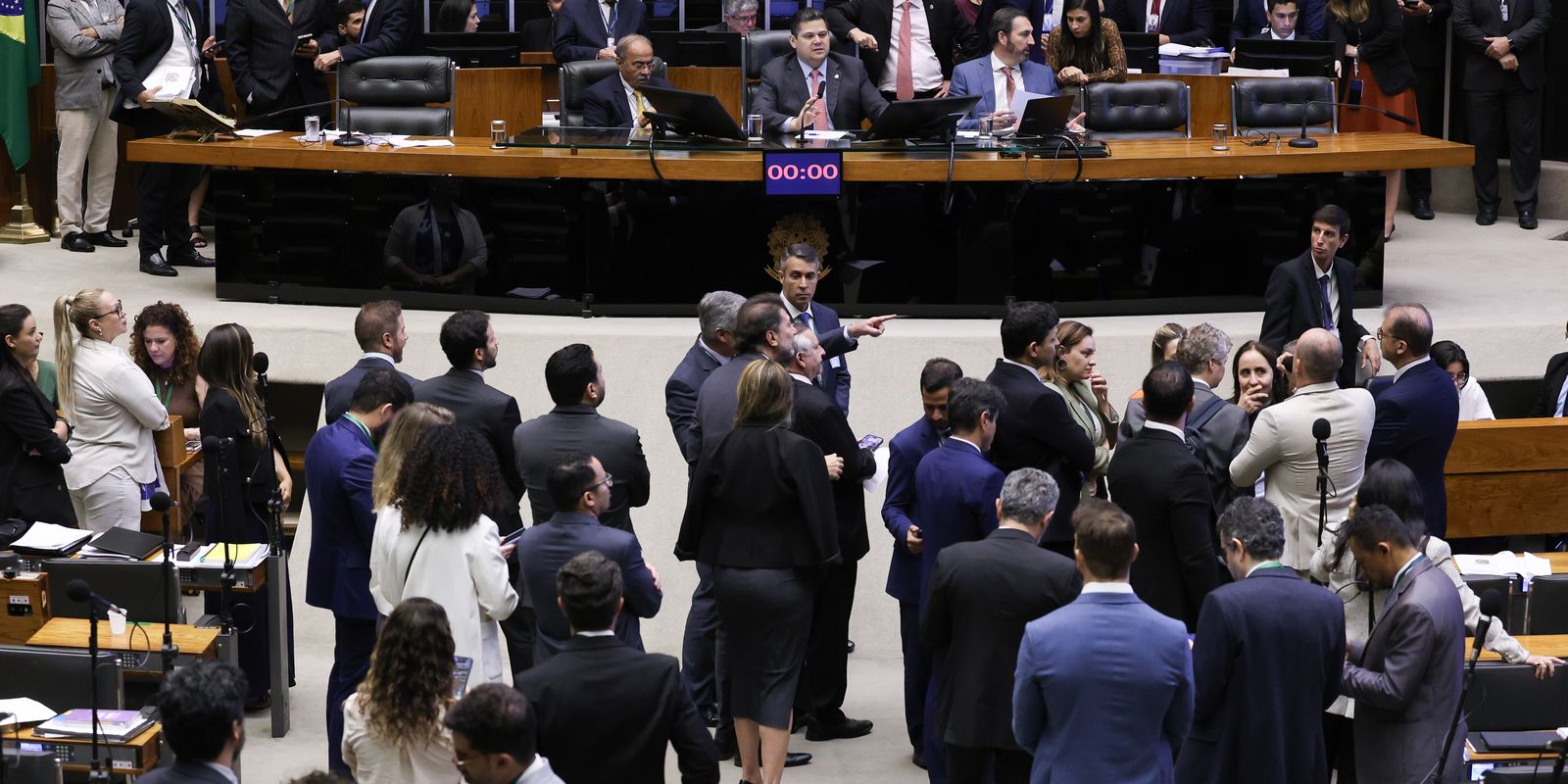
The National Congress approved this Thursday (4) the 2026 Budget Guidelines Bill (LDO). The LDO establishes guidelines for the preparation and execution of the 2026 Budget Law. 
The text now goes to presidential sanction. With approval, the expectation is that Congress will vote next week on the Annual Budget Law (LOA) for next year.
Among other points, the LDO predicts a surplus of R$34.3 billion in 2026, equivalent to 0.25% of the Gross Domestic Product (GDP). The text also establishes that the government may consider the lower limit of the target to make spending limitations.
Minimum wage and expense limit
The LDO text works with the parameter of R$ 1,627.00 for the minimum wage in January. But the final value will only be known after the release of the Broad Consumer Price Index (IPCA) for November.
Another point concerns the expenditure limit, which was calculated at R$2.43 trillion. This value grew above inflation of 2.5%, as stipulated by the rules of the fiscal framework.
When defending the proposal, the rapporteur, deputy Gervásio Maia (PSB-PB), said that the debate on surplus or deficit will not advance if Congress does not look into some issues, especially the review of tax benefits applied to some sectors of the economy.
According to the rapporteur, each year, the country fails to collect around R$700 billion due to the granting of these benefits.
In the rapporteur’s assessment, “those who already stand on their own two feet no longer need public resources” and the benefits can be applied to other sectors of the economy that require support.
Also according to Maia, the review could release around R$20 billion in the public budget for investments.
“We are talking about a country that gives up almost R$700 billion in tax exemptions. And some of the companies and industries that receive them should not have received these benefits a long time ago. They have to go to a company that is in need, to generate more jobs and contribute to the country’s development”, argued the rapporteur.
Party and electoral background
Parliamentarians included resources from party and electoral funds among expenses that cannot be contingency, that is, those that the government cannot cut spending on.
In September, the Mixed Budget Committee (CMO) set the electoral fund resources at R$4.9 billion for the 2026 elections and the party fund at R$1 billion. In addition, parliamentarians approved a 2.5% increase in the total amount allocated to parties.
Amendments
The approved text also sets a maximum deadline of the end of the first semester for payment of 65% of the value of individual amendments and state benches and transfers destined to health and social assistance funds. Another point approved is the one that removes the obligation to apply amendments to unfinished works.
Parliamentarians also approved reducing the deadline for federal bodies to analyze individual amendment proposals, adjust plans and disclose technical impediments from 105 to 100 days. The text allows the use of resources from collective amendments in health funds to pay active personnel expenses.
Furthermore, the proposal removes a discount of up to 4.5% of amendment resources for inspection costs when the federal body executes directly and sets a minimum value of R$200,000 for works and R$150,000 for services for so-called PIX amendments.
Municipalities
In relation to municipalities, the approved text exempts cities with less than 65 thousand inhabitants from having to prove compliance with the government to enter into agreements or receive resources; and authorizes the transfer of resources to non-profit entities in the health sector to carry out physical works, in accordance with Ministry of Health regulations.
The text also authorizes the allocation of Union resources for the construction and maintenance of state and municipal highways linked to the integration of modes or the flow of production.
In relation to the Global Expenditure Program, aimed at non-dependent federal state-owned companies, the LDO says that the primary deficit target is R$6.7 billion with an addendum of R$10 billion for companies that have an approved and current economic-financial rebalancing plan.
The following will not be considered in the primary deficit target: companies from the Petrobras group; companies belonging to the Brazilian Nuclear and Binational Energy Participations Company (ENBPar); and expenses from the Investment Budget, allocated to the Growth Acceleration Program (New PAC), limited to R$5 billion.
Initially, the document presented by the government set the New PAC and 27 objectives of the Multi-Year Plan (PPA) 2024-2027 as a priority. After accepting amendments, the annex now has 64 programs and 128 objectives.