However, peasant leaders announced the start of talks, now with senators, given the persistence of legal changes with which they do not agree.
(Photo: Cuartoscuro)
Morena accuses myths behind protests
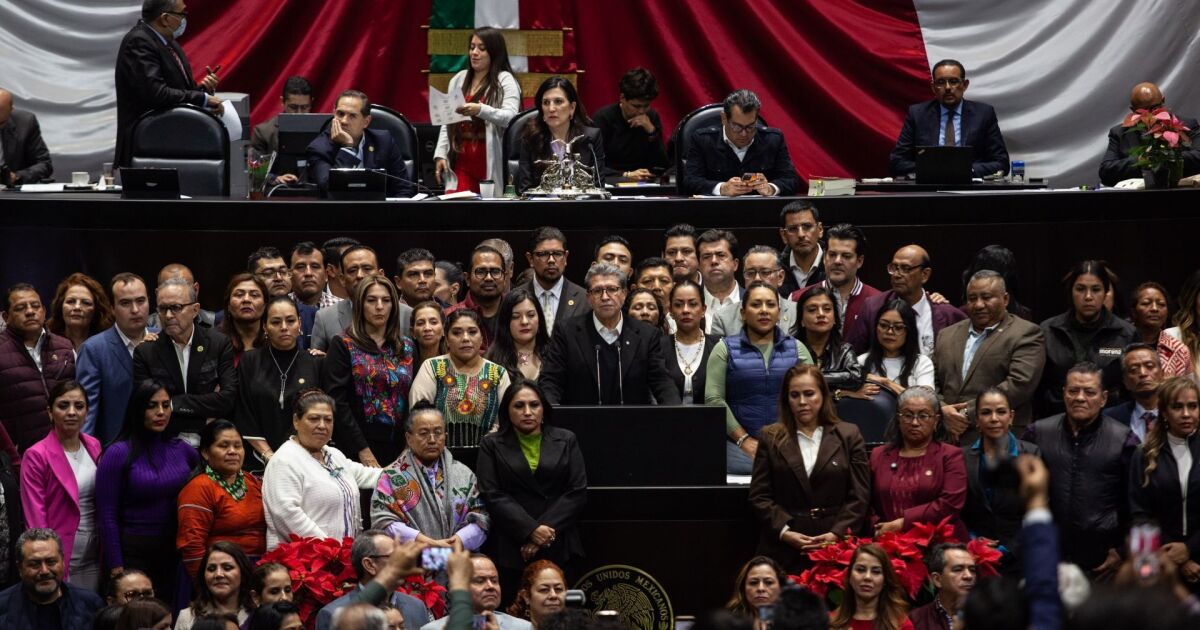
The approval of the reforms came with the denunciation of an “albazo”, since the discussion would be this Thursday, but Morena and allies gave it fast track to get ahead one day. And in the early morning, although five rounds of debate had been agreed upon, he tried to close the discussion earlier, on the third round.
That is why the opposition decided not to withdraw reservations and fight on the platform, so the session became marathon.
The reservations authorized by the plenary session and presented by the leader of the Morena deputies, Ricardo Monreal, were 18 changes previously agreed upon with peasant leaders and which were added to the 50 that had already been incorporated during the ruling.
The leaders Eraclio Rodríguez and Abelardo Valdez, of the National Front for the Rescue of the Countryside, reported that with this they suspended new mobilizations in Mexico City.
However, they insisted that seven thousand existing agricultural well systems still need to be protected.
They demanded to guarantee the historical lighting or drilling used by ejidos and communities since previous legislation.
They affirmed that there is already contact with the leader of Morena in the Senate, Adán Augusto López, to review changes before the ruling advances, but they warned that they will continue with mobilizations and protections if necessary, to “not leave loose ends.”
In the reservations made during the debate, according to the leader of the Morena deputies, Ricardo Monreal, the guarantee of succession rights was specified and extraction by free birth was regulated.
Community systems and water services were also recognized for productive activities of indigenous and Afro-Mexican peoples and communities, in addition to the fact that the treatment of their water adheres to their regulatory systems, but that will be left to the regulatory law of the second constitutional article.
The opposition warns of risks
According to Morena, inheritance rights were not affected and water concessionaires will be able to inherit, but with a new title with the same volume and type of use and prior permission from Conagua, issued in 20 business days.
However, the General Law did maintain article 22, which indicates:
“The rights covered by the concessions and assignments will not be transferred. Preferential rights derived from the transfer of ownership, merger and division of civil and commercial companies and inheritance rights will be governed in accordance with article 37 Bis 1 of this law.”
According to the opposition, this article “is a technical scam, a political fraud on the countryside.”
PAN member Marcelo Torres said that it is “to create a preferential right but it will be by reassignment, not automatic, it is not transferable or inheritable, so the modifications were pure foam, nothing solid.”
What they approved was “the right to stand in line again to present documents and wait for the authority to decide whether or not it wants to reassign,” he said.
In the reform, said Rubén Moreira, from the PRI, we do not talk about linked rights, that is, inheritable ones, but those of companies.
The article relating to successions, article 37 Bis 1, indicates that there will be a Public Fund for the Reserve of National Waters, and it will be made up of the volumes “coming from the extinction of concession or assignment titles for the exploitation, use or exploitation of national waters.”
In addition, it was maintained that the volumes derived from the session in favor of the water authority, those linked to the preference of rights (when ownership of a property associated with a concession title is transferred) and in cases of merger and division, in addition to cases that prove succession rights, may go to that Fund.
In the reallocation of volumes, the water authority will privilege those uses that benefit the human right to water.
Decisions will be made only by government bodies, without social participation. The person responsible will be the Committee of the National Water Reserve Fund, which will be made up of representation from the Ministry of the Environment, Welfare, Economy, Finance and Public Credit, Agriculture, and Rural Development and will be chaired by Conagua.
The indigenous consultation
Morena accused that thanks to the reservations, the opposition was left without arguments, and that is why he insisted that the package of reforms to the Water Law should have been consulted with indigenous peoples and communities, as stated in Article 2 of the Constitution and promoted by the leader of the deputies of the Institutional Revolutionary Party (PRI), Rubén Moreira.
Monreal presented dates of the consultations, but the coordinator of National Action (PAN), Elías Lixa, showed that these were consultations for the National Development Plan 2025-2030 and the Constitution orders consultation of any law that affects them.
The Morenista Dolores Padierna acknowledged that there was no such consultation, since article 43 of the Water Law says that “community water and sanitation systems administered by indigenous and Afro-Mexican peoples and communities will be regulated by the General Regulatory Law of article 2 of the Constitution.”