The Brazilian economy grew 0.1% in the third quarter of 2025 compared to the second quarter and reached the highest level ever recorded.
In relation to the third quarter of 2024, the Gross Domestic Product (GDP), the set of goods and services produced in the country, increased by 1.8%
Over four quarters, GDP expanded by 2.7%.
The data was released this Thursday (4) by Brazilian Institute of Geography and Statistics (IBGE).
The quarterly increase of 0.1% is considered by IBGE to be stable, that is, not significant.
According to the institute, GDP reaches R$3.2 trillion.
Sectors
From the second to the third quarter, industry showed the highest growth (0.8%), followed by agriculture (0.4%). The performance of services, which represent the largest weight in GDP, remained practically stable at 0.1%.
Observing the behavior of activities within the services, the highlights were:
– Transport, storage and mail: + 2.7%
– Information and communication: +1.5%
– Real estate activities: +0.8%
IBGE Quarterly Accounts analyst, Claudia Dionísio, explains that the performance of transport activity is the result of the flow of mineral and agricultural extractive production.
In the quarter, commerce, which is also in the services group, increased 0.4%.
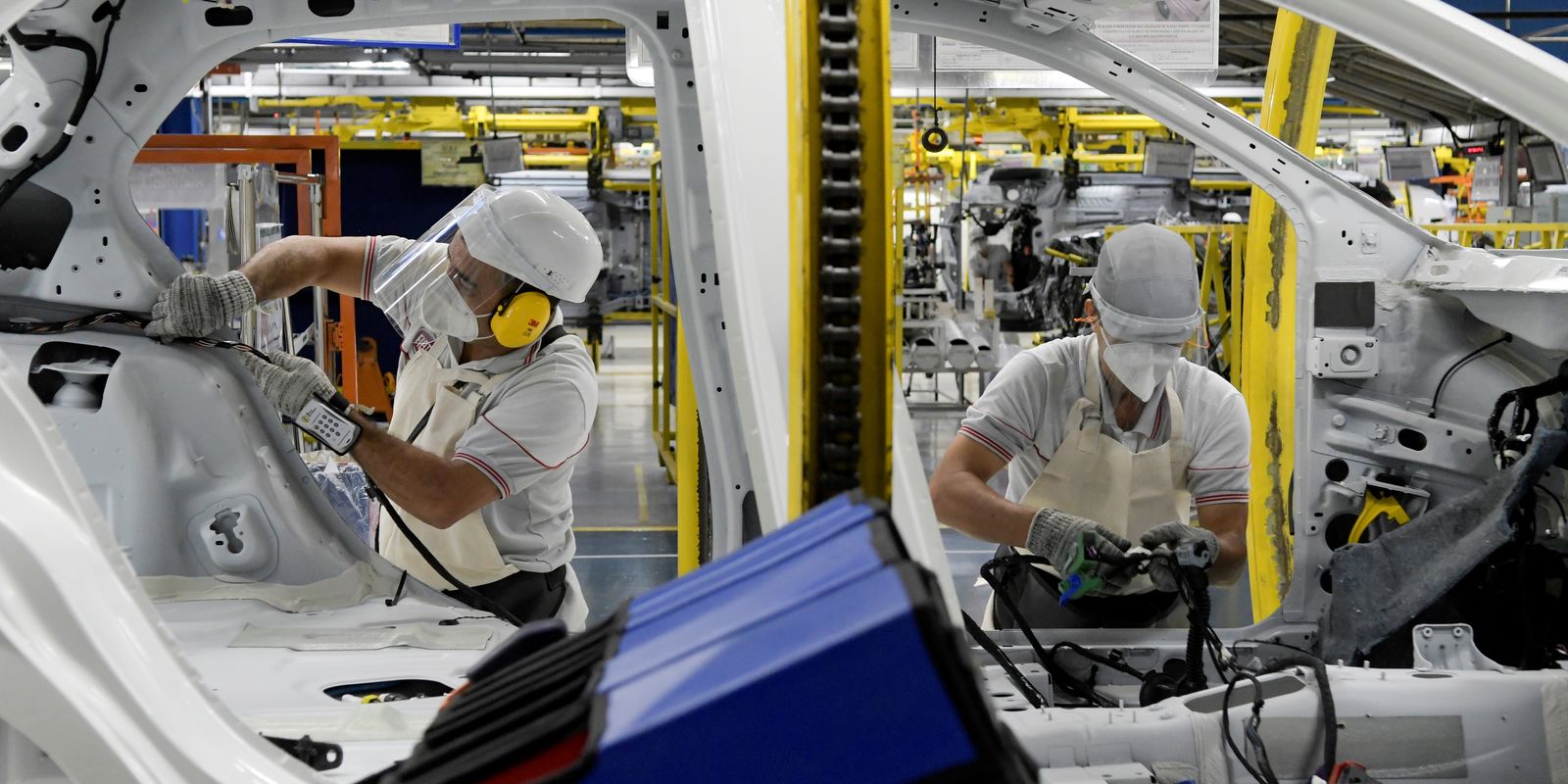
In Industry, there was an increase in extractive industries (1.7%), construction (1.3%) and manufacturing industries (0.3%). The electricity and gas, water, sewage and waste management activities segment declined (-1.0%).
On the expenditure side, household consumption (0.1%) remained practically stable and government consumption increased 1.3%.
Gross Fixed Capital Formation (GFCF), an indicator that measures the increase in a country’s productive capacity through investments, rose 0.9%.
Exports contributed with an increase of 3.3%. In the quarter, imports fell 0.3%.
Just as GDP reached the highest level ever recorded, agriculture, services and family consumption also reached record levels. On the other hand, the industry is 3.4% below the highest level, reached in the third quarter of 2013.
Deceleration
IBGE data points to a slowdown in the economy throughout 2025. In the first quarter of the year, the increase compared to the last quarter of 2024 was 1.5%. From the first to the second quarter of 2025, the expansion was 0.3%.
The same behavior is observed over four quarters. At the end of March, growth was 3.6%. Three months later, it rose to 3.3%, until reaching 2.7% at the end of September.
According to analyst Claudia Dionísio, one of the main factors leading to the slowdown is the restrictive monetary policy, that is, the high level of interest rates.
“Higher interest rates compromise several economic activities”, he assesses.
Among the activities most affected by interest rates, she cites the manufacturing industry (a sector that transforms raw materials into final or intermediate products), investments and family consumption, “which is related to credit”, she explains.
However, the researcher points out that factors such as a booming job market, an increase in workers’ income and the wage bill and income transfer assistance programs accelerate the economy, to a certain extent.
“They mitigate the contractionary effects a little”, he states.
Brazil has recorded in recent quarters the lower unemployment rates already investigated.
Why do I swear loudly
The basic interest rate in the country, to Selic, is at 15% per year, the highest level since July 2006 (15.25%). The Selic is decided by the Monetary Policy Committee (Copom) of the Central Bank (BC), which defends the high level as a way to combat inflation, accumulated at 4.68% in 12 months.
Since September 2024, inflation has been above the government’s target ceiling, which goes up to 4.5%.
By cooling the economy, high interest rates tend to reduce demand for goods and services, in order to stop rising prices. The side effect is the obstacle to job creation and economic growth.
Tariff
Researcher Rebeca Palis points out that the increase in exports shows that the American tariff, which began in August, which applied a rate of up to 50% on Brazilian sales to the United States, had a localized impact.
Furthermore, it notes that exporters have mitigated the obstacle. “The exporters themselves managed to redirect,” he said.
In the case of soybeans, for example, part of sales were directed to China, adds Claudia Dionísio.
In the American government’s view, tariffs have the role of protecting the American economy. President Donald Trump even claimed that it was also retaliation for Brazil’s treatment of former president Jair Bolsonaro, whom Trump considered to be persecuted, before being convicted by the Federal Supreme Court (STF), in September, for attempted coup d’état.
Since then, the Brazilian and American governments have been negotiating ways to seek agreements for the commercial partnership.
On the 20th, Trump removed additional taxation 40% on products such as meat and coffee.
The vice-president and minister of Development, Industry, Commerce and Services, Geraldo Alckmin, calculates that 22% of exports to the United States remain subject to surcharges.
What is GDP
GDP is the set of all goods and services produced in a location in a given period. With the data, it is possible to trace the behavior of the economy of the country, state or city, as well as make international comparisons.
GDP is calculated with the help of various sectoral surveys, such as commerce, services and industry.
During the calculation, care is taken to avoid double counting. An example: if a country produces R$100 of wheat, R$200 of wheat flour and R$300 of bread, the GDP will be R$300, as the values of flour and wheat are already embedded in the value of bread.
The final goods and services that make up GDP are measured in the price at which they reach the consumer. This way, they also take into account the taxes charged.
GDP helps to understand the reality of a country, but it does not express factors such as income distribution and living conditions. It is possible, for example, for a country to have a high GDP and a relatively low standard of living, just as there can be a nation with a low GDP and a very high quality of life.
Revision
IBGE usually makes revisions to previous GDP releases. The reanalysis of the 2024 data identified changes in some components (greater decline in agriculture, lower growth in industry and higher growth in services), but the variations were offset, so that the 2024 growth was confirmed at 3.4%.