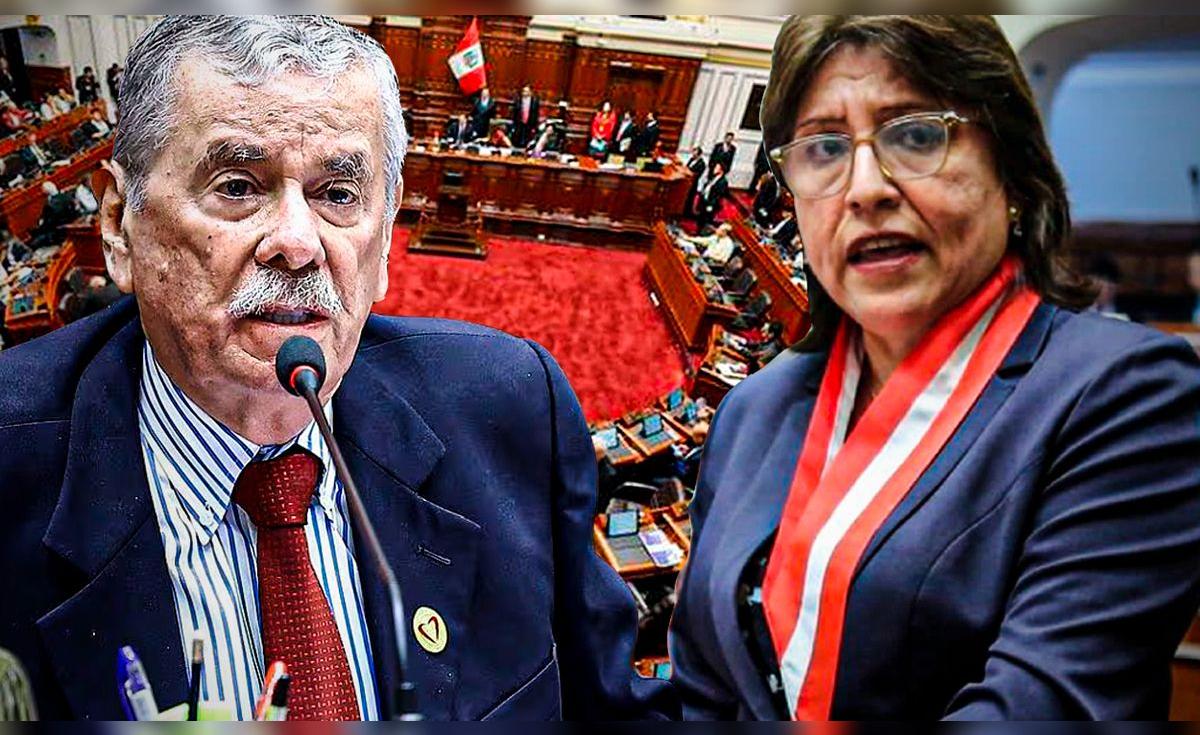
Political persecution. He Congress of the Republic managed to disqualify the suspended National Prosecutor from holding public office for ten years, Delia Espinoza. With 71 votes in favor, 19 against and 3 abstentions, the Plenary Session managed to approve the final report that accuses the judge of alleged constitutional infringement.
listen to the newsText converted to audio
Artificial intelligence
The central accusation lies in an alleged “disrespect” of Law 32130a rule that reestablishes the power of the National Police to lead preliminary investigations of crimes. According to the congressmen, Espinoza would have issued a resolution that directly contravenes this provision.
WE RECOMMEND YOU
ATENT4DO CRIMIN4L AND PROSECUTOR’S OFFICE UNDER ATTACK | WITHOUT SCRIPT WITH ROSA MARÍA PALACIOS
The controversial decision was made on a day marked by speed. The report had initially been rejected after obtaining only 63 votes, insufficient for the minimum of 68 required. However, after a reconsideration presented by the congressmen Jorge Montoya and Norma Yarrowthe Plenary proceeded to a second vote on the same day.
Fernando Rospigliosi accelerates the process against Delia Espinoza
The second vote took place under notable haste. With the Board of Directors chaired, this time, by the congressman Fernando Rospigliosithe session took a notable speed.
The Fujimorist interrupted the rapporteur, demanding to go directly to the operative part: “Mr. Rapporteur, only the operative part, please”said Rospigliosi, immediately giving way to the counting of votes that ended up disqualifying the suspended prosecutor.
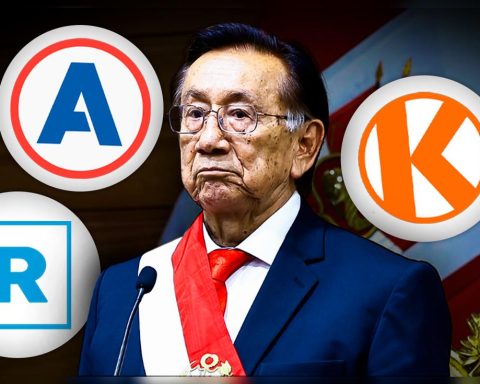
The congressmen who changed their votes were: José María Balcazar (Perú Libre), Katy Ugarte (JPP) and Kira Alcarraz (not grouped). Meanwhile, those who did not vote in the first vote and did vote in the second were: Edith Julón (APP), Guido Bellido (Vamos Perú), Francis Paredes Castro (Vamos Perú), Silvia María Monteza (Popular Action) and Juan Carlos Mori (Popular Action). They were the eight votes that ensured that Delia Espinoza was disqualified from holding public office for 10 years.
Delia Espinoza defends herself in the Plenary Session of Congress
During the debate in Plenary, the judge’s lawyer, Rodolfo Pérez, argued that the final report of the constitutional complaint focuses on the approval of resolution 2246, but confirmed that his client was not the one who signed said regulations. Pérez specified before the Plenary that the regulation was signed by the interim prosecutor Juan Carlos Villena.
In his defense he added that 15 parliamentarians of the 16 who voted in favor of approving the final report in the Permanent Commission have fiscal files, so he does not rule out that they would seek to leave Delia Espinoza out of the Public Ministry in order to stop or annul the investigations against her. This was corroborated with the statements of Congressman Jorge Montoya, who in his justification in Plenary argued different reasons why the disqualification of the magistrate was requested. “It is unacceptable that she dares to threaten the national representation (…) Her behavior of denouncing congressmen in the exercise of their duties is disproportionate and belligerent,” he said, and then accused her of a “public danger” for opening investigations against the parliamentarians.
With these statements, it is confirmed that it would be a political persecution and that the congressmen would have voted in favor of his disqualification so that they can be shielded by Tomás Gálvez.
For his part, Espinoza Valenzuela regretted that not all parliamentarians were physically present, describing this attitude as a “lack of respect for the Peruvian people.”
“What a pity that they are not all present in person, which would be a sign of respect for the Peruvian people because when they are going to be executed or act as executioners, eventually, with respect to a magistrate with an impeccable career, certain congressmen do not want to show their faces,” declared the magistrate.
Espinoza went further, linking the attitude of legislators with their future political aspirations. He stated that “They don’t want to show their faces because there are going to be elections and these gentlemen aspire to reelection,” suggesting that they avoid showing their position publicly to the electorate.
Congress had already lifted the immunity of Delia Espinoza
Prior to the 10-year disqualification from holding public office, hours before, Congress approved the lifting of Delia Espinoza’s jurisdiction, which had the consequence that she could now be investigated for the alleged crimes of ussuption of public office, abuse of authority, precavirate and generic falsehood for not applying Law 32130.
That is to say, Parliament left open the possibility for whoever held the highest position within the Public Ministry to be investigated by this same institution today.