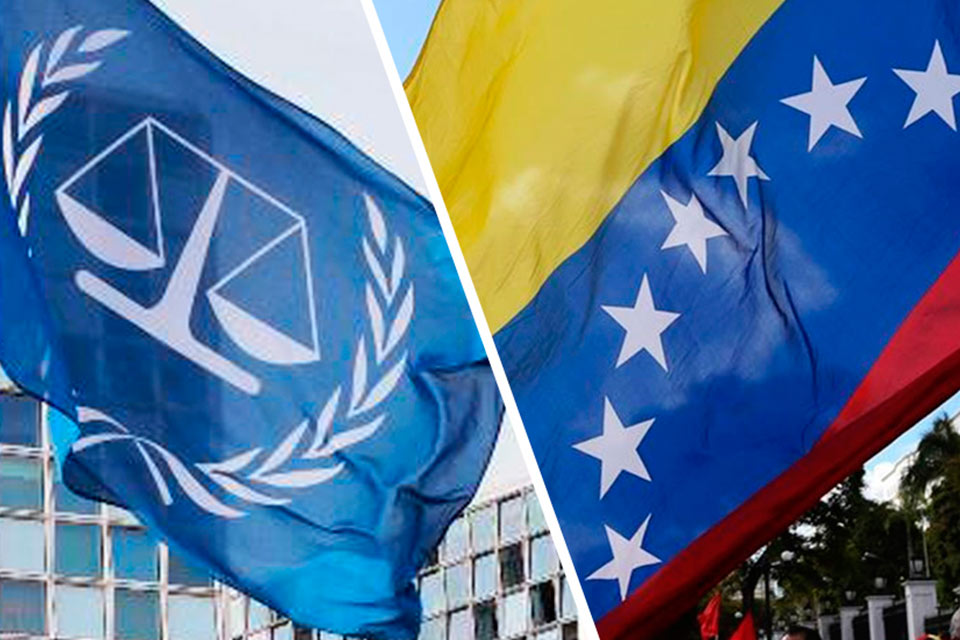
The decision by Nicolás Maduro’s administration to withdraw from the Rome Statute, which governs the operation of the ICC, will not affect the investigation into crimes against humanity that has been underway since 2021. Its financial obligations and the Venezuela II preliminary examination are also maintained, as the request to investigate the alleged crimes against humanity committed by the United States through the application of economic sanctions against the Venezuelan population is known.
The closure of the office of the Prosecutor’s Office of the International Criminal Court, a decision announced on Monday, December 1, brought an immediate response from the administration of Nicolás Maduro: the denunciation of the Rome Statute, of which Venezuela has been a party since 2000.
Within the ICC Prosecutor’s Office there are two processes regarding Venezuela: an investigation into crimes against humanity such as torture, arbitrary detentions and sexual violence committed at least since 2014, and a preliminary examination – also under the presumption of crimes against humanity – on the impact of United States economic sanctions against the Venezuelan population.
But what does the Rome Statute have to do with it? This standard created in 1998 established the creation of the International Criminal Court and governs its operation in all its areas. In addition, four international crimes were outlined: crimes against humanity, war, genocide and aggression.
The ICC also has a complementary nature to national justice systems, that is, its function is to punish those serious crimes committed by individuals over which criminal jurisdictions of the State parties cannot or do not want to proceed.
In the Venezuelan case, six State parties introduced a petition in 2018 to evaluate the alleged commission of crimes against humanity in the country. In November 2021, the ICC Prosecutor’s Office, headed by the British Karim Khan, reported on the initiation of an investigation in this regard.
Likewise, prosecutor Khan announced a memorandum of understanding with the administration of Nicolás Maduro – based on the principle of complementarity – to “reform and revitalize the criminal and justice system”, this with the aim of establishing “genuine accountability in Venezuela in favor of the victims of alleged crimes.”
Under this approach, in June 2023 a new cooperation memorandum was signed – which is not public – and the creation of a Prosecutor’s Office in Caracas was established without investigative powers, unlike the one created in Ukraine.
But the lack of “real progress” on that complementarity by the Maduro administration led to the decision announced this week by ICC deputy prosecutor Mame Mandiaye Niang.
*Read also: Closure of the ICC Prosecutor’s Office in Caracas: what implications does it have?
«After continued work, we have determined that real progress on complementarity remains a challenge. “Consequently, and aware of the need to effectively manage our limited resources, we have decided to close our office in Caracas,” Niang declared before the Assembly of States Parties, a matter that was ratified in the annual report of the ICC Prosecutor’s Office.
The response from Venezuela. In a statement, Nicolás Maduro’s administration denounced an “instrumentalization of justice” and the alleged lack of cooperation of the Criminal Court Prosecutor’s Office by not sending officials to the office in Caracas or making contributions to the initiatives on the Venezuelan side.
«Venezuela has linked itself in good faith with the ICC Prosecutor’s Office in a process that, clearly, does not fit into the assumptions provided for in the Rome Statute, but that aims to satisfy the anti-Venezuela agenda promoted by hegemonic centers. It is very obvious that crimes against humanity have not been committed in our country and we have demonstrated this in all instances of a process instrumentalized for geopolitical purposes,” it was stated.
Along these lines, but going a step further, the National Assembly –dominated by the ruling party– approved on Tuesday, December 2, an agreement and a project to repeal the Law approving the Rome Statute. In short, a legal instrument to withdraw from the ICC.
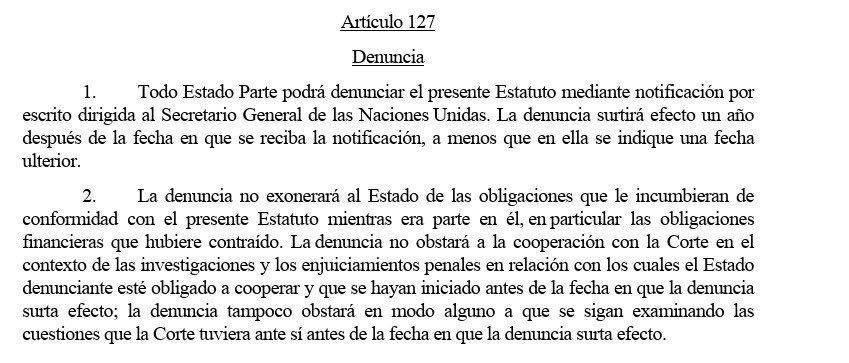
Implications of the decision. If Venezuela effectively denounces the Rome Statute, a year must pass for the decision to be valid, as established by the norm itself in its article 127 (1). However, the second section of said article states that this does not exonerate or eliminate investigations, criminal prosecutions or even financial obligations incurred by the State party.
As organizations such as Access to Justice or lawyers such as Tamara Suju and Joel Garciathe investigation for crimes against humanity continues.
«The repeal of the law approving the Rome Statute does not extinguish the jurisdiction of the ICC over crimes against humanity already committed. Leaving the Court does not represent an act of sovereign strength, but rather a setback in the defense of human rights,” García said.
This also applies to the Venezuela II preliminary examination, as the request made by the Maduro administration to investigate alleged crimes against humanity against the Venezuelan population committed by the United States through the application of economic sanctions is known.
The Prosecutor’s Office itself has also reiterated that the investigation into crimes against humanity continues, while organizations, victims and countries like Argentina –one of those who submitted the initial request– have asked that progress be made in the situation to identify those responsible and the corresponding arrest warrants be issued.
*Read also: The ICC “failed” Venezuelan victims when they needed it most, NGO says
“Our investigation remains focused and active thanks to the work of our dedicated and unified team, together with our partners and, as always, guided by the evidence and the law,” said Deputy Prosecutor Niang. This year’s annual report recognizes that they have “actively advanced throughout 2025, promoting multiple lines of research.”
The ICC has also insisted that the development of the investigation has not been affected by prosecutor Karim Khan’s decision to recuse himself from the case and continues to collect available evidence on the crimes reported by the victims, their representatives and human rights organizations.
*Journalism in Venezuela is carried out in a hostile environment for the press with dozens of legal instruments in place to punish the word, especially the laws “against hate”, “against fascism” and “against the blockade.” This content was written taking into consideration the threats and limits that, consequently, have been imposed on the dissemination of information from within the country.
Post Views: 99