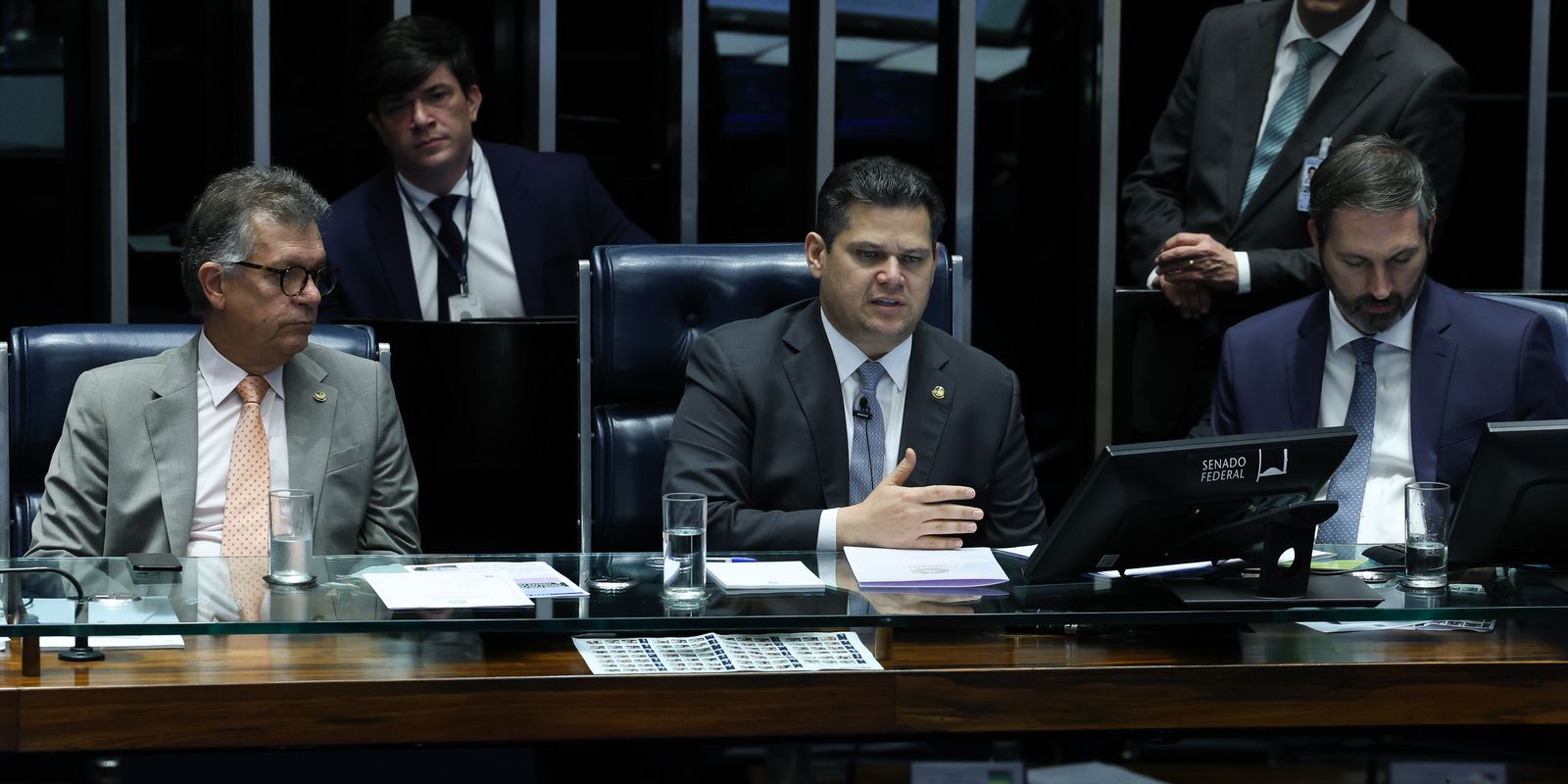
The president of the Senate, Davi Alcolumbre (União-AP), said this Wednesday (3) that he will create a task force to put several projects to a vote in the House. The initiative is a reaction to the monocratic decision of the Minister of the Federal Supreme Court (STF), Gilmar Mendes, that only the head of the Attorney General’s Office (PGR) is able to report ministers of the Court to the Senate for crimes of responsibility.
“I will organize, as president of the Senate, a meeting with the party leaders so that we can, within our institutional prerogatives, evaluate all the projects that are being processed in the federal senate”, said Alcolumbre, after the demonstration of several senators asking the House to adopt retaliatory measures against the STF.
“In fact, the presidency is being asked by many senators, by many leaders, to discuss matters that could be on the agenda for deliberation and we have not yet been able to appreciate them. Let’s think about an appropriate and opportune moment to reestablish the institutional pride of the Senate of the Republic”, he continued.
Among the proposals cited by Alcolumbre is the Proposed Amendment to the Constitution (PEC) 48/2023, which deals with the Temporal Framework for the demarcation of indigenous lands. The matter is the subject of a trial in the STF, scheduled to begin on December 5th and has Mendes as rapporteur.
“I wanted to ask the President of the CCJ [Comissão de Constituição e Justiça]Senator Otto Alencar [PSD-BA]to quickly put the deliberation of this PEC 48, of 2023, on the agenda”, said Alcolumbre during this Wednesday’s plenary session when talking about repressed demands.
The parliamentarian added that the house already knows a lot about the subject. “It’s time for us to define the deliberation in the CCJ plenary. If the party leaders choose, I would also like to ask that they could sign a set of signatures from the party leaders, so that we can, with the approval of the President of the Commission, if he deems it necessary, collect the appropriate signatures for us to put together a special calendar and immediately bring the deliberation of this PEC directly to the Federal Senate Plenary”, he stated.
The judgment on the time frame for the demarcation of indigenous lands will be carried out virtually by the STF plenary. Electronic voting will remain open until December 15th. During the trial, the ministers must express their opinion on the final text approved by the special committee that debated a proposal for legislative changes to the topic.
Earlier, Alcolumbre released a note demanding respect to the Senate and defended the possibility of changes to the regime of monocratic (individual) decisions, explicitly citing PEC 08/2021, which limits monocratic decisions in the Supreme Court and other higher courts.
In the note, the president of the Senate said he received with “concern” the content of Mendes’ monocratic decision, taken this Wednesday, in the case of the Allegation of Non-Compliance with Fundamental Precept (ADPF) 1259/DF.
The minister is the rapporteur of two actions that question the compatibility of different sections of the Impeachment Law with the 1988 Constitution, one filed by PSol and the other by the Association of Brazilian Magistrates (AMB). In the decision, Mendes suspended the section of the Impeachment Law (Law 1,079/1950), which gave “every citizen” the prerogative to denounce magistrates.
“The established situation indicates the need to change the regime of so-called monocratic decisions, especially those that preventively suspend the validity of the law”, argued Alcolumbre.
The president of the Senate also said that it is not “reasonable” for a law voted in two Legislative Houses and sanctioned by the President of the Republic “to be reviewed by the decision of a single minister of the STF”.
“To this end, a collegial decision by the Court must be required, the sole and final instance to declare the constitutionality or otherwise of a current law”, he continued.
The Constitution provides that it is up to the Federal Senate to prosecute and judge ministers of the Supreme Court in the case of possible crimes of responsibility, but it does not address the possibility of impeachment of magistrates. The topic is addressed in the Impeachment Law, which regulates the matter.
“The judicial decision goes against what is clearly provided for in Law 1,079 of 1950, which guarantees any citizen the right to sue for a crime of responsibility. This was a choice made by the legislator and, regardless of whether we agree with it or not, it needs to be respected. Any abuses in the use of this right cannot lead to the annulment of this legal command”, he criticized.