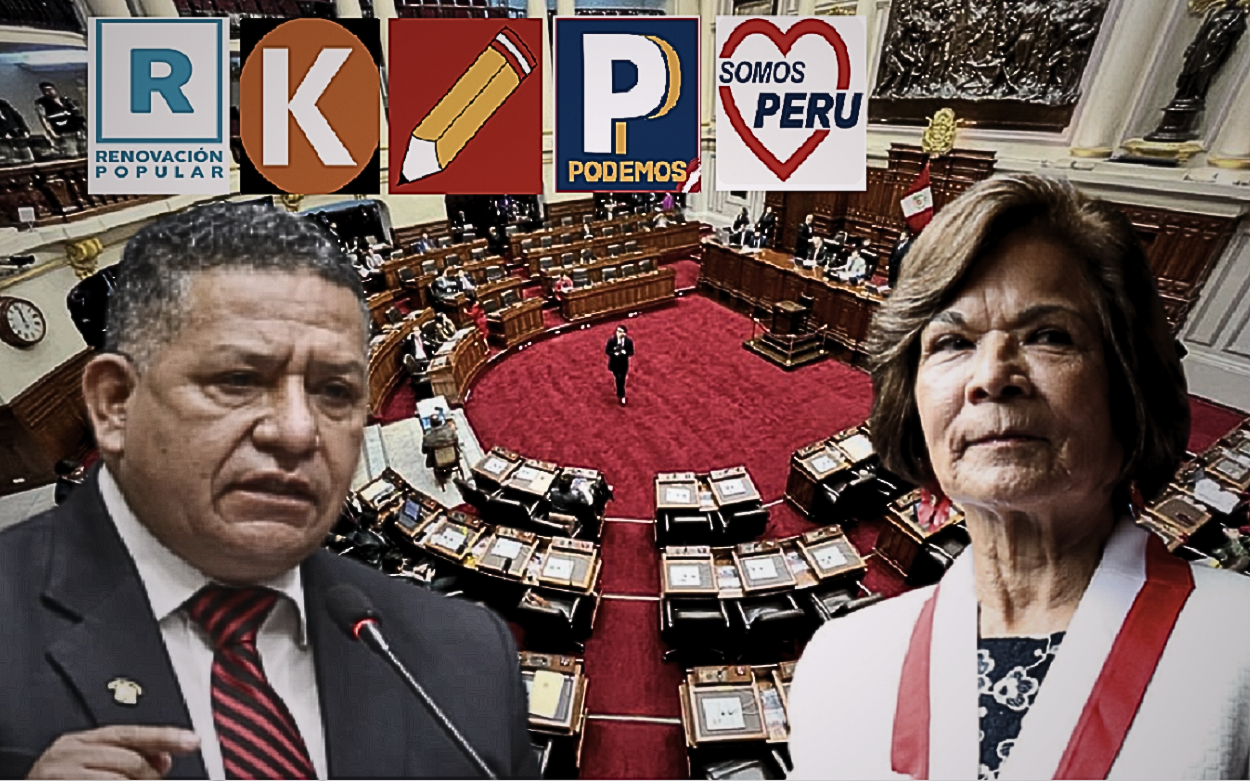
Although at the beginning of November the Congress Plenary decided that the bill that raises the re-election of rectors of public universities returned to the Education Commission, now the legislator of Renovación Popular, Esdras Medina, has requested a reconsideration of the vote to achieve its main objective.
Medinawho was one of the greatest promoters of the so-called university counter-reformasked the board of directors of Congress for this reconsideration after the Plenary Session voted in favor of the previous issue so that the initiative returned to the Education Commission for the respective debate that it never had.
And at the beginning of November, the Board of Spokespersons exempted bill number 7240 from the opinion of the Education Commission,by Esdras Medina, who It aims for the authorities of state universities to be re-elected for an immediate period of 5 years through universal voting. The benches of Fuerza Popular, Podemos, Together for Peru, Peru Libre, Renovación Popular, Somos Perú, Bancada Socialista and Honor y Democracia supported this measure.
Well, Medina’s insistence is worrying because the proposal was not reviewed or technically debated by the Education Commission,but it went directly to the Plenary Session of Congress regardless of the implications that could be generated within the study houses.
The Association of National Universities of Peru (Aunap) regretted that a reconsideration of the vote on the aforementioned initiative was allowed because it would violate university autonomythe one that they claimed to defend so much when they approved the law that dismantled Sunedu.
“The misnamed Law of Institutional Strengthening of the Universities of Peru nothing strengthens us, but weakens us because it modifies the University Law. Its approval without debate or consultation violates the university autonomy enshrined in the Constitution,” said Aunap in a statement.
After requesting the president of Congress, Fernando Rospigliosi, and the president of the Education Commission, Segundo Montalvo, to take action on the matter, the Aunap explained that the exoneration of rulings is an exceptional mechanism that should only be applied in real emergencies, “but in this case it has been used in an absolutely unjustified way”.
Jeri Ramon Law
The Concertación por San Marcos collective, which brings together four groups of San Marcos teachers and students, also showed its rejection of the bill that“It would have its own name” because it would allow the immediate re-election of the rector Jeri Ramón.
“It is suspected that they seek to support rectors allied to the interests of congressmen. Congress does not legislate in favor of the common good of the nation, it responds only to particular agendas (…) The mistreatment has been continuous during these five yearsand endorsed by its allies in the university environment”,the group responded.
It is worth mentioning that the rector Jeri Ramón is close to Esdras Medina, author of the proposal, since both were the main promoters of the university counter-reform law. In 2023, the second reiterated that Sunedu violated university autonomy. However, two years later, a bill of his is accused of the same thing.