The Peruvian government announced that it will present a formal presentation to the OAS Permanent Council to defend what it considers the “original essence of diplomatic asylum,” with a view to stopping what it describes as an inappropriate use of the figure in cases of people convicted of common crimes.
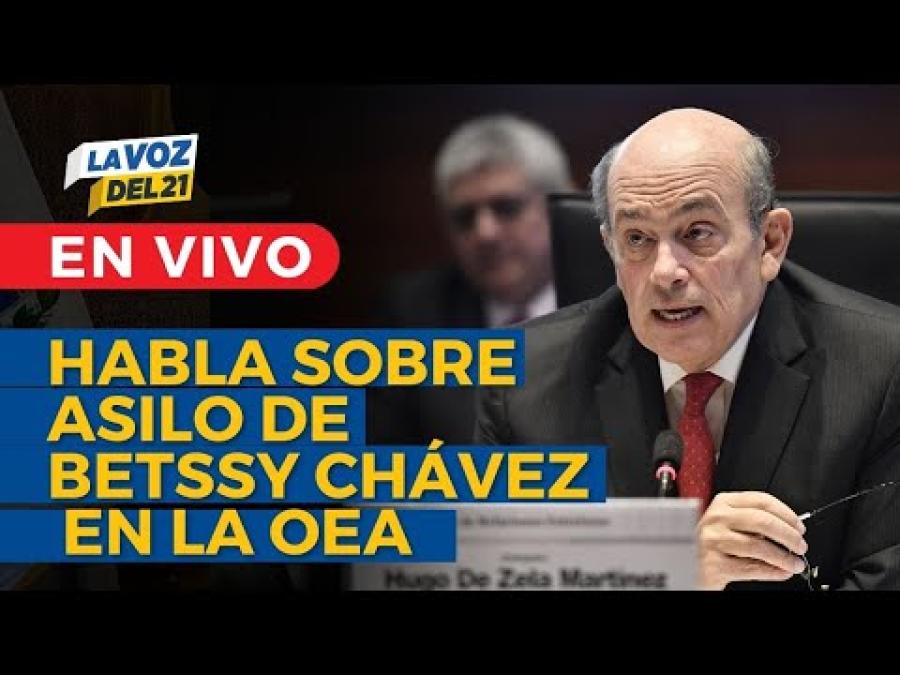
The person in charge of supporting the Peruvian position will be Foreign Minister Hugo de Zela, who travels to Washington DC with the intention of seeking consensus among the member states to ensure that the international regulations, contained in the Caracas Convention on Diplomatic Asylum of 1954, are applied “as it was originally intended”: exclusively to protect politically persecuted people.
This presentation by the chancellor to the OAS occurs because the Executive adopted this legal route in the face of what it considers a “distorted use” of diplomatic asylum, after the Mexican government granted diplomatic asylum to Betssy Chávez, a former minister recently sentenced to 11 years in prison for conspiracy to rebel for her participation in the coup d’état perpetrated by Pedro Castillo.
Chávez Chino’s asylum in the Mexican embassy in Lima triggered a diplomatic rupture between both countries.
In addition, asylum in the Brazilian embassy and subsequent safe conduct that led the former first lady, Nadine Heredia, to escape from Peruvian justice would also be added.
DISVERTED RIGHT
According to the Foreign Ministry, the Convention has been distorted by allowing people convicted of common crimes to request diplomatic asylum. De Zela maintained that such use undermines the credibility of the international instrument and proposed that countries that grant asylum require prior information from the requesting State about the legal situation of the asylum seeker. This, he said, would ensure that requests are based on actual political persecution, not judicial advantage.
The Peruvian government considers that this approach is necessary in a regional context where the figure of asylum has generated controversies, something that, according to Peruvian authorities, puts legal security and the principle of justice at risk.
Peru’s presentation to the OAS could trigger a regional debate on the reform of diplomatic asylum rules. If their proposal is accepted, member countries will have to define more demanding and mandatory criteria for evaluating applications, which could redefine the way diplomatic asylums operate today in America.
Meanwhile, the international focus remains on the Betssy Chávez case, but also on the role of asylum as an instrument for the protection of human rights or, according to the Peruvian Foreign Ministry, as a refuge to evade criminal sentences.
RECOMMENDED VIDEO