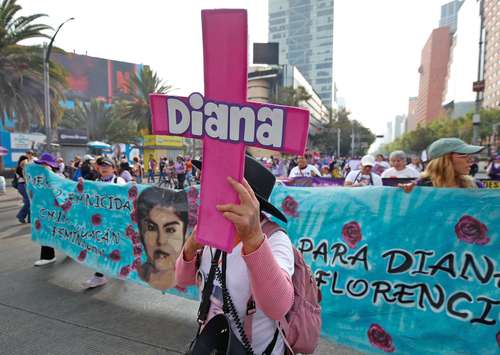
▲ Feminist and women’s mobilizations have taken over the public square with conviction and legitimate fury during the last decades.Photo Cristina Rodríguez
T
maybe no one has done more in Mexico for identifying and then preventing gender violence than Dr. Martha Tronco, who in 2007 proposed the creation of the Institutional Management Program with a Gender Perspective at the National Polytechnic Institute. Once there, and based on the results obtained from the administration of 14,000 surveys among the institution’s students designed to collect reliable data on the dynamics of aggression between couples, Dr. Tronco developed the violenceometer in 2009—an artifact in the form of a vertical ruler that allows clearly identifying the evolution of violent behavior, from hurtful jokes to feminicide, also passing through, and among others, control and blows. Created with very few resources but with unmatched determination, the violenceometer made legible a series of daily practices that, with astonishing frequency, have been confused with loving behaviors or whose naturalization in our environment makes them go unnoticed. There is no hard data in this regard, but if there were, it could be demonstrated that, to the extent that it facilitates the truthful and immediate recognition of gender violence, to the extent that it makes us aware of the growing proximity of the danger, the violenceometer has saved as many lives as antibiotics or vaccines.
The factors that contribute to the continuity of violence against women are multiple, but impunity must be counted among them in the first instance. According to the organization México Evalúa, almost all of the victims of feminicide in Mexico during 2024 did not have access to justice. To this we must add that the high tolerance for women’s suffering continues to cause family members, friends, neighbors, and colleagues of the aggressors to prefer to remain silent so as not to alter the state of things. Furthermore, gender violence has historically been silenced with great frequency, either because it is considered the preserve of private life (dirty clothes are washed at home) or because it has become a naturalized component of patriarchal daily life.
Feminist mobilizations, and more generally of women, have taken over the public square with conviction and legitimate fury during the last decades, becoming a critical voice and a moral compass of everyday reality, but they have also taken over in a very significant way everyone’s language, commanding it to say the unspeakable. And it is there, in the task of identifying the violence that is disguised as “love”, or as a “natural and inevitable thing”, or as “human nature”, or as “this is how I am”, where the violence meter reaches its maximum power, a force that is at the same time cultural, medical, and political.
That is why the graphic emergence of the violent meter, with its design that is both familiar and surprising, is so crucial today. That rule that changes color, starting from the apparently common green of blackmail or deception, until reaching, at the top, the red of maximum alert, clarifies things for us suddenly, in the blink of an eye. A year ago, in the performative reading of Liliana’s invincible summer that took place in the streets of Zapopan, organized from the University of Guadalajara by the tireless Patricia Rosas and her team, some teachers and students read the violence meter aloud, but they conjugated it in the first person singular. Not only did infinitive verbs like “hit” or “scratch” resonate in the Guadalajara sky, but they were conjugated in the first person singular in order to capture our reflective attention: “I hit” or “I scratch,” for example. Equally significant are actions such as those of RED Gráfica de Conciencia Social, a collective of designers that has presented “30 alerts against gender violence” in various places, an exhibition of posters that highlight the constant threat and growing danger of intimate partner violence. These design workers have facilitated like few others the prompt, almost visceral identification of that elusive but obvious violence that takes so many lives from us.
There should be monuments in its path. Their names should hang visibly on subway platforms and in squares and in markets and on government buildings. Couplets would have to be made about their achievements. It is true that gender violence is overwhelming and devastating, but it is also true that the efforts to win the battle follow one another, invincible. Hopeful. Luminous. From this Ring comes the deepest admiration for your work and sincere gratitude for your vision, your solidarity, and that commitment that is both formidable and exciting to create a world without violence for the women and men of the future.
*Winner of the 2024 Pulitzer Prize. Author of the book Liliana’s invincible summer