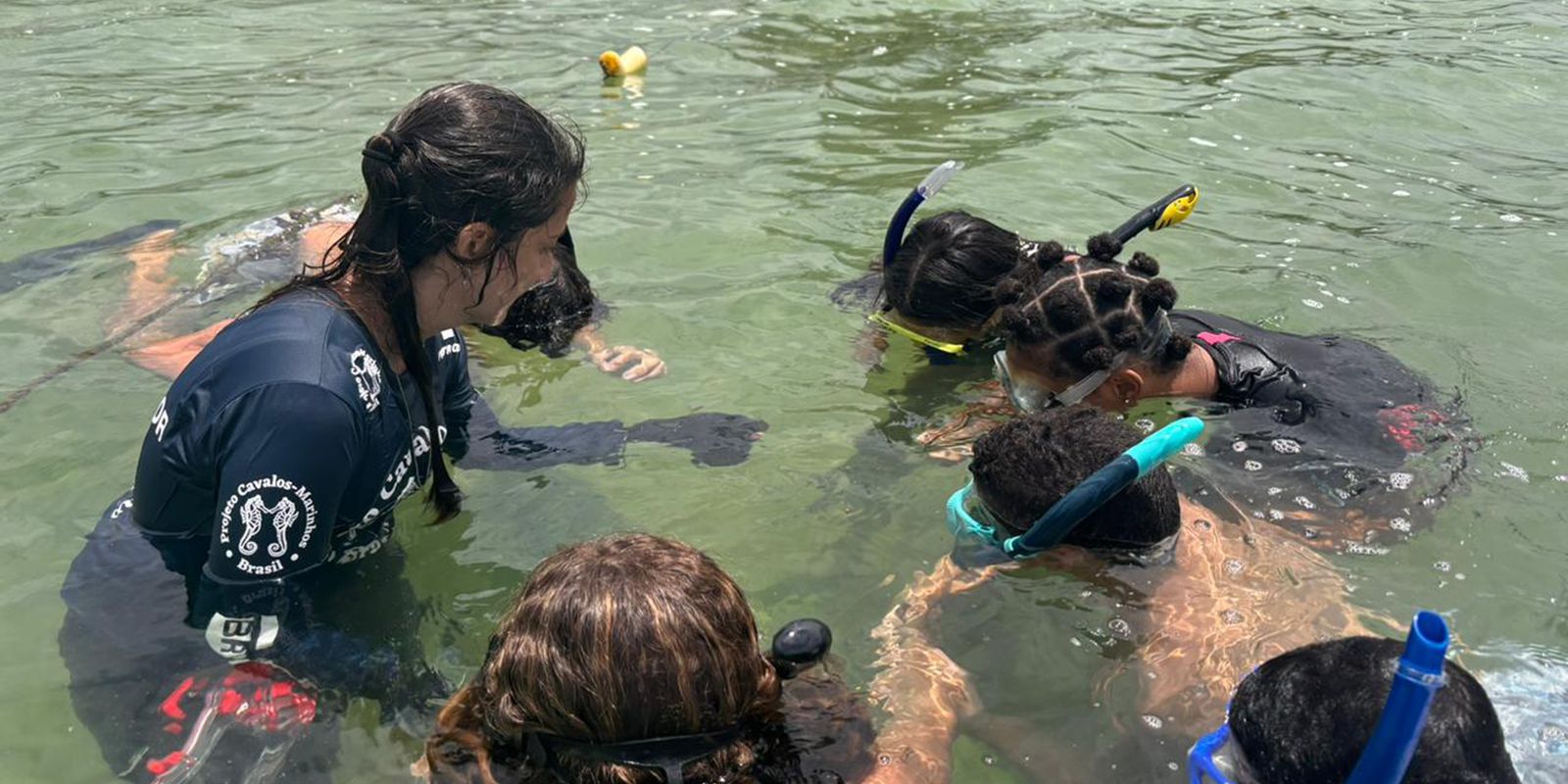
The Seahorse Project formed this Monday (1st) the first group of seahorse guardians, made up of 31 children and teenagers aged 12 to 14. During the three months of the course, the guardians visited the Cavalos-Marinhos Educational Space, in Rio de Janeiro, took several classes on the preservation of the region’s natural beauty and, on November 27th, they carried out the first monitoring dive at Ubás beach, in Laguna de Araruama.
“They had a very large collection of the Araruama Lagoon, because the central concept was that they appropriated the Lagoon as an important environment for them as important people in the city and that they understood how it works and wanted to take care of it. And the seahorse was an icon to create this perception of belonging, of care. Showing that a very sensitive animal can occur in this region and needs to be taken care of by them”, said the project coordinator, Natalie Freret-Meurer, to Brazil Agency.
From now on, young people will be the official guardians of the site. The idea is for them to act a little more like environmental care inspectors. “They should observe what is being done, good and bad, around the Laguna de Araruama. They should be careful with the Laguna and understand a little better how everyday attitudes can make the Laguna improve”, highlighted Natalie.
>> Follow the channel Brazil Agency on WhatsApp
Reducing waste consumption, not throwing waste into the Lagoon should be on the guardians’ observation radar within the assumption of how necessary a healthy environment is not only for animals, such as seahorses, but also for people.
“From the moment they become guardians, they have the mission of creating a healthier lagoon for themselves and the other living beings that live there.”

Seahorse Guardians Graduation – Seahorse Project/Disclosure
Guidelines
The Guardians of the Seahorses project was promoted by the Cavalos-Marinhos Project in partnership with the city hall of Iguaba Grande, located in the Lakes Region of Rio de Janeiro. The action had the participation of other projects to talk a little, for example, about seabirds (Albatroz Project), rays (Mantas do Brasil Project) and rescue of weakened fauna (BW). “We had partners who were essential for them to understand a little about the diversity of marine species,” said Natalie.
One of the main points passed on to the guardians is that they guide the population about the prohibition of capturing seahorses, provided for in regulation 455 of the Ministry of the Environment. The coordinator of the Cavalos-Marinhos Project explained that the only people who can touch this animal are researchers with licenses to carry out studies and research.. The Cavalos-Marinhos Project has existed for 23 years, operating throughout the state, with support from the Petrobras Socio-Environmental Program.
With the motto Transformar para Conservar, the project works with caiçara women, so that they can develop, for example, biojewelry from reusing fish scales, or from fishing nets that would otherwise be abandoned and are used as handicrafts.
“So, we work a lot in the social area so that people can engage within a more sustainable concept.”
The project also works with environmental education and training of early childhood education teachers, with the training of park rangers for conservation units, “always focusing on the seahorse, but understanding that it is within an ecosystem and that everything needs to be taken care of and protected as well”.
The project’s performance is closely associated with this entire part of conception, reconstruction and perception of a healthy environment for everyone, within a line called “unique health”, which refers to a healthy environment for living beings, other species, and human beings. “And we all have to be healthy. Within this line, we look for some actions that can contribute to a healthier environment”, explained Natalie.
Recommendations
For people who find a live seahorse, the project recommends that they admire it a lot, but never touch it. “Always leave it in its environment.” If you wish, you can inform the day and place where you saw the animal, using the project websitehelping to increase the number of records about seahorses.
If they find a dead seahorse in the sand, for example, they can contact the Seahorse Project via Whatsapp ((21) 99379-6417), to rescue the animal, which will be used in studies.
“As we work with conservation and don’t kill any animals, we always try to ensure that they are well. But we rescue dead animals to carry out deeper studies on their ecology and access things that we wouldn’t have normal access to”, explained Natalie.
Contact can also be made if the animal is found injured, for health assessment, rehabilitation and release.
Environmental crimes must be reported to the Brazilian Institute of the Environment and Renewable Natural Resources (Ibama) by telephone on 0800 61 8080 (free toll throughout Brazil) or by email at [email protected]; in addition to the Environmental Secretariats of the places where the crime occurred.