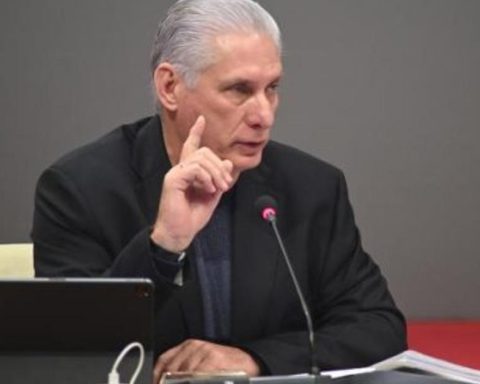
Madrid/What any Cuban has been able to verify for weeks with a simple visit to funeral homes and cemeteries It has been recognized by the Government only this Monday: the arbovirus epidemic in Cuba is causing more deaths than they had initially said. Specifically, according to the Vice Minister of Health, Carilda Peña Garcíain the daily television space in which the director of Epidemiology, Francisco Durán, took over last week, the health authorities recorded a total of 33 deaths, 21 of them due to chikungunya and 12 for dengue, most of them minors (14 for chikungunya and 7 for dengue). However, he did not clarify what period of time this balance corresponded to.
Until reaching that figure, the official took some detours. After presenting the contagion figures, which generally decrease but continue to present an epidemic panorama. “I also wanted to add a comment for the population and there have been questions that the population has been having about the people who unfortunately do not have a way out of serious illness due to these diseases,” said Peña García, eight minutes into speaking, without mentioning the word dead.
Next, he acknowledged that “both the surveillance system for nonspecific fever and the cases that are diagnosed have a great relationship with what the system is able to know and it is something in which we have to improve day by day.” Still, before offering the numbers, he excused: “When a person’s death occurs, when a person dies and is in the series as a suspected or confirmed case of the disease, when I say confirmed it is because it has a positive PCR, because it has a process, a process that involves a group of anatomopathological, clinical, virological analysis, and that really determines the cause of death.”
Last week it closed, this Sunday, with a total of 38,788 cases of “non-specific febrile syndrome”
Only at the end of his speech, remembering that they had already said that there were three deaths from dengue – without specifying that this data is from October, two months ago–, provided the updated figures. These overshadowed the apparent optimism with which the space began: last week it was closed, this Sunday, with a total of 38,788 cases of “nonspecific febrile syndrome” – the first step before determining whether they suffer from dengue, chikungunya or some other type of virus –, 972 less than the previous week.
However, the vice minister conceded, “there are a series of municipalities in which this behavior is not shown,” but rather they have an increase in infections. The graph on the screen speaks more clearly than Peña García: in 81 municipalities infections are increasing and in 87 they are decreasing (almost half and half, then). The entire island is “in an epidemic zone,” the official indicates with another graph, except Isla de la Juventud and Matanzas, where it all started with the detection of the first caseslast July, before the virus spread throughout the country.
Last week, 5,717 new cases of chikungunya were registered, which include both “clinical-epidemiological suspicions” and confirmed by PCR. The vice minister also boasted that 30 fewer serious cases were reported than the previous week. Regarding dengue, he did not give specific figures but it does continue in the 14 provinces. No cases of oropouche were reported.
Finally, he said that there are 10,949 sources of vector growth in the country, that is, the mosquito. Aedes aegypti“and that causes the infestation index to grow,” specifically 0.89.
What the minister did not talk about is covid, to which doubts and criticism have been pointed out in recent days by specialists within the Island. Contrary to the statement of the Ministry of Health, which attributes the epidemic mainly to a chikungunya outbreak, testimonies of severe clinical symptoms, unexpected deaths and symptoms that, according to numerous doctors and patients, do not fit the usual description of arboviruses proliferate on social networks.
There are 10,949 sources of vector growth in the country, that is, the ‘Aedes aegypti’ mosquito, “and that causes the infestation rate to grow.”
The publications of the Avilanian doctor have been especially revealing. Reinaldo Verona Boncewith decades of work in tropical medicine. He started a conversation that, in a few hours, spread throughout the island. In an extensive analysis posted on Facebook, the doctor stated that “the lethality present in our country is incompatible with the historical records” of chikungunya and that current transmission patterns “deny the epidemiology of arboviruses.”
A particularly disturbing point in the debate is the unusual gravity precisely from the symptoms in minors, something that several doctors consider incompatible with a typical chikungunya outbreak. “My son was in therapy with bronchopneumonia and shortness of breath. What does a mosquito have to do with this clinical picture? I also saw babies with the same thing,” warned mother Karina Silveira after her son’s hospitalization. For Dr. Verona Bonce, the appearance of critical conditions in newborns and adolescents “is unprecedented in arboviral diseases in the Caribbean.”
The doctor maintains that, while medical literature describes chikungunya as a generally benign virus – with a fatality rate of only 0.1% –, in Ciego de Ávila “daily mortality has gone from an average of 12 to 14 people to 34 in 24 hours.” At the same time, he denounces the absence of conclusive diagnostic tests: “Without PCR for everyone, there is no possible diagnosis.”