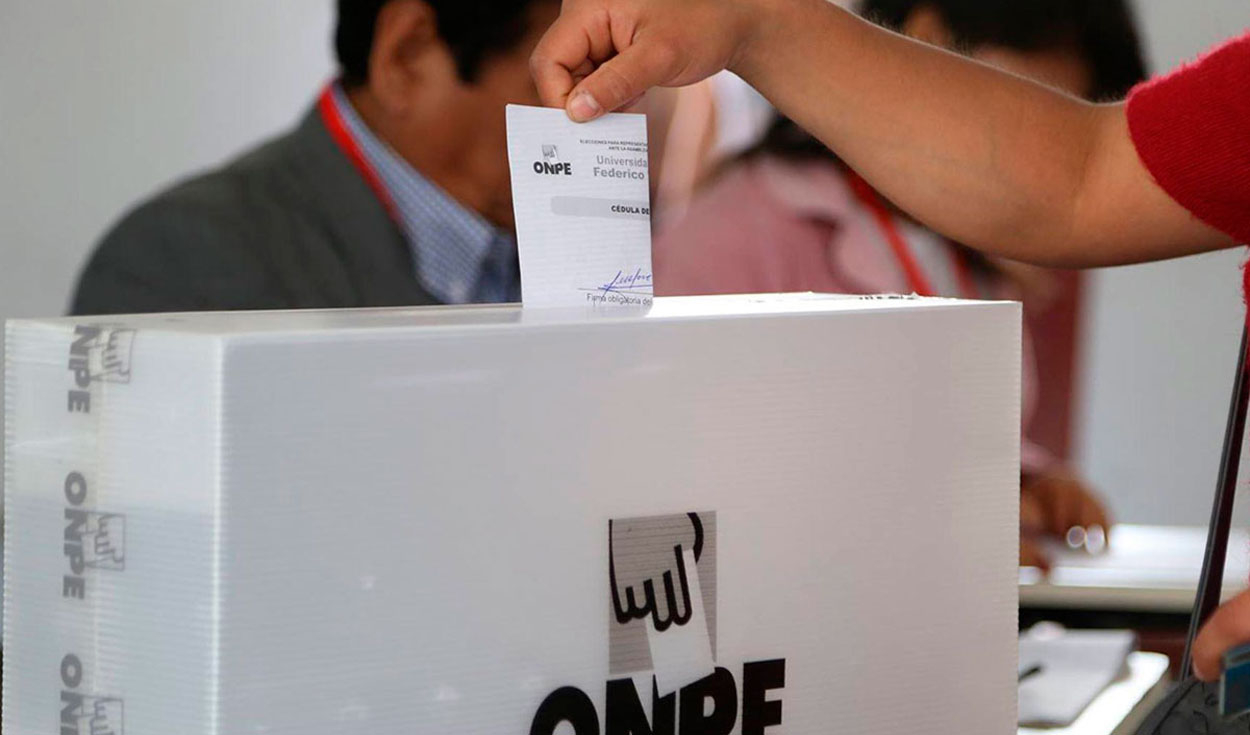
The number of undecided voters has increased. According to the latest national survey by the Institute of Peruvian Studies (IEP), between September and November the number of people who have not yet chosen a candidate for the 2026 elections increased by 6.2%.
Less than 5 months before the General Elections, Peruvians do not have any preferred candidate for the presidency. In September, the percentage of those who did not mention any names was 62.7%, while in November the figure increased to 68.9%. This means that 7 out of every 10 Peruvians do not have a candidate.
This percentage includes blank voting options, refusal to vote, blank voting and not specifying a specific candidate.
The survey reveals that only 22.3% already know who they will vote for. 68.9% do not mention any candidate when asked who they would vote for.
YOU CAN SEE: Government will ask Congress to prioritize a project that allows the Armed Forces. expand presence at borders
On the other hand, the numbers of the presidential candidates Rafael López Aliaga (Renovación Popular) and Keiko Fujimori (Fuerza Popular) have decreased compared to last month.
Currently, the former mayor of Lima has a voting intention of 6.2%, a value lower than 8.5% the previous month. Meanwhile, the leader of Fujimorism presents 3.7% compared to the 5.9% she obtained before.
Those who did increase their preference among citizens are the candidates Alonso López Chau (0.9% to 2.4%) and Carlos Espá (0.1% to 0.8%).
Another of the characters that appears among Peruvians is the current president José Jerí with a preference of 5.1%, despite the fact that he is not authorized to run for the next elections.
Vision about President Jerí
On the other hand, 46% of Peruvians disapprove of José Jerí’s government. Almost three months after assuming office, the president registers greater rejection in Lima, a region that remains in a state of emergency due to citizen insecurity; and in the south of the country, where the regions continue without obtaining justice for the murders during the social demonstrations of 2022-2023.
Jerí assumed duties on October 10, after the vacancy of Dina Boluarte due to permanent moral incapacity evidenced by the overwhelming increase in crime. In that first month, citizen disapproval was even higher, being 53%.
Disapproval comes from the three socioeconomic levels and to a greater extent from those who have an ideological identification of the left and center.
In comparison with other former presidents who assumed office due to the vacancy or resignation of the head of state, such as Dina Boluarte, Francisco Sagasti and Martín Vizcarra; José Jerí has greater approval only if the reference is his predecessor.
Sagasti and Vizcarra registered higher levels of support after their first month as presidents, exceeding 50% approval.
Broad rejection against Congress and Rospigliosi
Disagreement, however, is not unique to Jerí but also accompanies Congress.
After Dina Boluarte’s vacancy, there is an increase in approval of Congress, which goes from 4% to 8%, an unremarkable figure, as it means that 9 out of 10 Peruvians continue to disapprove of parliamentary management.
The greatest rejection comes from Metropolitan Lima, being 95%, and from people over 30 years old. And, once again, of those who have an ideological identification of left and center.
The same results are faced by Fernando Rospigliosi, who assumed duties as president of Congress, despite the fact that Fuerza Popular initially assured that they would not preside over either Congress or the government in power.
Rospigliosi begins his administration with 75% disapproval, a rejection similar to those obtained by previous presidents of Congress after their first month in office. As was the case of Alejandro Soto, from the Dina Boluarte regime, with a disapproval of 74% and José Williams, from the Pedro Castillo administration, with 62%. The disagreement of the Fujimori is greater in Lima and the south, as well as in socioeconomic levels A/B and C.