Publishers, sellers and independent writers agree that book fairs give a “breather” and are a window to achieve better sales in the midst of an economic crisis that has worsened this year. The Western Book Fair, organized by the Andrés Bello Catholic University (UCAB), concluded this Saturday, November 29
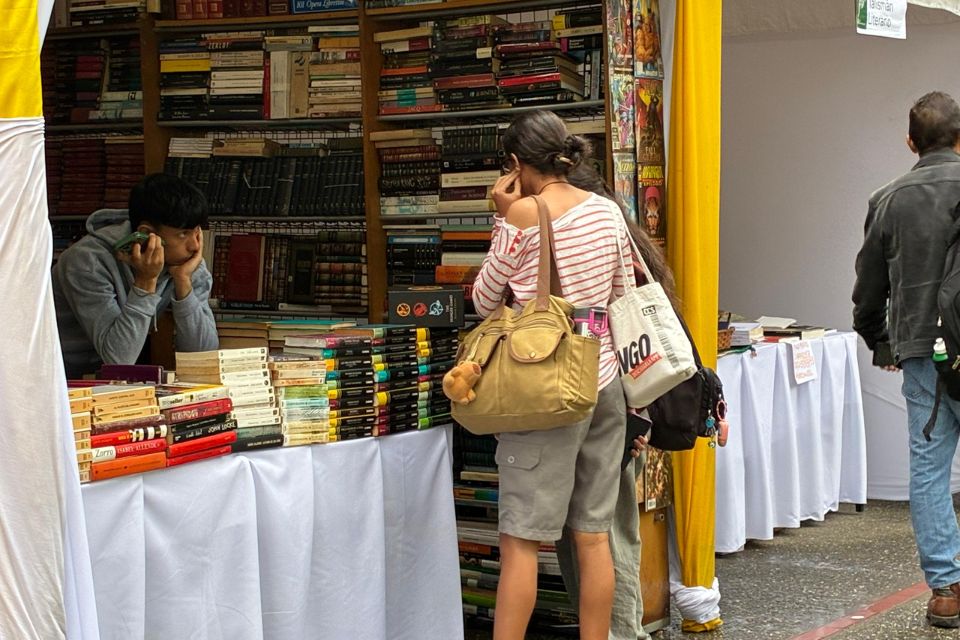
Offers on classic, paperback and second-hand books, lower prices compared to local ones and a variety focused on youth and technical texts were part of the scenario at the Western Book Fair, organized by the Andrés Bello Catholic University (UCAB) that concluded this Saturday, November 29.
The FLOC, which celebrated its tenth editionbrought together more than 35 exhibitors, including publishers, distributors and independent sellers, who agree that this type of fairs give a “breather” and are a window to achieve better sales in the midst of an economic crisis that has worsened this year.
Gustavo Oliveros López, editor and writer at Barralibros Editores, highlighted that the UCAB and its fair “has done interesting work because we find author books, it allows them (the authors) to recover a little from the publishing tragedy that all Venezuelans are experiencing. The fairs held by the State are fairs dedicated to propaganda and promotion.
He commented that publishers like Barralibros try to “survive the obscurantism” and continue publishing texts by new authors, Venezuelan and foreign, anchored in foreign sales or publishing digital books.
“Books are released thanks to Amazon,” acknowledged Oliveros, who calculated that the cost of printing and production with national printers increases three times as much as using this platform. As? The book is published on Amazon, they are purchased this way and then brought to Venezuela.
A 300-page book can cost $6 on Amazon. When you bring it to Venezuela, it increases twice as much because the shipping price is included, which the bookstore charges, which can be half, and the rest is divided between the author’s royalties and the profit for the publisher.
«The way in which the author recovers some of the investment from the purchase of books is through presentation in bookstores and fairs. There are practically no book distributors anymore, so now the same publisher is in charge. Of course, making that distribution is not easy. Of the bookstores that remain, and that must also make a living from the sale of books, the percentage they charge is large for the distribution of that book that is placed on a shelf,” Oliveros explained.
For bookstores, sales are sustained by book sagas – such as the hunger games either game of Thrones–, technical or self-help texts, said Marbelia Balabí, representative of El Mundo del Libro, and Alexis Rojas, owner of Librería Hermanos Rojas.
Balabí indicated that “the sale of books has greatly decreased due to the country’s situation, the economy. It has been seen that they buy what they need most. They no longer buy like before, when they liked a book, they want to read it and they buy it.
Nor have their establishments (two stores in Cumaná, two in Caracas and one in Maracay) received a large number of national authors or publishers. He considers that it is due to “the flaws of paper”, although he acknowledged that they could not make large investments in that regard due to the decline in sales.
At the El Mundo del Libro stores, which began operations in 2018, books range from $15 to $45, depending on the type of binding, whether they are illustrated, the year of publication, among other factors.
While at the Rojas Bookstore, located under the bridge on Fuerzas Armadas Avenue, in the center of Caracas, they have seen an increase in book sales in the last year.
«Digital is still used, but boys look for physical books. The books that are moving the most are the youth ones, those from Wattpad, and finance books,” commented Alexis Rojas, dedicated to the business for 33 years.
He pointed out that the covid pandemic gave a boost to digital purchasing and reading, especially of sagas and books to learn more about sales and economic analysis. Rojas calculated that sales have increased 8% more than in previous years, and book fairs like the one in the West also help with that goal by allowing more access to the public.
«Culture is not dead»
Marcelino Bisbal, Venezuelan writer and researcher and part of the organizing committee of the Western Book Fair, pointed out that this space has been maintained for 10 years “with great persistence” to be a cultural window and “a space for reflection, for enjoyment, for debate around what we call world-culture, because world-culture is the reflection of the present world and the imagined world.”
“The FLOC is not imagination, it is not an optical illusion, it is a fact that tells us that culture has not died in Venezuela,” said Bisbal in the openingaccording to a press release.
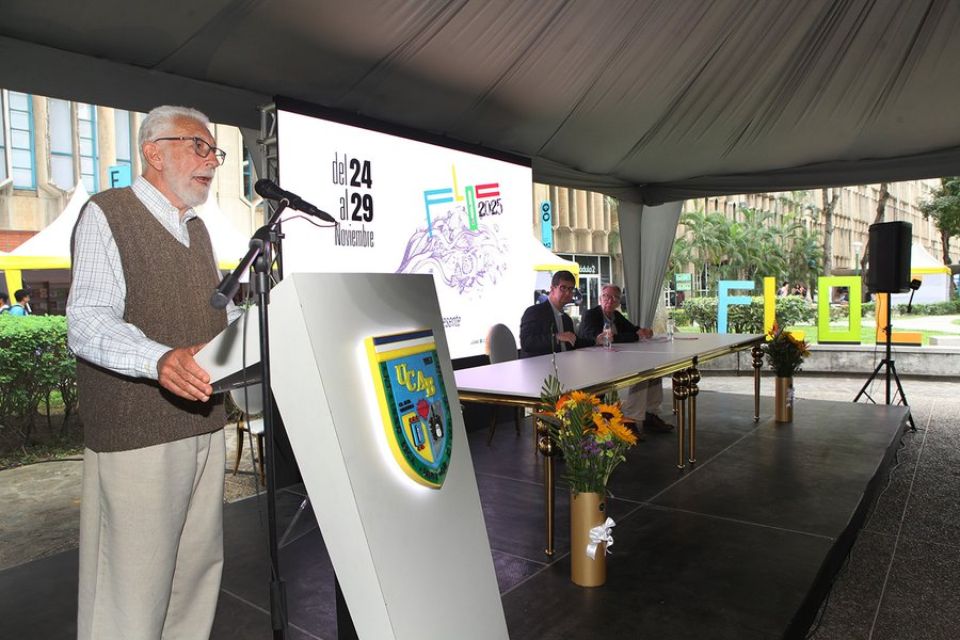
The director of the Abediciones publishing house, Marcelino Bisbal, pointed out that the Book Fair is also “a party in honor of the book and everything that is happening around it, which is expressed in knowledge, hope and action for a better present and a livable and normal future.” Photo UCAB
The Venezuelan historian and writer Elías Pino Iturrieta, on behalf of the Foundation for Urban Culture, also pointed out that “cultural activity in Venezuela is not going through its best moment. That the UCAB hosts this event becomes an essential testimony of autonomy and an area of resistance. Hence the transcendence of the FLOC, which allows us to cling to the alternative of a different and exalting history.
Produce as independent and intellectual property
Production as an independent author is possible, although it is not exempt from the risks of the Venezuelan environment and those faced by writers in other countries, such as piracy.
The Venezuelan writer Rosa Reina assured that producing in Venezuela “is possible.” Dedicated to writing since 2010, she has published the children’s story Suki wanted the sun (available in Spanish and English), the book First Letters and recently released a line of notebooks for left-handed people.
«I am an independent author but you do have to look for possibilities and resources. It is not easy when you do not have a publisher to support you, but today there are printers that work on demand and that helps the independent author a lot to make their work available to the entire public,” he acknowledged.
You also have to use social networks to reach the target audience, indicated the independent author. “These fair spaces are also ideal for reaching the audience we want,” he highlighted.
Independent authors also face problems with plagiarism of their works. Reina is currently pursuing a lawsuit for the illegal copying and marketing of her book «First Letters» which, like the rest of his works, is duly registered with the Autonomous Intellectual Property Service (SAPI).
“The SAPI (Autonomous Intellectual Property Service) has given us all the support and advice to carry out the process… The Prosecutor’s Office is also there to support the authors, but it is a matter of conscience, of community, of not buying piracy and going to the original source because copyright is violated,” he stated.
He reaffirmed that by copying and marketing any work, whether visual, musical or written, a “distortion” is created and the artist himself is injured. «Producing in Venezuela is difficult, we must recognize that and those of us who are behind each work. Producing a work means a lot of effort, a lot of work, a lot of investment and each of us does it to reach the public and have the goal of making them happy.
*Journalism in Venezuela is carried out in a hostile environment for the press with dozens of legal instruments in place to punish the word, especially the laws “against hate”, “against fascism” and “against the blockade.” This content was written taking into consideration the threats and limits that, consequently, have been imposed on the dissemination of information from within the country.
Post Views: 250