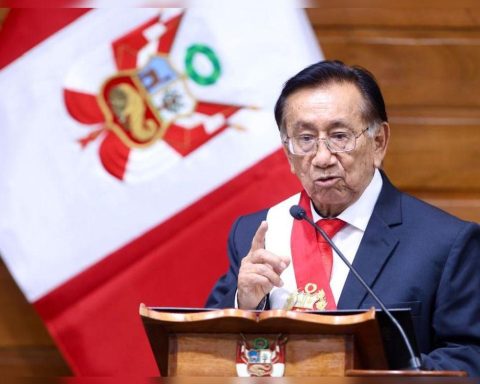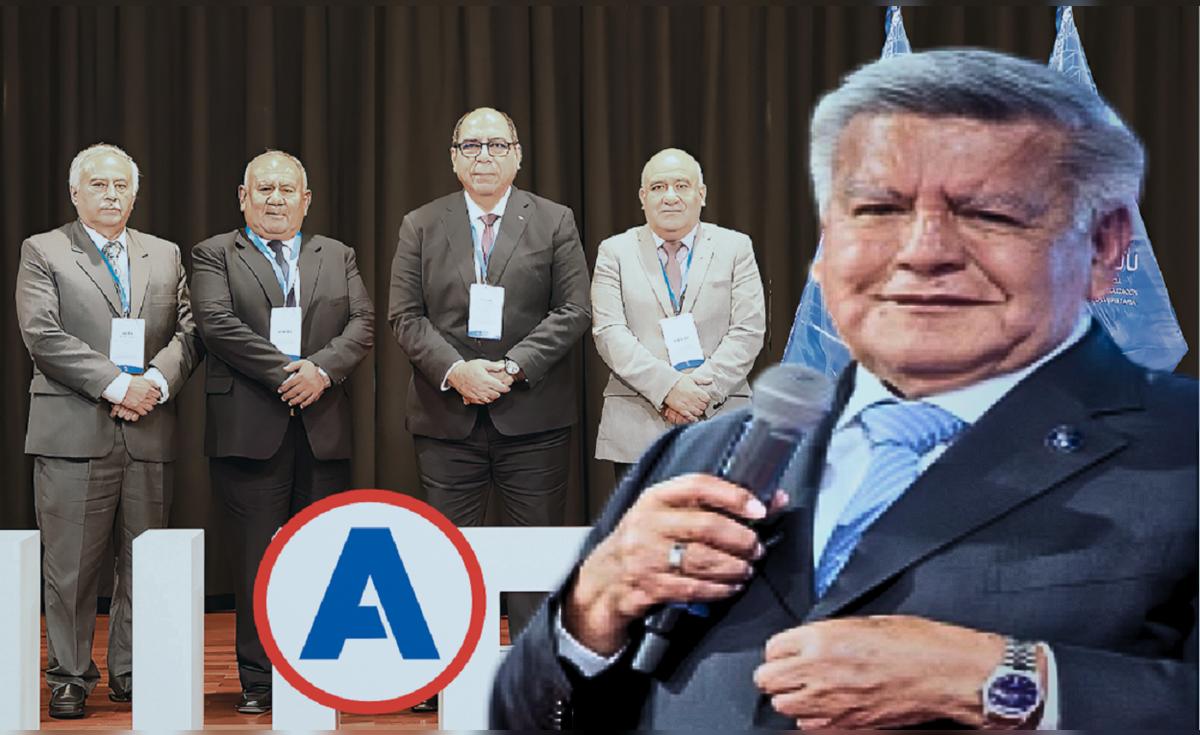
Private interests prevail. Although the current management of the National Superintendency of Higher University Education (Sunedu) has undertaken a series of setbacks in recent years, two congressmen from the Alliance for Progress intend to approve, in contraband, the express re-election of four of the seven directors of Sunedu.
listen to the newsText converted to audio
Artificial intelligence
It turns out that Eduardo Salhuana and Jorge Flores Ancachi have proposed modifying articles 17 and 20 of the University Law so that the mandate of the superintendent Manuel Castillo and the councilors Manuel Hernández, Miguel Vallejos and Andrés Ramos It no longer expires in February 2026 but is extended until February 2028 based on a ministerial resolution.
WE RECOMMEND YOU
CASTILLO CONDEMNED AND ESPINOZA CASE DOES NOT END | WITHOUT SCRIPT WITH ROSA MARÍA PALACIOS
The scandalous thing is that to achieve their objective they have requested to include in the opinions of the Budget Law and the Debt Law 2026 said modification that has nothing to do with financial and economic issues, in the opinion of specialists. The debate and approval of these initiatives would be heard this Friday, December 28, by the Plenary Session of Congress.
Well, this intention has generated the concern of the Association of Universities of Peru (ASUP) and the Association of National Universities of Peru (Aunap)which have shown their rejection because it would violate university autonomy.
The Aunap stated that, last August, the public universities appointed – through elections – two of the new directors of the Sunedu. These are Lidia Asencios and Carlos Reyes, who will replace Manuel Castillo and Manuel Hernández.
He also recalled that the National Council of Deans of Professional Colleges elected Maximiliano Cárdenas as the new director of Sunedu to replace Miguel Vallejos, in accordance with the provisions of the University Law.
Meanwhile, the ASUP responded that, even the four directors of Sunedu, whose mandate they seek to extend, They had to leave their positions in August 2025 because their 3-year period began in August 2022 when they were elected and not when they took office only in February 2023.
“They no longer represent the institutions that elected them. For ethical and legal reasons, we request your resignation“said Ada Gallegos, director of ASUP.
20 rectors of public universities asked for the same thing.who urged the president of the Budget Commission, Alejandro Soto, not to incorporate any text that extends the mandate of the four Sunedu directors mentioned.
The ASUP went further. This Friday he presented an amparo action before the Third Constitutional Chamber of the Superior Court of Justice of Lima to stop this smuggling in Sunedu. Among the defendants are congressmen Jorge Flores Ancachi and Eduardo Salhuana.
Acuña Factor
It is important to mention the role that the legislators of the party of César Acuña are playing, who – coincidentally – is the founder of the César Vallejo University.
Not only congressmen Salhuana and Flores have sought to extend the mandate of the current directors of Sunedu. Last July, when she was president of the Budget Committee, Parliamentarian Lady Camones allowed this claim to be smuggled in in the final provisions of the Supplemental Credit Law project. However, in the face of opposition from the universities, the Permanent Commission had to go back and delete it from the aforementioned norm.
Now, the opinions of the Budget and Debt Law 2026 are in the hands of the president of the Budget Commission, Alejandro Soto, who is also affiliated with the Alliance for Progress party.
“We call on the president (José Jerí), the president of Congress (Fernando Rospigliosi) and especially to César Acuña to clarify that there is no interest from the bench in the face of these intentions that disorder the university system,” said Ada Gallegos, director of ASUP.
Controversies during management
Manuel Castillo’s management has been framed by a series of controversies. In one of his first measures as superintendent, in April 2023, he expedited the recognition of his friend and former client Santos Montaño as rector of the National University of Piura. The latter left that position this year, was later convicted by the Judiciary for acts of corruption and, finally, died last April.
At another time, during an activity where he received the rectors with a red carpet and buffet, the superintendent declared that his management seeks to be “the loving, accommodating and affectionate father” of the universities. Then, in September 2023, he reported that he trusted the good faith of these institutions when they created careers indiscriminately.
In February 2024, the superintendent recognized the Congressman Esdras Medina (Popular Renewal) and the rector of the UNMSM, Jeri Ramónfor having been the main promoters of Law No. 31520 which, according to him, “restores university autonomy.” In front of dozens of rectors, he requested applause for both of them. And there was no shortage of reasons, since, thanks to that rule, which was one year old that month, Manuel Castillo was able to occupy that position.
Later, in May 2024, Castillo’s management completed the elimination of licensing, supervision and inspection directorateswhich were important to put the university system in order since 2014. These have now been merged into the Evaluation Directorate of the University Higher Educational Service. This was carried out after approving the new Organization and Function Regulations (ROF)which had observations from the PCM Public Management Secretariat that were not accepted.
But that’s not all. Through a statement, the four directors, whose term expires next year, They committed to not license those universities with denied licensing; However, they have not kept their word because they have already delivered this authorization to the Universidad Peruana del Centro, the Private University of Trujillo and the Los Angeles Catholic University of Chimbote (Ancash).
APP leaves no rollback effect
After the publication of this note, this Friday, the APP bench reported that it withdrew and nullified “any proposal that could be interpreted as an extension of mandates at Sunedu.” “Absolute respect for democratic institutions, university autonomy and the constitutional framework that regulates the higher education system in the country is reaffirmed,” he said in a statement signed by spokesperson Eduardo Salhuana.
He added that they also reaffirm that any decision regarding higher education must be centered on the country’s young people, since they have the right to receive a quality education in solid, supervised institutions with clear rules.