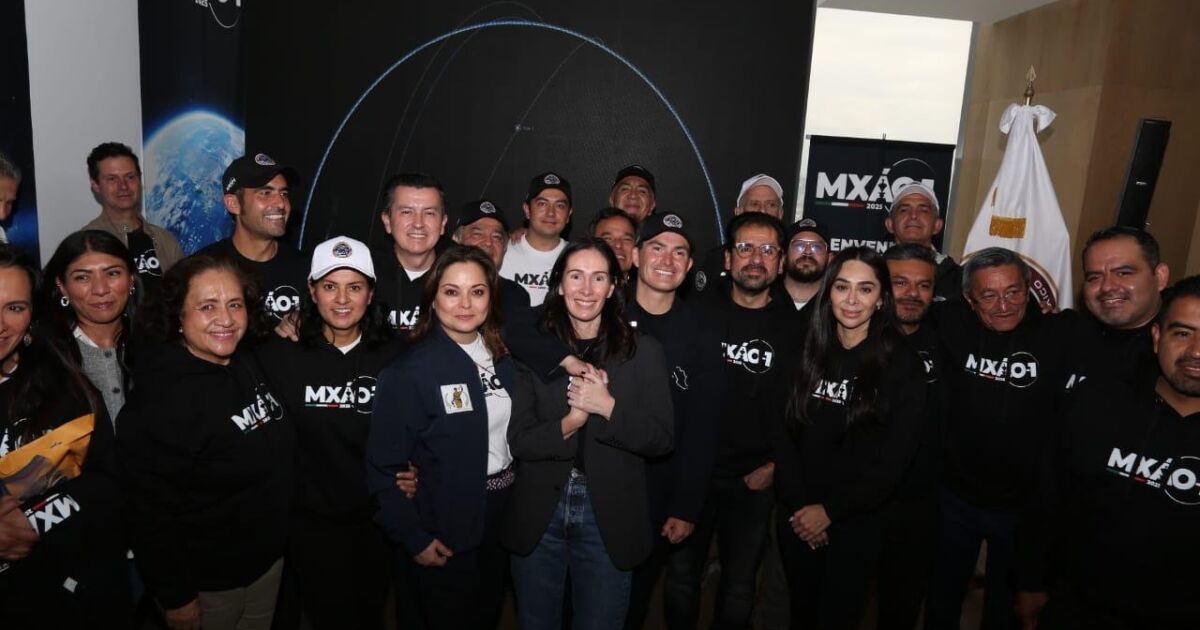
“Today Álvaro Obregón is not only on the map, it is in space. This achievement represents the power of collaboration, the vision and the will to transform the local into something truly universal,” said Javier López Casarín, mayor of Álvaro Obregón, after the confirmation of the launch into orbit.
Mayor’s authorities indicated that the MXÁO-1 is an Earth observation microsatellite that orbits at an altitude of 521.6 kilometers, travels at a speed of 7.6 kilometers per second and is equipped with a high-resolution multispectral camera of 1.5 meters per pixel, which will generate strategic information to improve the quality of life of citizens.
Once it is put into operation, the satellite will send images that will be used to monitor natural areas, riverbeds and ravines; detect deforestation, fires and landslides; strengthen public security through territorial mapping; optimize urban mobility and infrastructure, and support scientific and environmental research projects in the country’s universities.
The information will be processed at the Monitoring and Analysis Center located in Santa Fe, where specialists and academics from the High Level University Cluster, made up of 27 institutions, including 20 public and private universities located in the district, will transform the data into useful knowledge for public management and sustainable development.
The MXÁO-1 was developed under the triple helix collaboration model, in which academia, industry and the Government worked in a coordinated manner.
“The MXÁO-1 symbolizes the future of governance: governments that collaborate with academia and industry to build real solutions. Today, Mexican innovation orbits the planet,” highlighted López Casarín.
The microsatellite will remain in orbit for the next few years, with the aim of developing information that will contribute to urban development, sustainability, risk management and community safety.
“Every byte that arrives from space will be a smarter decision on Earth. MXÁO-1 reminds us that when science is put at the service of people, anything is possible,” said Casarín.